-

Dallas Kingsbury, MD
Medical Director & Assistant Professor of Rehabilitation and Sports Medicine at NYU Langone Medical Center
Danford Works, Fountain Life Naples & NYU Langone Medical Center
This discussion is intended for informational purposes only and does not constitute medical advice or establish a doctor-patient relationship. Information shared on the podcast should not replace consultation with a healthcare provider. Always consult your physician or a qualified health provider with any questions about a medical condition or before making health decisions based on this content.
Dallas Kingsbury, MD, is the medical director for two companies:
- Danford Works is a virtual platform that combines personal data analysis and 1:1 coaching to empower people to live their healthiest and most active lives.
- Fountain Life (Naples Center in Florida) is a company dedicated to proactive and personalized medical care via cutting-edge artificial intelligence-enhanced diagnostic testing.
He has been a teaching assistant professor of Rehabilitation and Sports Medicine in the Rusk Rehabilitation department at NYU Langone Medical Center in New York City.
His interests range from interventional sports & regenerative medicine to in-depth consultations on maximizing a healthy lifespan.
This discussion is intended for informational purposes only and does not constitute medical advice or establish a doctor-patient relationship. Information shared on the podcast should not replace consultation with a healthcare provider. Always consult your physician or a qualified health provider with any questions about a medical condition or before making health decisions based on this content.
John Shegerian: Do you have a suggestion for a Rockstar Impact Podcast guest? Go to impactpodcast.com and just click be a guest to recommend someone today. This edition of the Impact Podcast is brought to you by ERI. ERI has a mission to protect people, the planet, and your privacy and is the largest fully integrated IT and electronics asset disposition provider and cybersecurity-focused hardware destruction company in the United States and maybe even the world. For more information on how ERI can help your business properly dispose of outdated electronic hardware devices, please visit eridirect.com. This episode of the Impact Podcast is brought to you by Closed Loop Partners. Closed Loop Partners is a leading circular economy investor in the United States with an extensive network of Fortune 500 corporate investors, family offices, institutional investors, industry experts, and impact partners. Closed Loop’s platform spans the arc of capital from venture capital to private equity, bridging gaps and fostering synergies to scale the circular economy. To find Closed Loop Partners, please go to www.closedlooppartners.com.
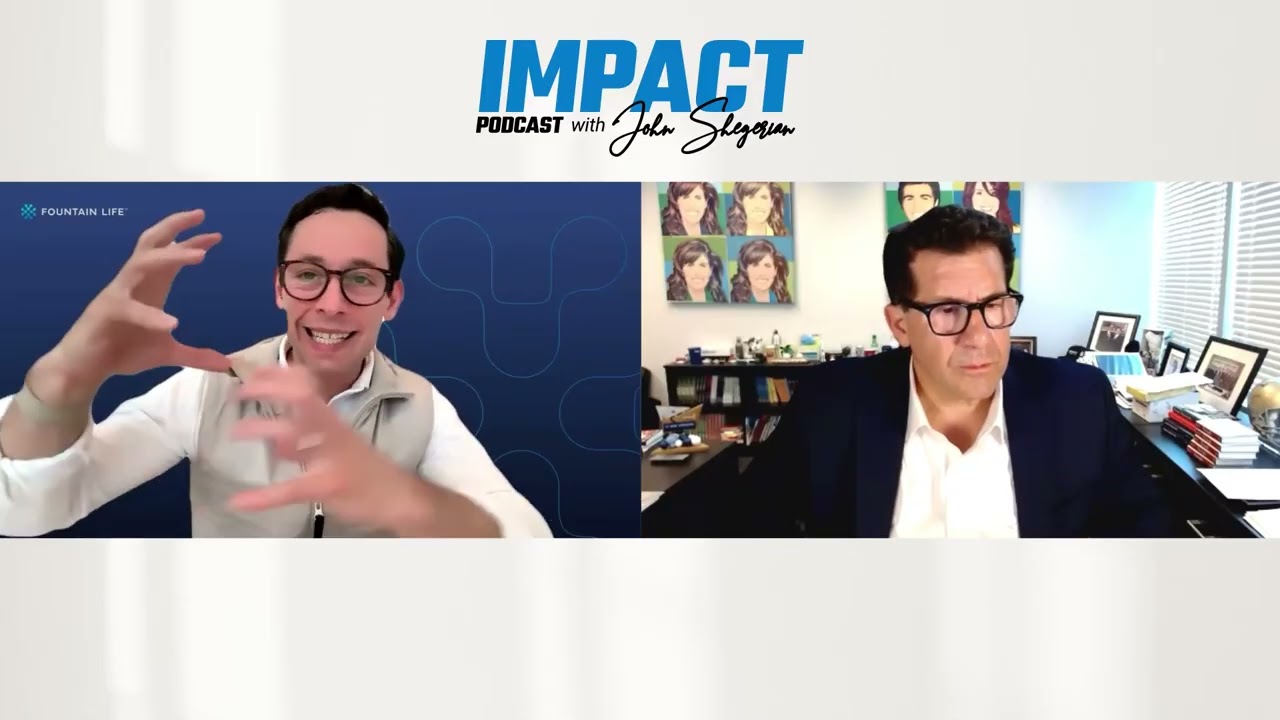
John: Welcome to another edition of the Impact Podcast. This is a special edition because I get to have my great friend, and he’s also my doctor, Dr. Dallas Kingsbury, back with us on the Impact Podcast. Welcome, Dallas, back to the Impact Podcast.
Dr. Dallas Kingsbury: Thank you, John. It’s great to be back.
John: Well, it’s wonderful to have you, and of course, I know you as Dallas, but you are Dr. Kingsbury, who’s the Medical Director of Fountain Life Naples. It will be in the show notes, and you can just click on the link to go to Fountain Life. Also, you’re the Chief of Regenerative Medicine for Fountain Life, so you have really unique perspectives on some of the most cutting-edge medical 3.0 topics of today. We’re going to get into that today, but before we start talking about my own journey at Fountain Life, which I love being under your care at Fountain Life and just under your care as a whole, I’d love you to share a little bit also about your own background. How did you get on this fascinating journey? Who inspired you to not only become a doctor, but also to become one of the foremost doctors in regenerative medicine in the world?
Dallas: Yeah, it’s a great story, and I love going back into my background, but my dad’s a chiropractor, and I remember being very young and walking around his chiropractic office all the time and seeing the joy he brought to people and his enjoyment and his passion that he brought to caring for his practice members is what he called them, but his patients. And I just grew up around an office where someone cared for people, and I was there all the time. I eventually worked there for a little while, too, so it’s a memory that I have. I was, fast forward through where I was interested very deeply in biology in high school, and then through college, I thought I was going to do neuroscience. I wanted to do research in alternative medicine, and it comes to my last year of college, and I’m thinking to myself, I don’t know if I want to actually do a PhD in neuroscience, and I asked my dad’s brother, who’s a chiropractor, I asked his advice, and he said, “Well, can you be a doctor?” And I go, “A medical doctor, of all things?” It’s the chiropractor that’s saying, and I said, “I have the credits, I have the prerequisites, I just got to take the MCAT, the pre- medical test.” And he’s like, “Just be a doctor, then you can decide on whatever you wanted to do from there,” which was so funny, and I took the advice, and I said, “Sure,” so I took the MCAT, got into medical school. It was really from there that I had, that’s where I had a little bit of a break, where I realized everybody going to medical school already had- most of them knew what they wanted to do. They had family members, or they had this sort of passion of, they did all this volunteering in hospitals, and all this, and I did two years of medical school, I still had no idea what kind of a doctor I wanted to be. I then decided, I’m going to take a year off, where I joined the circus, of course, and so I’ve told this story many times, but I had a background in doing flying trapeze as a hobby, and I took an opportunity, I said, “You know what, I’m going to follow this,” and I did flying trapeze semi- professionally, and I taught at a circus school for a year, and I met a lot of performers through that. It was in New York City at the time, in like 2008, and there was a lot of performers, and a lot of interest in sort of Cirque du Soleil and circus, and that’s where I actually met a lot of essentially high- level performing athletes, and I gained an appreciation for an interest in sports medicine. And then I joined, I went back to medical school, residency, I did rehab, and then sports medicine, and so that’s how I ended up in that field. And in residency and my fellowship, I did research on actually treating tendon injuries and joint injuries with platelet- rich plasma, which then gets me into an interest in regenerative medicine, regenerative sports medicine. So that’s- it has its full circle. I got to Fountain Life in 2021, and it was just a great fit after having been in academia for so long, because it was an interesting startup company, early diagnostic testing, with a goal of bringing some advanced therapeutics to people, and that’s where…
John: You graduated from NYU?
Dallas: NYU was actually my last job before leaving New York, so I actually went from my fellowship at HSS, Hospital for Special Surgery, to NYU as just my first academic job.
John: That’s right. And I met you back in 2015 at NYU.
Dallas: Yeah.
John: When you were at NYU Langone, and of course, I also know your wonderful wife, she’s also been my physical therapist, historically. I know her for 15 or 16 years, and she’s an NYU graduate, so, and got her, Dr. Jane Danford, so now you go over to Fountain Life, and again, for our audience, we’ll put Fountain Life in our show notes, so if you were to just give an elevator pitch, we’re in an elevator together in New York City, or in Naples, and I say, “Well, what is Fountain Life?” Talk a little bit about its mission, why it was created, and why it’s one of the leading brands in the world, and what it does.
Dallas: Okay, well, let’s say I have a little bit of a long elevator ride, so a longer elevator pitch is basically, but slightly longer, is that most people who are, we’ll say, high-performing individuals, and I say, “Do you have investment accounts? Do you have a 401k? Do you have retirement accounts?” Do you look at your investment assets on a regular basis? And most people like, of course. I said, “Do you look at these financial dashboards, either of you or your business, on a regular basis, more than once a year?” And everyone laughs. “Yeah, of course, I look at my personal asset, that little, whatever Excel spreadsheet you have, I look at it more than once a year.” Okay, do you look at it more than once a month? Yes. More than once a week? Yes. Do you have a similar 360- degree view of your health data that you can update and access more than once a year, or even more than once a month? And basically, nobody says yes. Very few people have something like that. And I said, “Wouldn’t it be great to work with an institution that actually was interested in comprehensively evaluating all of the possible risk factors for your health, and bringing them to you in an almost dashboard way and actually being the quote- unquote fiduciary for your health?” And that’s essentially what we’re doing. So I kind of explain it like this: there are four large disease classifications that more or less affect most people and either kill people or are major drivers of morbidity in people 65 and older. Number one is vascular diseases. So heart disease, heart attack, stroke, heart failure, arrhythmias, kills about four in 10 people. Cancer kills about two to two and a half in 10 people. Twenty- five percent of people die from cancer. Then you have frailty, low muscle mass and falls and head injuries due to that, or immune system frailty. On average, this is the most controversial way of packaging it called. But if you just accept that, that’s about one in 10. And about one in 10 people die from a neurodegenerative disease. That in itself, that’s about eight in 10 people from those one of those four things. I skipped over metabolic diseases like diabetes and prediabetes. That just doubles the risk of most of those other things I talked about, so it’s a risk multiplier. And if you put that together, those four things, we realize that you can detect all of those- many of those diseases, at a very early stage, where it’s much more actionable. We’re talking sometimes 10 to 20 years before symptoms manifest. So if it’s artery plaque, two decades, three decades before somebody gets a heart attack or chest pain due to a major artery blockage. If it’s Alzheimer’s disease, it could be two to three decades before somebody starts having memory problems. And so on, as it goes down below bone density, white matter hyperintensities in the brain, something like a very small tumor that is stage one, something like that. All those things, you can actually do a pretty good job at detecting early, not everything, but many things. And so the idea is, when I’ve looked at, and I just did this project recently, somebody that comes through a comprehensive testing, like we do at Fountain Life, we measure something like 1,500 novel biomarkers, actionable biomarkers in the first year, which includes whole genome sequencing. So it’s a little inflated, but you get it. And then each and every year, somebody comes through, it’s about 700 to 800 biomarkers that we check again on an annual basis. Then again, just like you’re managing your finances, looking at a company’s P&L sheet, you’re going to track individual categories over time, look for trends, try to identify actionable, where’s the thin end of the wedge on this particular risk marker, and we’re going to attack it. And then another one, maybe the next 100 are normal, we can skip over those. And you take problems one by one, and you solve them as early as possible. So that’s the pitch.
John: I wanted to be, I’m glad, I wish I was on that elevator with you. But I’m so glad I got to meet you in 2015 because I’ve watched the pitch evolve. And I’m so happy to where it is today. You know, just for our audience’s sake, I just want to say this, even though Dallas is one of the greatest doctors on the planet, and my personal doctor, and I’m going to talk about my own personal experiences with him. And Fountain Life, this program is just for informational purposes only. Please always consult your own physician, your own doctor, before you take any action in anything you do. So please just understand that this is for informational purposes only. Dallas, there’s so many hot topics in health and wellness and longevity and regenerative medicine that I want to talk to you today about. I want to start with one that is very close to home with me. My wife and I, Tammy, as you know, well, she’s known you for many years, and you’ve known her. She was part of, we were part of the generation where women back in the ’80s, whose mother has had breast cancer, like hers did, were flagged by the FDA not to do hormone replacement therapy because they said the odds would greatly multiply that then they would get breast cancer or some other form of cancer themselves. Just recently, I think within the last year, to be specific, the FDA pulled that recommendation of not using HRT with women. And now there’s been a large rush of women starting to leverage and use and go to doctors like you to start hormone replacement therapy, Tammy, my wife, being one of them. And she’s found it’s improved her life tremendously. So my question to you is, talk a little bit about what’s going on with HRT and women, and how can women benefit from hormone replacement therapy, now that the veil is off, and FDA pulled the cloud over their negative indications towards women using it whose family has had cancer in it before?
Dallas: Yeah, it’s a great question. And it’s a- and I wouldn’t call myself a women’s health expert. This is a very big topic. And that being said, I have a lot of women in my practice. And it is something where if you check enough of these biomarkers, and you spend enough time talking with women who are either perimenopausal or just recently postmenopausal, and you do this, again, this comprehensive testing and hear about their family history, you uncover a lot of things that, again, you just may not fully elucidate if you’re a woman who maybe thinks that there’s too much risk there, or you’re just, the only person that would bring it up would be your primary care doctor or something like that, and they just don’t do it. So, we look at bone density, and we look at bone density over multiple years on our DEXA scans, and you see the age-related perimenopausal decline in bone density year after year. And at some point, women are- women and their husbands and their spouses and their partners and even just themselves are going. “This is not great. Like, what do I do about this?” And then, of course, it’s just like, okay, bisphosphonates and other drugs, and all, you know, you can berate them and tell them they’re not doing enough exercise or something like that. And it’s, whereas… And our experience has been, and this has been shown even in the regular literature, is when you start a woman appropriately on the correct doses, and even just very simple estrogen replacement therapy, their bone density often reverses and goes back in the other direction and often normalizes. I’ve seen women go from osteoporosis to osteopenia, osteopenia to normal within the first year, second year, third year of consistent improvements. And you start realizing that there could be incredible, there’s just, I want[?] to overstate it, the benefits are just very obvious based on the data. Then it’s the, “Wow, I didn’t realize I wasn’t sleeping that well,” or, “I didn’t realize some of these nighttime awakenings, or my daytime, whatever, fatigue was the fact that I, yeah, I wasn’t sleeping well.” And I got on this, maybe it’s estrogen replacement therapy, and I’m sleeping so much better, and I have more energy, or there’s a myriad of things that are correct. And it’s not the primary complaint, but it’s a whole conversation about their biomarkers that are improving. That wouldn’t come up in a 15- minute conversation that you would have with your primary care doctor that you see once a year.
John: Tammy says to me, her sleep has improved, her mental acuity has improved, and her energy level has improved. Just those- that you just mentioned, she’s 64 years old, and she’s like, she has a new lease on life. So to me, everything you’re saying resonates, and I think it’s really important for women who are, like you said, perimenopausal and going through those changes to really closely look at that opportunity.
Dallas: One thing- I totally agree. And one thing that we’ve seen, and it’s just, it’s only in the whispers of our data that we have to really get into, and we’re planning on looking into this deeply, and maybe working with some experts on publishing this. But we were seeing, and I could just only say this based on my own cohort of women that have gone through multiple years of testing, having started HRT, or estrogen replacement therapy. And what we were seeing changes in, which again, we would want to do some statistics on, and truly make sure we’re right on this. But what I seem to have, I can almost say, I’ve seen almost for every woman who’s new to HRT is the improvements in brain white matter intensities over the course of the period of follow-up. So when we do our whole-body MRI, part of the brain MRI protocol is an artificial intelligence-enhanced map of the brain, and you can see different brain volumes. And one of the features, though, is white matter intensities, which you and I have talked about before. These are very common findings on brain MRIs in people in their 20s and older. And they always say, and it’s described in the literature as a normal feature of brain aging. And we know, though, on a microscopic level, it’s essentially changes in the white matter of the brain that are due to microvascular damage. And so, but some of this is just chalked up to, “Well, we’re getting older, and our vascular systems aren’t perfect. And these little micro-vessels get beat up over time due to who knows, pollution, and that’s all the other things of aging.” And it’s just like, the neurology community more or less just says, “You know what, it’s just, you get aches and pains in your knee, and you’re going to get white matter intensities in your brain.” Well, I’m excited eventually to somehow either publish this or make this more widely known, but we are seeing trends where we think that when we start women on estrogen replacement therapy, those white matter intensities improve. Again, it’s whispers in some of our data. I’m hoping that it’s something that we codify a little more closely. But that’s just been a very rewarding thing. We see bone density improve, their energy levels improve, white matter intensity gets better. It’s interesting.
John: That’s fascinating, Dallas. So when you say improve, do you mean they just accumulate less? Or do the white matter they already have, once they get in your program, actually recede and regress?
Dallas: Yeah, those markers, those actual vascular damage markers, get less. It’s not like they just stabilize; they actually go in the positive…
John: Wow. And I’m going to say again, for our listeners and viewers in[?] our audience, I am a member of Fountain Life. I really believe in it. I brought family members there. I brought friends and business partners there. Everyone I bring has a tremendous experience there. And my own personal experiences, it’s the best money I spend every year. And if I can’t take care of myself, then what should I be doing? I got to take care of myself. I want to live longer and better to enjoy my grandchildren and enjoy everything else that I get to do in life. So to me, Fountain Life is the place to be. And you are, to me, the best doctor I’ve ever met in my life. So I’m really lucky to have you. We’re talking about women, Dallas. I want to be balanced here. Let’s talk about prostate, a very common topic for men of my age: prostate volume, BPH, all sorts of other issues, getting up a ridiculous amount of times to pee in the middle of the night. Talk a little bit about what you’re doing with men and your clientele, which I know you have a big clientele of men down at Fountain Life. What you’re able to look at and what you’re able to help men with just to live a better life. It’s no fun getting up five times in the middle of the night just because it’s supposed to be that way. Our prostates are supposed to get bigger, and we’re just supposed to suffer. Getting up five times in the middle of the night, it’s just clearly not, you’re not getting a restful night’s sleep. I’ve been there before, and I know what it is to go back to a more normalized setting. Talk a little bit about what you’re experiencing with your own client base at Fountain Life with regards to men and their prostate.
Dallas: Yeah, and it’s something I think we’ve more or less stumbled onto, which is a longitudinal data set of individuals who are getting annual whole- body MRIs, DEXA scans, and all the other things. And you get interesting insights into changes that the literature has discussed when it’s studied in certain ways in, let’s say, small cohorts of people. But this is like a natural experiment where you’re just having individuals come in, and everybody gets scanned the same way. And now we’re at like 8,000 people having been scanned across all of the Fountain Life centers. And one of the things you know or that I think is relatively common knowledge is that starting in your 50s, and most men who are 50 and older, the prostate volume goes up, and probably starts a little bit earlier in your 40s. But the size of a prostate, when it’s measured, it’s about, you know, the prostate’s like this, this small, like almost the size of a plum or almost a walnut even. So about 15 grams or 15 cubic centimeters at the low end up to 30. So 15 to 30 is that number, that’s quote- unquote normal. But as men get into their 60s, it’s- that’s average 30s, and not at the high end; it’s actually average, and then it’s well above 30 into your 70s. And so that’s just sort of the normal aging process. But that’s one thing: if you just see the numbers in a research study or on a graph in a textbook, it’s another thing to be treating men. And now I’m on five years, six years of seeing annual Fountain Life testing. And I got a guy who is starting to get symptoms of prostate enlargement. They’re getting up a few times at night now. And you wonder, and you see their prostate measurements go up over time. And I just got to wonder, like, yeah, at some point, if this is accelerating, this guy’s going to need some sort of procedure, or else they’re going to have bladder issues in the future, or they’re just going to get their sleep interrupted, and that’s not good for health and longevity, right? So essentially, the urology field, on this small topic, is almost silent. And I’ve done as much as I could to sort of look into this. And it’s like, you just wait, and you give them medications like Flomax and Cialis, and then you wait until their prostate gets big enough. And then you got to do a procedure, whereas if it becomes symptomatic enough, whereas I kind of wonder, is there something you could do early? So there’s a cohort of men who tend to not have enlarged prostates almost across the board. And it’s men who are actually on a medication to preserve hair health, or their hair. It’s called finasteride, or dutasteride, or Propecia. Most people have, over the years, heard of that drug called Propecia, which is a drug that blocks an enzyme where testosterone is converted to something called dihydrotestosterone. Anyway, this drug blocks that hormone conversion enzyme, and voila, the prostate is actually, well, it preserves the hair follicle, some hair follicle preservation, at least to prevent male-pattern baldness. But it also has the dual action. And actually, it’s the same drug; it’s on two different doses to address prostate enlargement. But here’s the problem: that drug, at the dose that’s supposed to prevent prostate enlargement, is obviously only FDA- approved and indicated for men who have prostate symptoms, like frequency of urination, and they’re combined with an exam or finding of enlarged prostate. Well, probably the best, but what’s interesting is in the cohort of men that I see, the men who are on Propecia from, let’s say, their 30s or 40s, and I’m seeing them in their 50s, their prostate sizes are small, like they have the prostate of a 20- year- old. And it’s like I’ve seen this over and over again. I’m like, “This is very interesting.” And I’m wondering, is the right time to actually start that medication in men where maybe you just start to see that rise in prostate volume before it becomes symptomatic? I’m not saying that everybody should do this, of course. This is obviously, like you said, not general medical advice, but it’s more of a- I think it’s an interesting, totally under-discussed topic in our field, where if you could get started on that process early, maybe at a very low dose of that medication, and you’re working with a doctor who’s measuring all this and assessing you for side effects. Because that drug, by the way, is a little controversial. A lot of people say that there’s some side effects that are not worth taking it for. But I just wonder how many times somebody had to get a prostate surgery, that TURP, this resection of the prostate surgery, or all that. There’s almost a dozen or more now procedures where they can shoot hot steam to shrink the prostate or actually block some of the arteries that go to- embolize the arteries that go to the prostate. I mean, all these procedures, all to treat a problem that could be treated in your 40s or 50s if you started early enough. So I only mean that to say that if anybody’s interested in this topic- and it’s just so under-discussed in the longevity space. Again, I hate the word longevity, so it’s like in the health-span[?] early diagnostic testing.
John: And the preventative would be using finasteride, the small dose?
Dallas: Yeah, again, I hate to prescribe that because there could be so many reasons to not do it. So I’m so [crosstalk].
John: Well, one asymmetric outcome for me- I know I take finasteride underneath your care, and I get good night’s sleep. Like, just say that. I mean, I had a great night’s sleep, and I have friends that are my age that are literally up four or five times a night, which they say is massively disruptive to just feeling good in the morning. It just disrupts. So, anyway, anecdotally speaking, no medical advice, I know it’s affected me in a positive way. And that’s- it’s fascinating that you’re seeing that more and more with your client base, your patient base. I think that’s great. All right, now that we’ve done something for the women and something for the men, let’s do something for everyone. Let’s do something that’s one of the hottest topics on the planet: GLP- 1. GLP- 1 and the narrative against it that I keep hearing in the media, because I follow these issues, because I love what you do, and I’m just so into regenerative medicine and everything that we’re talking about today. The narrative against the GLP- 1s is that, “Oh, take GLP- 1, you’re going to shrink down. You’re going to- yes, you’re going to lose weight, but invariably you’re going to get sarcopenia because you’re not going to be building- you’re going to lose muscle mass and you’re going to basically shrink to the guy that sand is being kicked into his face on the beach.” Like, it’s just a very negative narrative. Talk a little bit about: is that a true narrative, or if done correctly or if done with GLP- 1 use with the right counseling, nutrition counseling, and training counseling in terms of body training, in terms of weight and other types of training- is that really a false narrative?
Dallas: Yeah, it comes from- so, in like 2021 is where semaglutide really- 2020, I think it was approved. I could be wrong on the exact date, but 2021 is when one of the large trials showed some fantastic data on semaglutide giving people 20, 25 percent weight loss. It was just the beginning of sort of the rise. Now, I had this early insight into early diagnostic testing at that time, so we were doing DEXA scans and whole-body MRIs. One of the things I saw, which was almost unbelievable, was seeing liver fat reduce almost… It was an incredible rate. So you can measure liver fat on an MRI, and we saw liver… It’s supposed to be less than four percent. [inaudible] calculation. We saw, early on in 2021, compared to 2022, I was seeing liver fat [inaudible] people with major fatty liver and[?] 25 percent, 30 percent liver fat- almost normal in a year. And I couldn’t believe it. I was calling radiologists, I was like, “Can you double check this?” I was calling people who are experts, I was like, “Is this possible?” And they’re like, “Yeah, I mean, it’s possible.” So we saw those changes, but of course on the DEXA scan you would see an improvement in fat loss, an improvement in visceral fat loss, right, like kind of belly fat. But then it was like that lean mass marker on the DEXA scan report would also come down often. And it really took some sophisticated understanding of how a DEXA scan should be read and interpreted. And so a lot but of the studies, again in 2021 then through ’22 and 2023, did show that there was a significant amount of lean mass loss alongside fat loss. And that’s where people kind of started making this- you know, the media took ahold of this and was like, “You know, Ozempic face and Ozempic butt,” and like all this, “You’re going to waste away and get sarcopenic.” And that’s all tied into the early DEXA scan findings on these studies in GLP- 1. Well, one of the things that you have to look at when you’re comparing DEXAs- now I’ve compared DEXAs across five years in many of our members- and what you see is lean mass is not muscle mass. So there’s three parts of a DEXA: it’s bone density, body fat, and then lean mass is the third category. Within the lean mass category, you have water, glycogen, and actual muscle, but there’s connective tissue. And then when you’re talking about like the abdominal region, because the DEXA does segment- you get arms, legs, and trunk- it’s also like organ mass, okay? So if somebody loses- let’s say somebody loses 20 pounds on a GLP- 1 and then their DEXA also said, “Oh, well, you lost 10 pounds of lean mass,” you’d be like, “Oh my god, I lost 50 percent muscle!” It’s like, no, a lot of that’s water weight. A significant amount is actually loss of water weight, which is lean mass. That happens for a lot of different reasons: their diet changes, sometimes their sodium intake goes down because they’re eating less, and there’s a whole bunch of reasons why water- so their lean mass will go down because of the loss of water, loss of muscle glycogen, sometimes again due to dietary changes. Then you also have trunk mass loss. And so I’ve done this longitudinal look over time, and I’ll pull up their DEXA scans from one, two, and three years, and I’ll say, “Yeah, but look at how much of that lean mass was lost from your trunk.” And that’s where a lot of it is lost, and I go, “That’s like organ shrinkage, okay?” The actual sort of little fatty deposits within organs goes down, and that’s counted as lean mass. And so when you put it all together and you can actually look at all of these things, you realize it’s so much less. It’s like less than 10 percent, I think, for a lot of people. Now, I have some fantastic- and this is for people who are not necessarily hitting the gym super hard, lifting super hard, and consuming a perfect amount of protein- I’ve had people actually do a complete what’s called body re-comp, where they lose 20 pounds of fat, but they gain five pounds of muscle, they gain five pounds- see, I even made the mistake- they gain five pounds of lean mass. And so, yeah, their arm and leg lean mass indices will go up. And I’ve seen that, and it’s impressive. But those people are dedicated to lifting three or four times a week and consuming sufficient protein. But anyway, it’s just so individualized, and it’s highly responsive to coaching.
John: That’s right. And weight training, and the proper physical exercise. If people don’t cut their- if people cut their eating with a GLP-1, but then maintain the right type of exercise with professionals around them, it’s not an automatic that they lose that lean body mass.
Dallas: Absolutely not.
John: The way the media sounds, it’s like you take the pill, the body mass is gone. Like it’s overnight. It’s a false narrative, right?
Dallas: Totally. All right, we’ve seen it in some people you’ve referred to us. It’s been fantastic. Let’s talk about Florida.
John: Florida being what, the first state in the nation that passed legalized live-birth stem cell administration, right? I don’t know how to say it right. Say it right. You say it, I said it wrong.
Dallas: No, it’s okay. So there were a few states- Nevada, Utah, Montana and Florida were all sort of circling around this for a while. I believe Montana, Utah, and Florida had it before, I’m sorry, Nevada had it before Florida; I could be wrong on that. There’s a few other states that are pursuing this, but essentially this is a… And again, this is a state-level thing, so I wouldn’t call it necessarily like a national push, or driven by one single firebrand within the wellness community or within an alternative sort of health. This is sort of a grassroots thing that it seems like a lot of state-level representatives are taking on. And so you have in individual states various different elected legislators that say- and of course they are hearing it from certain people they’re involved with, but it’s not one person. It’s a groundswell of interest in the topic. So there was a Florida law, when it was a bill it was called Senate Bill 1768, and it passed 149 to 0 in the legislature of Florida, so both houses. And also like Republicans, Democrats, it was all pretty bipartisan. And they basically said, “Look, if you’re a physician in Florida, you can perform stem cell therapy for a non-FDA-approved stem cell therapy, as long as you’re doing it for the purposes of orthopedics, wound care, or pain management.” Those three things. And there’s some other stipulations: you have to get stem cells from a company that is certified by one of four very rigorous regulatory agencies- not federal regulatory, but basically agencies, I keep saying agencies that’s a federal thing, but governmental thing. Non-governmental entities that were formed around proper tissue banking, and blood, biotherapies, and other things like that. So some rigorous stipulations that you can’t just get stem cells from anyone. And these are generally stem cells that are derived from- at least in that Florida law- these are either umbilical cord stem cells, placental stem cells, and other perinatal products. So not fetal in origin, not embryonic stem cells.
John: No babies are dying to get the stem cells. All that false narrative that came from the past administrations, none of that’s going on to harvest these stem cells?
Dallas: Correct.
John: Now, before we get to what’s going on with stem cells at Fountain Life, give a little- how do I say this the right way? A warning, just some education. Why shouldn’t people be going out of the country to what their friend of a friend’s cousin told them should be a great place to get stem cells for low cost dollars in the middle of some wild country that is remote, with a doctor nobody’s heard of in a clinic that’s not registered, etcetera?
Dallas: Before some of these state laws had- and again, these are non-FDA- approved therapies, so the FDA has not legalized stem cells.
John: Understood.
Dallas: And so- but before some of these states have taken it upon themselves to pass these laws, the only place to get a therapeutic like this, if you were inclined- let’s say the most common thing would be like knee pain from knee arthritis. You get a cortisone shot, or maybe you get a- and then a PRP injection, and your knee still hurts, okay? So that would be like one possible scenario, and you’d have to go outside the country. Often it was the Caribbean to Antigua, Costa Rica, Panama, Honduras, South America. And there were- some of those centers were fairly reputable, some of them had good reputations, or even had maybe published a little bit of research. But for the most part, it was just, who do you know that went to one of these places, and they had some success, and yada. And again, many of them had supposedly good processes and safe- deriving stem cells safely, storing them safely, and all that. The problem is, you just don’t get any sort of guarantees when you’re flying outside the country and you have a complication. Well, what do you do? I mean, those are doctors that don’t have a license to treat you when you’re back in the U.S. They can’t help you when you’re back if you have an issue. And trying to go back and sort out where the cells came from and all that is just… So it’s just like, yeah. I kind of tell people like, “Look, you wouldn’t necessarily drive or fly to another country just to buy a car or buy a great watch, or invest a significant portion of your assets in a company overseas just because they had a slightly cheaper rate on something.” If it’s something very important to you like your health, I would say try to stay in the U.S.
John: Right. But like, as you and I know, even using the car analogy is a little bit of a stretch, because if we buy a bad car and it costs us a couple- it’s a mistake and we lose a couple thousand dollars, one thing. But let’s talk about real- life examples. There’s a doctor that I use who handles a specific part of my body, who’s well known- I’ve introduced him to you before. He’s actually world famous and has a massive celebrity clientele base. Okay. When I was talking to him about you and Fountain Life and about my experiences there with stem cells, he goes, “Please give me Dallas’s information.” And I said, “Oh, okay, fine, sure. Why, what’s going on?” He goes, “John, I have celebrity clientele, without giving names, that I begged them not to go to some of these off-brand places, and two of them out of six got a very bad blood-borne disease when they did that, i.e., hepatitis or some other blood-borne diseases.” This is serious. It’s not only losing some money and suffering some embarrassment or some shame; you can put your life at risk if you go somewhere that’s actually not practicing what they say they’re practicing. Is that not correct?
Dallas: Yeah, I’ve heard similar reports. And look, I mean, I have sympathy if I just assume good intentions, right? Assuming that most places even around the world, like, you’re a doctor, you have all good intentions, right? Even in the best of situations, how do you- I know that if something happens with someone in my care, I can take every single action to try to correct a problem, correct a process, prove that I’ve done that. We are- I’m gathering- with the procedures that we’re doing at Fountain Life, we are gathering data. I’m tracking if anybody has a rash, or if they get a headache. [crosstalk].
John: Anything.
Dallas: I’m like, we’re logging that and tracking that, and we’re able to go back and look. And our team is very careful to follow up with people. You remember…
John: Let me just testify. I’ve had two stem cell IVs at your clinic already, and I’ve also had numerous joint shots for stem cells with massive success personally speaking. Again, one person’s experience. But the amount of contact that Fountain Life gives and care, not only you personally, but your staff in terms of using an app to make any reports on any issues that come up after the stem cell administration, live phone calls, text messages- it’s comprehensive that you don’t want anything slipping between the cracks, which to me makes me feel safe. And therefore, that’s why I’m so excited to use these products, because, and by the way, like I said, I’ve seen massive improvements all throughout my body because of these stem cells. So I’m a huge believer, but I’m a huge believer in doing it the right way.
Dallas: And it’s the provenance, exactly. So I have chain of custody and provenance with every single lot of cells we get shipped. You know, I work closely with the company that we get our stem cells from, and I just have so much information on this. I make it available and I show patients this, and it’s hard to know that you have all of those resources if you’re working outside of a reputable institution, right? It’s just- if you’re outside the country, it gets even harder. So anyway, [crosstalk] on that one.
John: Yeah. For our audience that’s just joined us, we’ve got Dr. Dallas Kingsbury on. He’s the medical director of Fountain Life Naples, he’s also the chief of regenerative medicine for Fountain Life, he’s also my long… He’s also been my doctor for a long time, he’s a longtime great friend of mine and the Shegarian family, and actually our company as well. He comes every year and he lectures for our company on these very same issues. To find Dallas and his great team over at Fountain Life, go to www.fountainlife.com. They’ll be in the show notes; you don’t have to write it down. We’ll make it easy to find and easy to contact them. Dallas, let’s go over to a sister topic of stem cells: peptides. What’s happening now? It seems like under the Trump administration there’s been more of an opening up for the use of peptides in the United States. Is that true, what I’ve been hearing anecdotally? And if so, is this proliferation good for health and wellness and regenerative medicine, or is it being misused or overused with results that are still- the science isn’t in? Where do you fall in that discussion with regards to the use of peptides?
Dallas: Yeah, and this is so timely, but also it could potentially age poorly if anyone were to listen to this podcast [inaudible].
John: Sure, science changes, science evolves.
Dallas: Yeah, so that FDA advisory panel, which was… Which had just, this is just now a few weeks ago as of our recording now, voted, I believe to recommend the removal, the banning of the, basically, was it five or six peptides? One of them didn’t get recommended, but I think the other ones did, and to add them back to the bulk substance compounding list. So these were basically peptides which I can explain in a minute, that were on a list of, let’s say, non-FDA-approved substances that compounding pharmacies could compound. Okay, this is very historical. So there’s essentially a list of compounds that are not FDA approved that, for whatever reason, and this is complicated because it gets into what things need to be FDA approved. Are they supplements? Are they whatever? But these are sort of like pharmaceutical compounds that, for several reasons, the FDA said, “Yeah, a compounding pharmacy can make this and sell it,” despite it not being FDA approved. I’ll just leave it there. A lot of these peptides were on that list, and then they were removed a few years ago. This advisory panel voted almost, not unanimously, but for many of them, many of them got it… Essentially said, “Look, five of these six peptides could go back on that bulk list.” The FDA hasn’t at this point done anything with it, so they’re still not able to be compounded. So my broad take on it is that peptides are drugs, and other than the peptides that literally your pituitary gland makes or your thyroid makes or your parathyroid makes or whatever. Whatever your body doesn’t make, if a company manufactures a product and it is even anything slightly different than how your body makes it, and even if it’s almost the same, it’s just manufactured in a unique way to be injected, that’s a drug, and there’s hundreds essentially of peptide drugs that we currently use. Insulin and oxytocin, so Pitocin. Women that are undergoing, are essentially about to deliver a baby, they’re in labor, they get Pitocin. That’s a peptide. There are hormones that women or men who have low bone density and osteoporosis can take to improve bone density. Okay, those are all peptide drugs. And then, of course, the most famous ones now are GLP-1s, which are peptide drugs. So if you look at the drug development pipeline, and if you really look at GLP-1s, what it took for Eli Lilly and Novo and some of these other companies to develop the GLP-1 drugs that we use now from the original GLP-1 molecule and that secretion from the Gila monster, that story essentially, which became exenatide. So when these drugs were, when these compounds were discovered years ago in the ’90s, essentially GLP-1 that your body makes lasts, if you just isolated it and injected the pure form that your body makes, as a- you know, I’m just going to put this in a needle and inject it, it would last in your body for like two minutes, a minute and a half. The half-life is way too short to be a drug. So successively, over the course of the early 2000s and the mid-2000s and now 2020s, these GLP-1 peptides have had to, these companies have poured billions of dollars taking the string… So peptides are essentially a string of, it’s a single molecule that’s a string of amino acids, and they take this amino acid out and they pop another one in, and they add a side chain, and they do this, and they say, “Oh, well, it gets degraded too quickly if you have this, so we’re going to change it this way. We’re going to add a linker molecule so it hangs around in the bloodstream for longer.” Billions of dollars of development to get a drug that’s effective. Now, you look at a lot of the wellness peptides, they’ll call them wellness peptides, that are being, that even got voted by that committee to go to the FDA and say, “Hey, I want to put this back on the bulk compounding list.” And it takes so long, even in a podcast like this, to go through each and every one of these wellness peptides and sort of talk about their history. Almost all of these have patents, just like GLP-1 drugs had patents, have patents, and are actively being researched. A lot of these other ones, like BPC-157 and TB-500, or thymosin, which is really a fragment of thymosin and beta-4, GHK copper, and an endless number of other ones, a lot of growth hormone peptides like CJC-1295, these are drugs now that had patents that were owned by pharma companies, and they were heavily researched, ostensibly, and for various different reasons, were tested, and oftentimes tested in humans and animals, went to phase one and phase two clinical trials, and all failed their clinical endpoints. And in the case of, let’s say, TB-500, we’ll just call that thymosin and beta-4, this TB-500 peptide that’s supposedly great for injury recovery and wound healing and all this, that company, they probably spent over 100 million dollars in R&D, and that company now has like one employee left. I just looked at the SEC filings recently. That poor company’s RegenRx[?]. There’s like one person that now officially works for the company. Now it’s like, I feel bad because the guy that discovered it, discovered the thymosin peptides back in the 1960s, it was like, it was just a great story, and he actually made some revolutionary discoveries with something called thymosin alpha-1, which was used for hepatitis C in some other countries. Very interesting story, but they tried to get thymosin beta-4, again, which is like TB-500, for eye drops for certain eye diseases, and they tried it for heart attacks. I mean, they tried so hard, and the trials failed to do anything so good that they could get a phase three trial underway, could get additional funding, could get FDA approval. And so now you have this resurgence of interest in the wellness community that is like, but, oh, but it’s good for wound healing or good, oh, it’s good for this, but I’ve tried it in my patients or I’ve tried it myself, and it helped my shoulder feel better, and whatever the story is, because it’s always anecdotal, and everybody is now swearing by this, and this has been happening now for years, and it’s been this very interesting upsurge. And I’m not exactly sure why, and I think a lot of people are, but it’s a combination of social media, probably an increasing willingness to give yourself injections, probably due to the GLP-1 [inaudible] in the first place, and a little bit of, I think, a counterculture narrative or an anti-establishment narrative of, “Oh, there’s the big evil pharma or FDA that’s trying to suppress healthy or things that are going to help you, and so therefore you got to buy these compounds from a research pharma, research company, a peptide website, or a compounding pharmacy in order to heal yourself because big pharma doesn’t want to do it.” And my read is that most of these peptides have been studied, and they are in the wastebasket of defunct and failed drugs for a good reason because they never work. So that’s my obviously very opinionated take on…
John: That’s why you’re here. We want, you’re on the cutting edge of regenerative medicine. You get to see a lot of things before anyone gets to see it. I know it because you share some of the things with me about what’s coming, what’s in the pipeline. So, to me, it’s great to hear an opinion that’s not saying, “Go out and take today BPC-157, and you’ll be a new person.”
Dallas: Look, I reserve the right to have somebody run a real clinical trial on one of these and show some great results in tendon injuries, and if the results are good and the study is well done, I’ll hop on the bandwagon, right? If there’s good data, I’m willing to be shown good data. I’m just not convinced on what I’ve been seeing, and I’ve been seeing a lot. I get a lot of people who have sports injuries, and they’ve tried these peptides, and for everyone that’s like, “Oh, it helped my knee pain,” I get five people that are like, “I tried it, didn’t help.” So I have the opposite of the anecdotal data.
John: That’s okay.
Dallas: I see that, and then I’m just also very, there’s a very near future where I think, again, some of these very forward-looking pharma companies, big and small, are developing med drugs, the quote-unquote right, meaning randomized controlled trials, actual money spent on assessing these effects in humans with pharmacokinetic data and safety data and all this. For example, increasing muscle mass, there’s going to be a slew of drugs that are probably out in the next three or four years where it’s, for example, an antibody that can block myostatin. And by blocking that little, yeah, that little protein, myostatin- by blocking myostatin, you can actually unlock a little bit of muscle growth in older people, which…
John: Would increase the chance for sarcopenia.
Dallas: Then there you go, and it will because there’s already human data on it. But the development of that antibody, monoclonal antibody, followed the process, right? You would consider this to be a, wow, I mean, who- there’s so many people, millions of people who are in their 70s and 80s who could benefit by a single infusion or an infusion you get a few times in a year that could increase your muscle mass by whatever, five to ten pounds of lean muscle. That, right? I mean, maybe that’s an overestimate, but the idea would be, okay, that would be considered a potential longevity indication in the sense that it would be a drug that combats some of the just pure effects of aging. Sarcopenia and frailty are just aging conditions, and this is the- this would be the, and guess what? Those drugs, these drugs will be undergoing the normal regulatory process, and I think there’s going to be more. I think there’s going to be ones for Alzheimer’s disease and neurodegenerative diseases. You’re going to see a lot of this happen in the next five to ten years. I even talked about AI-assisted drug development, which is coming, and so it’s almost like we’re in a weird point right now where the defunct failed wellness peptides have, like, I think you’re, once these other medications and real drugs start coming out that combat these real diseases, I think this is like this period in 2026 we’re going to look back on it and be like, “Yeah, nobody’s…” We were maybe a little off on that. I don’t know. I could be wrong. I reserve the right to be proven wrong.
John: No, I think you’re right. I think if we’re just, if we’re to use the analogy of the tech boom of 1998, ’99, 2000, so many of well-intentioned dot-coms went away, and you had some breakthrough companies that survived. GLP-1 obviously is going to be one of the survivors. They’ll maybe be the Amazon of the breakouts, but it also created a whole generation of technologies that learned from the mistakes of the old gen that then actually have the benefits that were promised from the first gen.
Dallas: Yeah, or the, yeah, I mean, like there’s so many examples. I heard this recently on a totally separate podcast, but the fiber, the high-speed fiber boom, right? Of how many companies were, like, now, of course, that was a real technology which really worked, but clamoring, though, to lay down fiber everywhere, right? And now it’s like everything’s Wi-Fi, and here we got satellites, and you’re like, “What are we doing with this fiber?”
John: [inaudible] comes in and chops everything, right down. Hey, I want to touch on one last issue. Fountain Life, probably the most famous and the granddaddy of health, wellness, longevity, regenerative medicine clinics in the world, these others that have come up now. But when a lot of the naysayers talk about these kind of wonderful clinics that are going to keep growing, I believe they say it’s too woo, too many tests. Too much testing is no good. I want you to share, and I’m going to share my opinion as well, about why I feel that this testing is so important for all of us. But I want you to share about your thoughts because you’ve summed it up many times before when I’ve seen you in public settings and talking about this, the absolute critical importance of coming to the realization that we’re all going to get something at some point. As Peter Attia always says, we’re all prepping for when the bow breaks. It’s going to break on all of us at some point. How do we prepare ourselves best for that event? And so, like you’ve pointed out, I want you to share the science with our audience in terms of catching cancer or some other horrific disease at stage zero to one, as opposed to catching it from stage three to four.
Dallas: Yeah, so this is my concern back in 2021, where I first came in, right? Where I said, “Nasha[?], what are you doing?” Because I remember in medical school the concern of when you start learning about CT scans and that, just the technology, and it’s- I remember the term, learning it in medical school. You learn it, I read a whole textbook chapter on CT scans, right? And you learn the term incidentaloma, which is an incidental mass-like finding, let’s say, a CT scan, and it means this is something where the radiologist that reads the scan says, “I don’t know what this is. It could be benign, but from the scan that I’m looking at, I can’t tell if it’s benign or cancer, meaning I don’t know what to do with it. Should you get it scanned again in three months to six months? Should you get it biopsied? Should you just forget about it?” Now, that term incidentaloma, and the now, so by the way, what had people done? What had doctors done in the ’80s and ’90s when CT scans had become, started becoming more popular or available first and then being used in emergency settings and other settings? Of course, as it… Of course, it can look inside the body, and you can see problems, and so, of course, you started using it, and now we find these into, okay, well, now we found that appendicitis, right? And we, you know, so go in, snip out the appendix, now you’re healed up. “Yeah, but, Doc, what do I do about that kidney mass that we just now go back and look at, or what do we do about that thing in the pancreas?” It’s a cyst. Was it benign? I don’t know. So that was the ’80s, and so what ended up happening in the ’90s? So what ended up happening is, of course, doctors doing the best that they could over time, many of them would have ordered this test and that test and gone on and get a biopsy. Well, many of those biopsies resulted, not many, but some, rare, but also iatrogenic injury, meaning just the medical field caused an injury to somebody by accident, essentially, accidentally because they underwent a procedure. Well, over time, it all became very worrisome to doctors, at least when I went through medical school in the early 2000s, which was, “Don’t get a scan that you don’t need because if you’re going to find something, it may lead to an unnecessary biopsy, and you’re going to cause harm to that patient.” And this could be true from unnecessary lab tests. Well, it may uncover something that you don’t know what it is, and by, you’re going to cause anxiety in people, and you’re eventually going to subject people to more tests and more and more risky procedures. That was the… That’s the negative of doing all the testing, especially that we do, but also other companies are doing, and honestly, that people can get just through their doctor if they have somebody who just is very, has a lot of hypochondria. You could probably get your doctor to order a lot of this stuff, or now you can go to Prenuvo and just do it yourself. So, okay, with that backdrop, I come to Fountain Life in 2021, and now I’m like, “Oh my God, am I going to just uncover all this stuff that I’m just going to subject all my patients, these incidental findings and workups?” And my personal experience, having done this for five years, is that, on average, just does not happen as often as I would have imagined. So a lot of it comes down to the fact that we have a lot of data on people, and we have a lot of time to review that data. And so, as their doctor, I just have a lot of bandwidth to discuss things with people. I don’t have to just react quickly and order another test. Plus, I have just a lot more time to review their medical history, their family history, their risk factors.
John: And Dallas, as you said, the data becomes, as you’ve done with me, is actionable data. We can take action.
Dallas: Yeah, and it’s discussion too. So I, having done this a lot, I just know certain things that look a certain way on an MRI are very likely to be benign, and because we have these members that follow up with us regularly, we can follow it and repeat a scan in six months and determine stability. And I find that, look, have there been people that have been scanned and they have a lot of anxiety before the next time that happens? But it just happens so less frequently than you- if you read the statistics on studies that look at post-MRI anxiety on incidental findings, the rates are high, but the rates that I’m seeing are not high. And I think it’s just, it’s up to the doctor to manage those expectations. The other difference is that MRIs these days and radiologists these days, compared to the ’90s, are much better apt to label something as benign and not needing any follow-up. Honestly, the number of times I’ve had to subject one of our members to a biopsy that turned out to be benign has now been strikingly low, way lower than what would have been projected if you looked at the stuff from the textbooks that I read in the early 2000s. So I’m kind of coming around and saying, “Look, all those concerns are there, but they can be managed by newer technology, newer data, and really just great discussions with a physician who’s willing to take ownership of it.” And so we manage anxiety, we manage incidental findings. Then the flip side is the hundreds of people that we’ve actually found a cancer in, and we can act on it early, so-
John: Including people I know and love that you’ve worked with to help get them well again.
Dallas: Yeah.
John: So give the statistic. Just, I know there’s some very interesting statistics. If you catch cancer between zero and one, what’s the life expectancy versus catching it between three and four?
Dallas: Yeah. So, on average, when you catch cancer late, like a stage four diagnosis, the average life expectancy at five years is something around 20%. Yeah, one in five people, barely one in five people, are still alive after a stage four diagnosis of all cancers combined. Something like lung cancer, it’s five percent. Okay, five in a hundred people are still alive after a stage four lung cancer diagnosis. You catch something at stage one, all cancers combined, now it’s something like nine in ten people are alive at five years. And then again, for this example, for lung cancer, it’s like 95% of people are alive in five years. So it’s a massive difference. I mean, it’s like a four-fold increase in survival, essentially, if you can catch a cancer early.
John: And again, I love all the science you just gave, and I just love your analysis that you just gave comparing today to the ’80s and what you’ve seen over five years. But I’m going to share this after having worked with you for years and getting a lot of tests, more tests than I ever thought I’d get my entire life. What it brings to someone like me, who really likes working hard, loves being with his family, and enjoys life, is this: it’s three words, peace of mind. That I’m not going to get blindsided by something that’s going to absolutely alter the trajectory of my life because I refuse to… I’m one of these guys who say, “I’ve never been to a doctor in 30 years.” I don’t want to be those guys because my experience is eventually those guys get blindsided, and it’s not good. It’s not a good ending. So, to me, I love coming to Fountain Life and then undergoing all these tests under the care of you and your team because it just creates a peace of mind that it’s all going to be okay. Even if you find something, we are- you are going to figure it out, and we’re going to take the right steps to help me get to the other side.
Dallas: That’s it. I love it, John.
John: Well, Dallas, as usual, this has been amazing. I can’t wait to have you back because the fun part about what you do, it’s ever-changing. There’s no finish line. It’s ever-changing to the positive. As people that you know and work with, like Dr. Peter Diamandis says, we’re working towards escape velocity. David Sinclair talks about it. So, to me, the science is just ever-increasing, and on the next show, we’ll talk about AI and the interrelationship and how you’re leveraging AI. I think we’ll make that one of the key themes of the next show. For our listeners and viewers to find Dallas and his great team at Fountain Life, please go to www.foundlife.com. We’ll put that in the show notes. Again, remember, please, this whole show was for informational purposes only. Please, before you do anything and take any action, always consult your own physician and health professional before you take any action on yourself. This is just all for informational purposes. Dr. Dallas Kingsbury, thank you for your time today and the generosity of your wisdom and all your experiences. Thank you for your years of friendship and for being my doctor. You truly make the world a better and healthier place. Thanks again for everything.
Dallas: Thank you, John. Appreciate it.
John: This edition of the Impact Podcast is brought to you by Engage. Engage is a digital booking platform revolutionizing the talent booking industry. With thousands of athletes, celebrities, entrepreneurs, and business leaders, Engage is the go-to spot for booking talent for speeches, custom experiences, live streams, and much more. For more information on Engage or to book talent today, visit letsengage.com. This edition of the Impact Podcast is brought to you by ERI. ERI has a mission to protect people, the planet, and your privacy, and is the largest fully integrated IT and electronics asset disposition provider and cybersecurity-focused hardware destruction company in the United States, and maybe even the world. For more information on how ERI can help your business properly dispose of outdated electronic hardware devices, please visit eridirect.com.
Top FAQs from the Episode
Here are answers to some of the most common questions from this conversation.
Dr. Dallas Kingsbury describes Fountain Life as a program that brings health testing, imaging, and biomarker results together into a comprehensive picture of a person’s health. He explains that the team tracks results over time to identify changing risks and discuss findings before symptoms appear. The conversation focuses on using those results to guide individualized discussions and follow-up with a physician.
Dr. Kingsbury explains that a decrease in lean mass on a DEXA scan does not represent muscle loss alone, because the measurement also includes water and other tissues. He discusses examples from his practice in which people lost fat while maintaining or increasing lean mass with resistance training and sufficient protein. He emphasizes that results vary and that interpreting scans and providing individualized coaching are important parts of the discussion.
Dr. Kingsbury discusses concerns about verifying where cells come from, how they are handled, and what follow-up is available if complications develop after a patient returns home. He describes the importance of documented cell provenance, adverse-event tracking, and access to the treating physician. The episode also distinguishes state-level permissions for certain treatments from FDA approval, rather than treating availability as proof of safety or effectiveness.
Dr. Kingsbury explains why he is skeptical of relying on personal testimonials to judge wellness peptides such as BPC-157 and TB-500. He contrasts those anecdotes with the clinical trials, safety data, and drug development work he would want to see before adopting a treatment. He says he would reconsider his position if well-designed studies produced convincing results.
Dr. Kingsbury and John Shegerian discuss the potential value of finding disease earlier alongside the risk of incidental findings that can lead to anxiety, additional tests, or unnecessary procedures. Dr. Kingsbury describes how he approaches those findings using medical history, follow-up imaging, and conversations with patients. His account reflects his clinical experience at Fountain Life, rather than a recommendation that everyone should undergo the same screening.
 Spotify
 Apple Podcasts
 Amazon Music
 iHeartRadio
 YouTube
 YouTube Music
 Audible
 Pandora