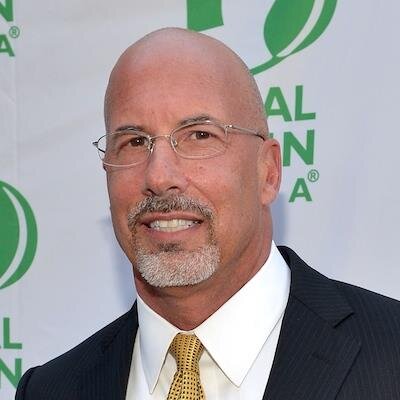
JOHN SHEGERIAN: Welcome to another edition of Green is Good. We’re at the pre-Oscar party at Global Green’s 12th annual pre-Oscar party. We’re here with the Executive Director of Global Green, Les McCabe. Les, tell us what’s so special about tonight’s big event.
LES MCCABE: I think the important thing about tonight’s event is it’s the only one of its kind. Literally, as you can see, we’re stepping on a green carpet right now, which is symbolic of the fact that Global Green is about green urbanism, it’s about resiliency, and it’s about sending a message in what is important in this part of town, which is Hollywood, the entertainment industry, about how important the environment is.
JOHN SHEGERIAN: Tonight, also, there’s going to be a focus now on Global Green 2.0. Can we talk a little bit about that?
LES MCCABE: Sure. Global Green has been around 20 years since its founding by Mikhail Gorbachev and Diane Meyer Simon. They’ve done some amazing work in the U.S. and abroad in a whole variety of areas. When we realized that we wanted to plan for the next 20 years, we sat down to form a strategic plan that would focus primarily on two key areas. The first key area, John, is green urbanism, which is a pretty big umbrella. It includes anything in an urban area, and that’s really driven by the fact that, as you know, 80 percent of the population in the U.S. lives in an urban area now. Globally in 2015, it will be 80 percent. The other piece of it is resiliency and response to climate change. With 40 percent of the U.S. population living in coastal areas, and as we witnessed with Katrina and Sandy, the effects of climate change, we’re really committed to responding to that. So there’s two key areas, green urbanism and climate change and resiliency.
JOHN SHEGERIAN: Les, this is your first Global Green event as the Executive Director. Share your thoughts a little bit about what you did before you joined Global Green, and now, how’s the first beginning of your tenure gone?
LES MCCABE: It’s been interesting and exciting at the same time. Before I came here, I worked for an international program called Semester at Sea, and I had the chance to literally travel the globe, nine times around the world, to so many places from India to South Africa to Vietnam to China, and really be able to witness firsthand the impact of pollution and climate change in other countries abroad and really see the devastation that was caused and how that impacted the lives of people living there. But after 25 years, I was ready to make a move, a career change. My family is from the West Coast, born and raised in California. I was living back East. I got a little bit tired of the snow – talking about climate change – and was contacted about this position. The two things that appealed to me, John, was number one the word global, and number two green. So I really felt I could build upon my international experience and the environmental pieces that I learned along the way, in addition to my early education in higher ed, and make it a perfect fit.
JOHN SHEGERIAN: Got it. Going back to what you talked about earlier about green urbanism, and for the next 20 years Global Green 2.0, share a little bit about L.A. and green urbanism and how that interrelation really makes a lot of sense.
LES MCCABE: Absolutely. It’s the second biggest city in the United States. It’s an important place to focus our time and energy. We’re based here for a reason, and while we have offices in New Orleans and D.C. and San Francisco and New York, the opportunity to do good work in L.A., which is very progressive, has a very progressive mayor, and a citizenship that knows that if we don’t start making changes, that the lifestyle of the citizens of L.A. county becomes very challenged by traffic, by pollution, by the cost of living, a whole host of things. We’re involved in several projects in L.A. and Little Tokyo and Koreatown, in consultation with developers for housing that’s affordable, that’s green, and that can really change neighborhoods and really serve as a catalyst for change that can emanate from those projects.
JOHN SHEGERIAN: Got it. We’re right now on this beautiful green carpet, where many of your celebrities and also sponsors are going to be walking in just a couple minutes. Can you give us a little preview of tonight? Who’s going to be here tonight? Why does it make it real special, and how is this kind of messaging so important because Hollywood really does set the trends and the tastes for the rest of the world?
LES MCCABE: Right. With people from Orlando Bloom to stars of television series and everyone in between, I think by coming tonight, they really send the message that while this week is about the Academy Awards and it’s an important week for Hollywood, that by being at this particular event on our green carpet, they can send the signal to not just the people watching the awards, but they can send the signal to the population around the world that being a celebrity, being in the entertainment industry, and being green is an important message to send to people, and to join them in a cause, so to speak. We have Common performing tonight, who, as you know, is an Academy Award nominee with John Legend, he’s a Grammy nominee. I think when we were approaching different people to perform, we really were looking for individuals like Common that are committed to the environment, that really want to present themselves to an event like this to signify their support of change in the environment and otherwise.
JOHN SHEGERIAN: Les, I see a car about 25 feet from us, and this is a city of cars. Talk a little bit about that car and who some of your sponsors are and why it’s important, in a city of cars, that you have a car sponsor who’s going to be talking in a little bit about green cars.
LES MCCABE: Absolutely. GM’s new Chevy Volt is our primary sponsor tonight. We’re really proud to have them as sponsors. They’ve been sponsors for prior years. The Volt is a great vehicle. It’s an all-electric car. You’re starting to see more and more of them on the road. This is the next generation of Volts, and the fact that GM gets behind this event as a major supporter and brings the vehicle here, I think is symbolic to the people that are walking the green carpet, the people that are attending the concert, that these vehicles exist in an affordable way, and that driving them does make a difference, not just from an economical standpoint, but also from the standpoint of leaving a small to nothing footprint, unlike regular fossil fuel vehicles.
JOHN SHEGERIAN: So from celebrities to green electric cars, here in L.A. pre-Oscar, this party has it all.
LES MCCABE: I think it does. This is the 12th time we’ve done this party, and we look forward to doing 12 more plus. It really does stand out, I think, amongst all the other Oscar parties this week. We’re very proud of it. We’re proud of our sponsors, we’re proud of the celebrities that support us in this, and of all the media that comes to learn more about Global Green and 2.0 in our next 20 years.
JOHN SHEGERIAN: Les, it’s such an honor to meet you tonight and to interview you. I wish you all the luck in your new position, and I wish you all the luck tonight to have just a smashing event.
LES MCCABE: Thanks, John. It’s great talking to you, and thanks for being here tonight.
JOHN SHEGERIAN: Thank you. This is another edition of Green is Good Radio. We’re here tonight with Les McCabe, pre-Oscar party, Global Green.
Top FAQs from the Episode
Here are answers to some of the most common questions from this conversation.
Les McCabe identifies green urbanism and climate resilience as key areas of focus. In this archived interview, he discusses helping communities respond to environmental pressures.
McCabe discusses Global Green’s involvement with housing projects in Los Angeles neighborhoods. He describes affordable, environmentally focused development as a possible catalyst for wider community improvements.
McCabe describes the event as a way to bring environmental issues into Hollywood’s spotlight. He explains how celebrity participation can communicate support for environmental change.
 Spotify
 Apple Podcasts
 Amazon Music
 iHeartRadio
 YouTube
 YouTube Music
 Audible
 Pandora