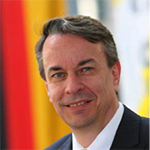
JOHN SHEGERIAN: Welcome back to Green is Good. This is the Green Festival’s edition of Green is Good. We’re here in New York City, New York, and we’re so honored to have with us today – this is the boss with us. He’s come in from Germany. The boss himself, Roland Bleinroth. Thank you for coming back to Green is Good. This is your second time on, but the first time we’re actually taping it on video as well, so thank you and welcome.
ROLAND BLEINROTH: Thank you John. It’s always a pleasure.
JOHN SHEGERIAN: It’s great. Now you are the boss. You’re the CEO of Messe-Stuttgart, and Messe is a lot bigger than just Green Festival here in America. Can you explain what Messe-Stuttgart is?
ROLAND BLEINROTH: Well, actually starting with the word “Messe” it is actually the German word for trade show, so it’s really the Stuttgart trade show company. That’s what the name expresses, although you actually have a bunch of those when you go around Germany. There’s a Messe-Frankfurt, Messe-Hamburg, Messe-Munich, Messe-Berlin. Of course, the most important one is Messe-Stuttgart.
JOHN SHEGERIAN: Of course, it is. Now it makes sense. It means trade show. Give a little bit about the history of both you, because I know it’s fascinating, but for our audience members that didn’t get to hear the first show, talk a little bit about your journey and how it brought you to Messe-Stuttgart and how you’ve now grown it into such a big international brand.
ROLAND BLEINROTH: The history is really a long story. To make that short would be very difficult. In general, Germany has a little bit of a head start in the trade show business. That’s because they started like hundreds of years ago. Messe-Frankfurt, as one example here, was founded in the year 1240, and that’s been operating non-stop every since, with a few breaks, there with wars going in, but, otherwise, it’s been in operation since 1240. Banks always enjoy that when you tell them that story of when the company was founded and you say 1240. So, yes, there is a really, really long history of trade shows. It started with Emperor Frederik II. This was way back before the turn of the century, the first turn of the century, year 940 when he started discovering that trade shows are a good thing for the economy. That’s really where trade shows started in Germany, more than a thousand years ago.
JOHN SHEGERIAN: What was your background a little bit prior to Messe-Stuttgart and then how you joined and made it into an international brand?
ROLAND BLEINROTH: Personally I worked for [2:34 inaudible] for a long time actually in North America. I spent 10 years in Atlanta running the Messe-Frankfurt operations here. We launched quite a few shows in the States and Canada and Mexico.
JOHN SHEGERIAN: And you were a trade show expert by just what you were doing prior to Messe-Stuttgart.
ROLAND BLEINROTH: Well, that’s just one of those things. There are no trade show experts. You learn by doing it.
JOHN SHEGERIAN: Okay, I gotcha.
ROLAND BLEINROTH: Actually, these days you can study it. When I started, there was no such thing as studying to be a trade show manager. So you would study something like business or marketing or whatnot, and most people got into the trade show business by coincidence. That’s not something that is usually on your map when you’re in high school and you say oh I want to be a trade show manager, because you usually don’t have any exposure. It’s a shame, but that’s the way it is or has been so far. Same for me. It was a coincidence. At some point, I got from somebody saying, “Hey, there is a job and I think this is good for you.” I took a look at it, and sure enough, it was. And that’s one of those other things in the trade show industry, either people like it and then they really stick with it and they never get out of it again or they’re gone very quickly. It is something that takes a special type of breed, I guess, to be successful in trade shows.
JOHN SHEGERIAN: And how long ago did you then join on as CEO of Messe-Stuttgart?
ROLAND BLEINROTH: Messe-Stuttgart I joined in 2006, so it’s almost 10 years, almost 10 years now.
JOHN SHEGERIAN: Before we get talking about the New York event that we’re at and then national events that you’re going to be having for the rest of this year, let’s talk about home base. What do you actually do with Messe-Stuttgart back in Germany and how big that is over in Germany?
ROLAND BLEINROTH: The German trade show model is a little bit different from the rest of the world because of the historic perspective. All of the German trade show organizers also have their own facility. So we actually own a convention center, which is 1.2 million square feet in Stuttgart, Germany. It is quite new. It’s the most modern one in Europe. It only went online at the end of 2007. So it’s a really, really nice facility with a lot of bells and whistles and gimmicks and whatnot. I could give you a whole spiel of just that. It’s very, very interesting and very comfortable for exhibitors that attend these. We run about 70 shows annually across the board, medical industry, automotive industry, IT industry, a lot in B2B, some B2C shows so it’s really across the board.
JOHN SHEGERIAN: Year-round there’s shows happening – either being put up or being broken down, year around.
ROLAND BLEINROTH: Pretty much year-round. There are certain slots on the calendar that don’t work. Holidays, of course, are exempt. Vacation time is very difficult to run shows. There are certain slots that just don’t work, but the rest we are booked.
JOHN SHEGERIAN: And the Green Festival, Messe-Stuttgart Green Festival, explain when that is and how usually hugely successfully it is.
ROLAND BLEINROTH: Actually, the U.S. version of Green Festival here is older than what we do in Germany. Usually, it’s the opposite. We just started getting into that particular show segment back in 2007, and we launched the first event, which is a Slow Food show run with the Slow Food Association of Germany as our partners. That was the nucleus. Then there was a garden show, then a home and renovation show and an energy show and a yoga show then an iMobility, intelligent mobility show. So, it just added up and we now have eight brands, but they’re all individual shows. They are all individual brands, which are marketed individually and we don’t even have the umbrella brand Green Festival as we have here. There are just eight individual shows that happen to be concurrent. The attendee comes in with one ticket and he gets all eight. That’s how it worked in Germany.
JOHN SHEGERIAN: We we’re talking a little bit prior to filming off air about the success. Share with our audience a little bit how hugely successful it was this year.
ROLAND BLEINROTH: That show has really taken off, and it’s grown from year to year. This year we had eight halls filled so there was about a million square feet of space covered. There was maybe a little bit left for growth for the next year, but it almost filled the entire facility. We had 88,000 attendees, which is up 10 percent from the previous year. It was really packed. At some points, the aisles were so packed it was hard to get through. The show runs three-and-a half days, so one extra day compared to New York. It was a really nice show. I really enjoyed it.
JOHN SHEGERIAN: For our audience that just joined us I’ve got Roland Bleinroth with us today. He’s the CEO of Messe-Stuttgart. To learn more about Messe-Stuttgart and all the great trade shows they do year-round, please go to www.messe-stuttgart.de/en. Roland, now let’s talk about what you’ve done here in the USA. You came to the U.S. and you then took over what was already an historical green festival situation. Explain your vision on how Messe-Stuttgart came into the U.S. now, took over this Green Festival and is now scaling it to new heights.
ROLAND BLEINROTH: It was just an opportunity that came along. The former organizers and founder of Green Festival are still onboard – two major associations here, Green America and Global Exchange. They founded this particular show 14 years ago. They are still our partners here. They are still promoting the show. They are still backing it. We were happy to have the opportunity to step on this plate and take it to the next level. That was just an opportunity that came up. We thought it was the right show for us at the right time in the right place, because North America is certainly ready for it and we feel we can contribute a little bit to the growth of it.
JOHN SHEGERIAN: How long ago did you take over these shows?
ROLAND BLEINROTH: This was in March 2013. So we are pretty much in the second year now of us operating it. It runs in five destinations – five cities in North America and there is probably room for more.
JOHN SHEGERIAN: Right. You have a unique perspective. You’re European-born, but you spent a lot of years here in the United States. So share a little bit about the differences in sustainability, culturally speaking, in Europe and the U.S.
ROLAND BLEINROTH: Well, particularly with Germany, to start, they’re maybe pretty much ahead of the U.S. in that particular category. It’s been mainstream for the last 30 years or so. It is just becoming mainstream here, which is great, and we’re seeing it capture on really, really quickly, but that happened in Germany 30 years ago. Recycling and separating your trash is nothing new to people. That’s become a habit.
JOHN SHEGERIAN: It’s part of the DNA of Germany.
ROLAND BLEINROTH: That kids grew up with. They would expect the trash can to be a single can. It always comes in three or five inclinations right next to each other. So people actually grew up with it. They take a whole different attitude to it. It’s not something that you do because somebody tells you this is what you should be doing. It’s become natural.
JOHN SHEGERIAN: What have you learned from the experiences with the Green Festival, really not called the Green Festival as you say, numerous different trade shows underneath one roof, what have you learned from the sustainability version of the Green Festival in Stuttgart that you had four weeks ago that you can now apply to scaling and taking the Green Festivals in the USA to new heights?
ROLAND BLEINROTH: There are probably a couple of lessons. One of the most important ones is for people to grasp that it is not expensive, that it is not something that would cost them an arm and a leg if they really make intelligent choices about what they consume and what they buy. That is not really the case. You can be conscious of what you buy and be conscious of how you spend your dollars without having to spend more. The choices are out there. It’s a matter of finding it, and again, since it is a little bit more challenging to find these really good products, that’s why you should come to the Green Festival because this is where they are. People are actually excited when they walk through the hall and they discover great products that they never had heard of and they haven’t seen at their retailer. We have retailers coming in who feel the same way about it.
JOHN SHEGERIAN: The Green Festival is truly B2C and B2B.
ROLAND BLEINROTH: Yes. It’s a hybrid show, which is the same in Germany and it actually has to be because there are many small companies here and they need also a sustainable business base, not just three days of business here and that would not take for the rest of the year so they would definitely need the retail exposure. We’ve worked on that a lot the last two years to get the retail community to come here also. So, yes, we want the B2B business.
JOHN SHEGERIAN: So, Roland, this year when you look at all the cities that you’re going to, and here we are today in beautiful New York City, what new sponsors are you excited about that have signed on and which ones are you still really visioning and hoping to get in the future?
ROLAND BLEINROTH: I can still imagine a really, really long list of sponsors that could be involved and that should be involved. But it’s nice also to see that more and more are catching on. Maybe, most prominently, you start at the very top, the platinum sponsor, is Volkswagen and Audi. Those are our platinum sponsors.
JOHN SHEGERIAN: They’ve signed on this year.
ROLAND BLEINROTH: They’ve signed on this year and they will be presenting their electric and hybrid vehicles only. Not really the mainstream of what they do, but they will be highlighting their electric vehicles.
JOHN SHEGERIAN: Wonderful.
ROLAND BLEINROTH: For hybrid vehicles, Ford was onboard for many years in the past. So, yes, that’s also very exciting to see that the vehicle industry is really discovering electric mobility is an economical option.
JOHN SHEGERIAN: And your type of clients that come here will respond to that so they’re seeing this as a very important place to showcase their new products.
ROLAND BLEINROTH: It’s a great opportunity to get the message out to the customer. Again, you’d be surprised just on the vehicle-side how much is already a part.
JOHN SHEGERIAN: Do you have some brands that are already showcasing their products back in Stuttgart that want to now come and bring their brands to the U.S. yet?
ROLAND BLEINROTH: Yes, that’s happening also. We’re very excited about that happening. Some products are actually making the jump across the Atlantic. One is right here next to us doing test drives with bicycles. It’s a Swiss company called Stromer, who also became a sponsor here. They do all five cities in the U.S. now. These are gorgeous, really gorgeous bikes. You’ve got to see them.
JOHN SHEGERIAN: Electric bikes.
ROLAND BLEINROTH: Electric bikes. Yes, of course, you still pedal but you’ve got electric support to it. But they’re designed from the ground up. It’s not a bicycle with an added electric motor and battery attached somewhere, which always looks clumsy and not so attractive.
JOHN SHEGERIAN: These bikes are really designed beautiful.
ROLAND BLEINROTH: And they ride like a charm. You get 50 miles on one charge. It’s amazing.
JOHN SHEGERIAN: That’s a fascinating marketing principal. You really have then some very wonderful and long-term sponsors and folks that have been involved with Messe-Stuttgart that can now see the real, as you said earlier in the show, the rise of sustainability in the U.S., take advantage of their relationship with you and now bring their products here to the U.S. public.
ROLAND BLEINROTH: Exactly, and it’s working the opposite way too. Just earlier this morning, when I was talking to an exhibitor here who does little, really very, very small types of sonars, it’s not really a sonar about groups of infrared light. Very, very interesting product. We just chatted about him coming to Germany.
JOHN SHEGERIAN: So the reverse even is possible?
ROLAND BLEINROTH: His product is already certified in Germany. He can market it immediately, and he’s very excited about the opportunity to see that there is a Green Festival in Germany that he can now take advantage of. So it’s going both ways. This business, like any business, is becoming international also.
JOHN SHEGERIAN: How is the trade show industry as a whole? You are one of the real leaders of the trade show industry. How is the trade show industry helping push forward the green movement and sustainability movement so it moves faster through society?
ROLAND BLEINROTH: Like always it is an evolutionary process and it does take some time. We currently run trade shows, different trade shows not just Green Festivals, in six countries around the world. So we’re doing quite a few countries. The Green Festival right now is in Germany, and it’s here in the U.S. It hasn’t gone anywhere else yet, but we’re certainly looking at other countries. Just to give you one visionary thought here: Maybe China is going to come up. Yes, this is a topic that will be an issue in China not just yet, but give it a couple of years. I’m only talking a couple of years here. I can see this happening in two or three years in China.
JOHN SHEGERIAN: Messe-Stuttgart bringing Green Festivals or a sustainability forum to China. That makes sense.
ROLAND BLEINROTH: We run a lot of shows in China, and we see in the construction industry, industrial sectors and agriculture how the Chinese are becoming conscious about what they’re doing to the environment, what they’re doing wasting energy and all the rest of the sustainability problems that China is really at the top of the pyramid. They’ve recognizing it, and they’re changing their ways. They are very, very interested to discover how to do it. So I can see this happening in China in just a couple of years.
JOHN SHEGERIAN: I see this year to your lineup of cities you’ve added Portland. Can you share with our audience why have you added Portland? Why is Portland now part of the Green Festivals program?
ROLAND BLEINROTH: Portland became a destination due to the feedback from our exhibitor base. We spend a lot of time and effort serving our customers. One of those old wisdoms of business is listen to your customer. We do that. We survey our attendees a lot and our exhibitors, including the ones that are not coming. One of the outcomes was Portland is a hub where people are very interested in. We said okay if our customer wants Portland, we will talk a closer look at it. We did. We found it verified that there is a very interesting market in Portland, so we launched Portland for the first time this year and it is actually going quite well.
JOHN SHEGERIAN: That’s exciting.
ROLAND BLEINROTH: We’re excited about the first show there.
JOHN SHEGERIAN: I’ve seen as an employer here in the United States, Roland, that we have a lot of young people that come to work for our company but because people can work virtually now they want to live and work from Portland. We actually have some employees out of Portland, and they’re young. They love sustainability. I think you’ve chosen a winner of a location. I’m excited to go up there and bring Green is Good to Green Festivals in Portland. We’re down to the last two minutes, and I want to give you the opportunity. You’ve come all this way from Germany to be here at this wonderful event that you’re putting on, Messe-Stuttgart is putting on, what final thoughts do you have for our audience members, both consumers and potential exhibitors, in the United States and around the world before we sign off for today?
ROLAND BLEINROTH: It’s always exciting to be at this type of event at the Green Festivals, to see the enthusiasm that’s out here. We have 800 volunteers just in New York working on this event behind the scenes mostly, sorting trash to name one, which a lot of volunteers do. We have a zero footprint here. There’s no waste that this show produces. All the energy that we use, electricity, green renewable energies, so no footprint. There is no carbon footprint here. We work on this show actually being green, not only having it in a name. It’s exciting how people are willing to work for that as volunteers. We have that in New York as well as in the other destinations as well. To really see that movement, that people don’t see it just as a commercial enterprise but really as a mission is really exciting and really fun.
JOHN SHEGERIAN: Thank you so much. You know Roland it’s always an honor to have you on. We want to have you back on at any of the other Green Festivals this year. Green is Good is so honored to participate as a media partner with Green Festivals. It is truly an honor for us. For our audience out there, to learn more about Roland’s great company, Messe-Stuttgart, go to www.messe-stuttgart.com. Again, this is Green is Good. This is the Green Festival edition of Green is Good here in New York City, New York. Come to the Green Festivals all around the United States. This year they’ve added Portland. Go to www.greenfestivals.org to check them out and also you can go to www.messe-stuttgart.com as well. Roland, you are a sustainability superstar and truly living proof that green is good.
ROLAND BLEINROTH: Thank you. Green is good. You’ve got that right.
JOHN SHEGERIAN: Thank you.
Top FAQs from the Episode
Here are answers to some of the most common questions from this conversation.
Roland Bleinroth describes organizing shows while operating a convention facility. He contrasts that model with other event markets.
Bleinroth discusses exhibitors exploring markets in both directions between Germany and the United States. He describes events creating those introductions.
Bleinroth discusses separate collection becoming a familiar everyday habit. In this archived interview, he connects that familiarity with early exposure.
 Spotify
 Apple Podcasts
 Amazon Music
 iHeartRadio
 YouTube
 YouTube Music
 Audible
 Pandora