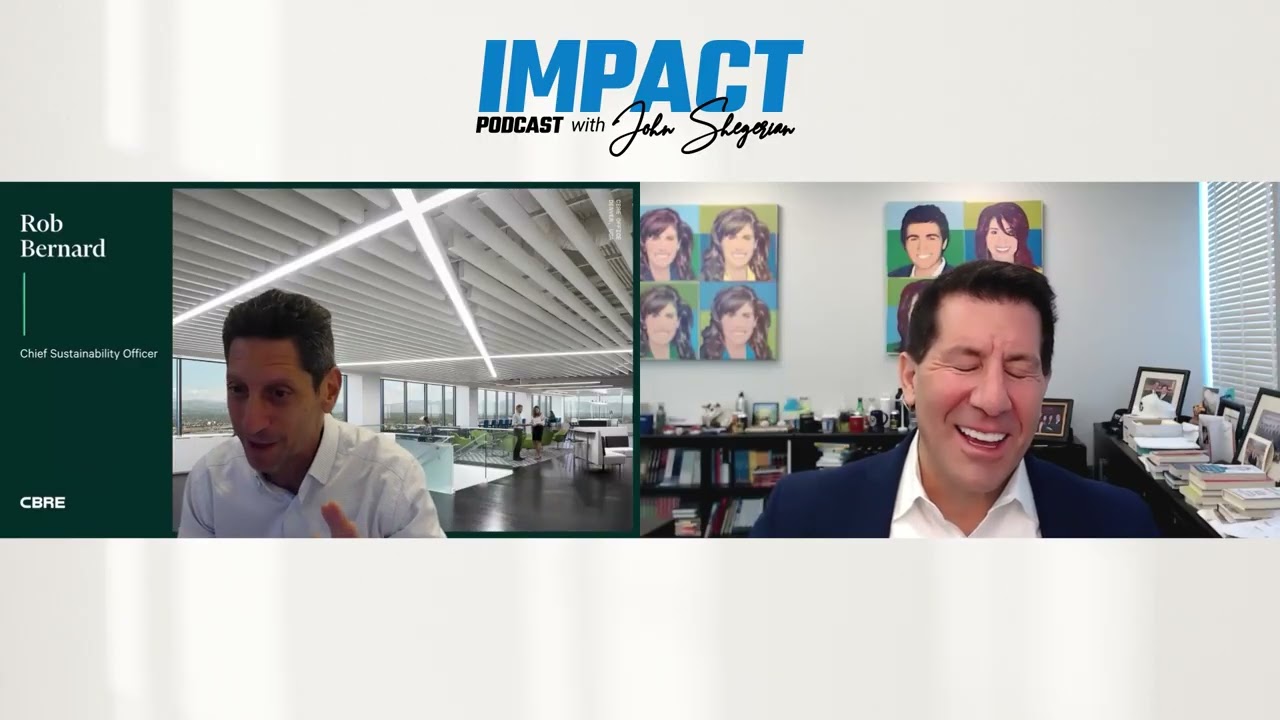
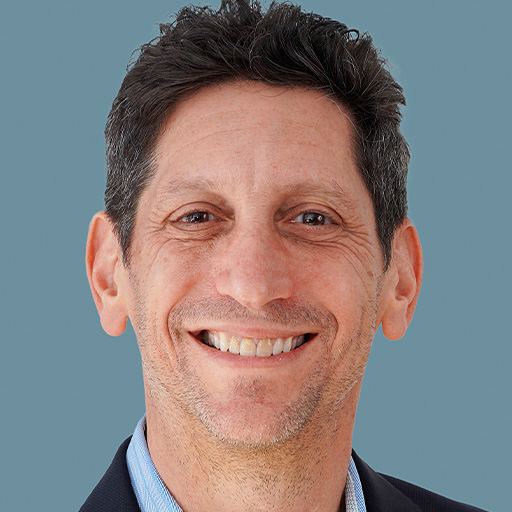
As CBRE’s Chief Sustainability Officer, Rob Bernard is at the forefront of working to create value for clients through sustainability. Rob comes to this role with a business and environmental background. He is leading teams across the company to help CBRE clients decarbonize the built environment, meet increasing regulatory requirements, and drive strong economic returns through the lens of sustainability. He also oversees CBRE’s own operational sustainability work, which includes a goal to achieve net zero emissions by 2040.
John: Get the latest impact podcast right into your inbox each week. Subscribe by entering your email address at impactpodcast.com to make sure you never miss an interview. This edition of the Impact Podcast is brought to you by ERI. ERI has a mission to protect people, the planet and your privacy, and is the largest fully integrated IT and electronics asset disposition provider and cybersecurity focused hardware destruction company in the United States and maybe even the world. For more information on how ERI can help your business properly dispose of outdated electronic hardware devices please visit eridirect.com. This episode of the Impact Podcast is brought to you by Closed Loop Partners. Closed Loop Partners is a leading circular economy investor in the United States with an extensive network of Fortune 500 corporate investors, family offices, institutional investors, industry experts and impact partners. Closed loops platform spans the arc of capital from venture capital to private equity. Bridging gaps and fostering synergies to scale the circular economy. To find Closed Loop Partners please go to www.closedlooppartners.com.
John: Welcome to another edition of the Impact Podcast. This is a special edition we’ve got today with us, Robert Bernard. He’s the Chief Sustainability Officer at CBRE. Welcome Rob to this Impact podcast.
Robert: Thank you. I’m excited for our conversation today.
John: Hey, we were talking a little bit offline, so I want to bring that conversation online. I would love you to share where you grew up and how you got on this wonderful and important journey that you’re on right now at CBRE.
Robert: Excellent. I grew up in a small little town in the northern corner of New Jersey called Hillsdale, New Jersey. I think you might know it.
John: I had a great childhood in Hillsdale, New Jersey like you did. So very great town.
Robert: In my journey sort of had me wandering all over the place, but we’ll get into it today. I ended up spending 20 plus years out on the west coast at Microsoft where among other things I started and ran their environmental strategies and sustainability for about a decade then ended up back on the east coast doing some private equity work. And then over the last two and a half years I’ve been at CBRE helping hopefully transform the way we think about sustainability here not just CBRE but commercial real estate in general.
John: Before we get into CBRE, which I’m so excited because we’ve never had you guys on before. Talk about where did you get the mindset that you wanted to be in the sustainability world? Of course you’re humble. You were truly Microsoft’s first chief environmental strategist. How did that come to be?
Robert: If we go back in time sort of 2007, 2008 the world was sort of accelerating into I’ll call it an awareness about sustainability. As a world’s largest software company, it was very much an opportunity for us to think about how does the intersection of what software can do. Not just how does Microsoft operate, which became a big theme over time, but what could software do? We were actually approached, there was something called the C40 Cities and they wanted to track carbon in cities across the world. They didn’t have a software solution to go do that. And so they approached Microsoft and just because I’ve been very vocal inside the company about the importance of software on sustainability, my phone rang and they’re like, Hey the C40 Cities wants to talk to us and that sort of led from one thing to the next. And then in partnership with Accenture and SAP we actually ended up building either the first or second instantiation of the CDP platform. Then from there it just sort of was off to the races, like, Hey, we need to be more deliberate as opposed to just reacting to people calling us. What do we want to do in the world on sustainability?
John: You were the first chiefs environmental strategist. What was it like and what is it like coming in and actually having that proverbial whiteboard and it’s up to you to vision this out with leadership and make it a reality?
Robert: I think it’s a great question. I’m so lucky, like I happen to be at Microsoft and I happen to be vocal all about the importance of it and they chose me to sort of help figure out the journey. CBRE never had a chief sustainability officer.
John: Well, that’s why I want to put [crosstalk] first time there and then I want to tie that back to what you do now with CBRE and coming back in with the proverbial white page and how was your experience different because you knew a lot more than the first time you did that.
Robert: I think there’s a lot of difference, but there’s one common theme.
John: Let me hear it.
Robert: That sort of permeates both which is what does a company that anybody listening works for? And then what are the things that that company can uniquely do in the markets they operate in to advance the agenda of sustainability? And can you do it in a way that absolutely makes business and economic sense?
John: I’m so glad you said it that way. Is that really what I find to be when I get to interview so many cool and important people like you that are doing impactful work with your colleagues? Rob, the theme I’m getting now, the last six months or eight months of these interviews and podcasts is this, that these highly politicized and highly charged acronyms, alphabet soup of acronyms that have become sort of the vogue, the last five, six years are sort of a little bit falling by the wayside and now tying that to what you just said, but what is now summed up is materiality. Materiality as to the vision and the mission of CBRE. Not just doing sustainability randomly or in a void, or where it just looks cool but really doesn’t make sense more virtue singling. It’s more now about the materiality of the core mission of the brand and doing sustainability that ties back materially to the core brand’s mission. Is that sort of become the [crosstalk]
Robert: It’s great to see the evolution. But the whole thing is like transforming our economy to be way more efficient. We take the word sustainability and park it. Take ESG and all these sort of acronyms, they exist around sustainability.
But if you look at it at its core it’s about a much more efficient way of doing whatever business you happen to be in. Then can you do it in a way that actually has a neutral or potentially even positive impact on the infrastructure of the planet? So if we think about it that way, you go like, okay, this is a classic business transformation opportunity.
John: Linear to circular.
Robert: Linear to circular extractive towards, again, circularity, renewable, abundant, limitless sources of energy over time. All of these things if you take a long horizon perspective, the faster we make the transition to those types of ways of operating, the more profitable we’re going to be and the more productive we can be.
John: You joined CBRE about two and a half years ago?
Robert: Yes.
John: Let’s just tee this up. For our listeners and viewers who don’t know the amazing CBRE, first of all, the fine Robin and his colleagues at CBRE. We’re going to put some exact links in the show notes. But overall it’s cbre.com. Annual revenue 36 billion a year over 140,000 employees around the world, and of course all the countries you serve is global. Now you walk in, again, proverbial white page two and a half years ago. You came from one massive brand, you’re now at another massive brand that’s touches all parts of the globe. How does that journey begin at CBRE then?
Robert: I think the way I would describe it is what existed at CBRE and which wasn’t dissimilar to Microsoft was well-intentioned chaos. So let me give a like little a bit context of [crosstalk]
John: That’s great.
Robert: CBRE and at the time it was probably six and a half 7 billion square feet now it’s 8 billion square feet that it touches globally. It’s just an approximation but just to put that in context for the viewers. Take all the energy from like Denmark plus Switzerland and then a bit more. So the scale is massive and you’ve got a lot of really smart people inside the company. But they’re disconnected. So you got people in Spain doing awesome stuff and you got people in Germany doing great stuff and they here in the United States and you get the idea in APAC and everywhere around the world, people doing really good stuff. But they’ve created a basically a siloed solution for their clients wherever they happen to be in the world. If you literally were to travel around the world physically or virtually, you’d see that Sibr already had a whole bunch of different things to say. And they were all great. So then my job was to sort of extract out what are the patterns across all of these great solutions and offerings the company has. Where are they inconsistent and how do you make them consistent and unified across the company? The first thing we did after I interviewed several hundred internal and external people was create a very simple structure and a very simple strategy. It’s kinda interesting because I’ve been doing sustainability, like I said, since like 2007, the complexity has exploded. We could spend an hour just talking about what does CRD mean and how do you do reporting? How do you report to CDP? How do you think about SVTI, et cetera, et cetera, et cetera. So you have this mass complexity and our job is to simplify that because the goal is to actually accelerate like value creation and to accelerate sustainability. So in order to do that you’ve gotta take this complexity and make it very simple for internal customers and external customers to understand.
John: I love that what you just said. Well-intentioned chaos is such a brilliant way of summing it up. How do you then remove silos when you come in, and is it easier to walk into well-intentioned chaos or is it easier to walk into a void of anything going on in sustainability and just literally starting from ground zero? When you intellectualize it, how do you come out on that?
Robert: I think the answer is both create opportunities. The reality is both exist simultaneously. In some markets we have this this well intent not to use the phrase, but like this well-intentioned chaos. But in other markets you’d go, or other parts of the business and people are like we’re not thinking about sustainability at all. So we have both of those conditions that exist. But if you take, again, back the fundamental thing and like we can talk about business and how you think about return on investment and all that stuff, but it’s like start with the end in mind, what’s the outcome we want for the customer? Improved outcomes for the customers. You start with that and then you start to walk backwards, and there’s two things. If you’re already working on sustainability, and I can help you go faster by giving you tools and frameworks and value propositions and relationship access that you didn’t have before you’re super excited in this world where you used to be islanded in a given country to be like I’ve got the power of this 140, 150,000 person company behind me now. I get to go. If you haven’t been in the game because you just haven’t thought about sustainability and we say, look, you can actually differentiate your business through sustainability for your clients and customers, now all of a sudden you start to lean forward in the chair versus if I show up and say, Hey John, you know what? You gotta do this, this, this, and this and this, because it’s corporate overhead and corporate tax. You’re like, Hey Rob, I got a thousand other things that happen in my day. Literally. Like what’s in it for my team? A lot of people say this, like, I’m super into the environment and I do these things personally I have to justify the action. My job is to say, let me translate outcomes and actions into things that are relevant to you as a stakeholder in this company or in this world.
John: I’m going to just start with a simple example our C-suite leaders when they’re looking for corporate offices, if I’m a C-suite leader at a large corporation and now I have my broker and he’s showing me two Tripple A beautiful buildings in, choose any city USA in downtown Chicago that I’m going to put my headquarters from my fast growing AI company into. When my broker’s showing me these two buildings, one’s a CBRE managed building and one is a competitor. And your building is Tripple A lead certified, whatever that’s called, platinum certified and the other building is not. Am I as a decision maker are you finding practically speaking, would I rather even given if the rates are tick higher, am I choosing the lead certified so this way I could put that in my annual impact report and it could also permeate the culture of my company in terms of how things are done?
Robert: I think the answer is, it depends and it’s not universal. More yes than no. So I think we did a survey and we can sort of put the links in the show notes.
John: Sure.
Robert: That says, I think it was somewhere around 70% of occupiers said yes, this was a key issue in their decision making. I’d go even further where if you said to me Chicago, which is interesting. We now literally flew over to London. Your ability to rent space or actually lease a space if you’re an owner requires certain levels of increasing sustainability. So in some cases, it is no longer even a choice. The market basically is saying, Hey, you have to take certain action as a landlord because there’s regulatory pressure as well. So depending on where you are, it is not just occupier choice it’s regulatory pressure or investor choices and many investors are saying, wait, my buildings in the long run are going to be worth more if there’s certain things I do. Like who doesn’t want to be in a more efficient building, because it means that you’re paying less in energy bills. By the way, it means they’ve probably thought a bit more about air quality and all sorts of other stuff. So it usually comes, like you said, two Tripple-A spaces in Chicago. The interesting and not surprising thing is, generally speaking there’s a high correlation with high levels of sustainability and other attributes in the building. So those things often go together, but yes 70% I think is the number and it’ll be in the show notes. Like think this is important enough that it’s actually going to influence my decision at the end of the day.
John: We’re going to get in later about cross regulation across different continents and how you reconcile that and rationalize that in your leadership also, because that’s a whole different topic I want to get into with you. Let’s go back to what we were talking about a little bit earlier though. Taking the simplicity but the challenge of the shift of being ahead of this linear to circular economy shift. So how do you look at taking what are traditionally liabilities, just call them waste streams in your buildings and turning them into products or services that are now assets and no longer liabilities. How does that shift from a linear to circular economy work within the framework and sustainability at CBRE?
Robert: I think there’s a couple of different things to think about there. We can talk about maybe also what a CBRE do in our own spaces. Because we’re just [crosstalk]
John: Please. Coming into that.
Robert: customer they have like 650 buildings and we’re [crosstalk]
John: Go into that.
Robert: We can use ourselves almost as an example, which is, Hey, if I’m going to be more circular, the first thing I have to do is start with information. Like, how much waste do I actually have in my buildings in my spaces that I occupy? How much am I throwing out? How much theoretically should I? Because we know what, like optimal rates and zero waste, and we do this with a lot of customers which is like, Hey, we can get you to 90% plus diversion in your spaces if that’s an issue and it’s important to you. By the way, more often than not in most locations, you’ll actually be able to do it more economically than if you’re actually bending to landfill a lot of stuff. Just think about that trade off which is, I have a material which can be used as an input to somebody else’s process, or it’s going to end up physically sitting in a landfill. Those things are very different. So that’s an area that we think about it. But it’s not just about what you would think about like, where do I throw my garbage? It’s also like, how do you think about all the different inputs and all the different aspects of how you run your space. So now think about the electrons coming into your building. Hopefully we’ll talk a little bit about energy and electricity. When I first got here, we had a small team thinking about some energy stuff. But we weren’t a significant player in the energy space in terms of sustainability. So we went out and we actually said, Hey, if I’m going to help our clients address the issue that you’re talking about, we have to have a very strong position and place in the market on energy. We went and we purchased the renewable energy brokerage and advisory business from NRG, which is a big power company here in the US.
John: Sure.
Robert: Because we said, look, if we’re going to provide a holistic service to our clients and a solution set, we gotta cover the whole thing. We’re going to talk a little bit, hopefully in a few minutes about water as sort of the next frontier in that.
John: Yes.
Robert: But the first frontier was like we already did a lot of the operations in the building, then we went to energy, and now we’re going to water. And you can expect us to keep marching down that path over time.
John: Got it. That makes sense. Talk about, where does that come from though? How do you decide to strata what to attack first and what to attack second, third, and how does that work?
Robert: I think it’s the intersection of two things. Importance to the client number one always. After you’ve already chosen a space to work and live and you fit it out and you’re running it. Energy has gotta come next, especially if you have any kind of carbon commitment. The next thing is, if you start to look at, and we’re doing this in a lot of clients is we actually looked at climate risk modeling. To your point, like I’m going to choose two buildings in Chicago, is we actually had a client hire us. We had several clients, but a client comes to mind, which is like they hired us to look at space in Manhattan, and we looked at 46 locations. We were able to rule out a whole bunch, even in the city of Manhattan, where buildings literally catty cornered from each other, had very different climate risk. Topography in New York, how water systems work, where the mechanical systems were. So in a case of another hurricane type of inundation there was actually going to be very different impacts for that client depending on which building they might choose. Now you go, okay, so I got climate risk, I got operational stuff. Now I actually want to think about where do I source my energy and my supply chain. So that’s sort of how we started to sort of and we may have gotten it wrong, but we’re just trying to start with what we think our client’s biggest issues are and sort of march our way towards creating a whole end-to-end suite of things that we can do either through our own services or through our partners.
John: This show has covered the topic of sustainability dating back to 2007, so sort of same path as your journey as well in terms of how far it dates back. Sustainability, as you said, has been a great evolution. Talk about why commercial real estate and what you do in all the billions of square feet that are under management by CBRE really plays an important part in the whole sustainability sector around the world.
Robert: If you just look at the math 40% of all energy is used in buildings. There’s different models that say how much is commercial and residential? If you look at growth of energy use today, data centers, AI. Like we know what the reality is and so that 40% may stay at 40% or it may actually go up a little bit depending. Like our industry has to step up. It’s a huge opportunity and to some degree it’s an obligation of commercial real estate companies around the world to address this issue.
John: Two and a half years in, which is enough time to get the ball rolling the way you want, but of course, lots still to do. What are the most proud of to date on how CBRE is working towards advancing sustainability as a whole globally speaking on a macro basis?
Robert: I think the number one thing starts with get in the room. So when I think about the number of customers who have hired us to be in the room with them whether it’s as a thought partner, as an operating partner, as a broker for their energy or some combination of all of those things, the more rooms we’re in, the more impact however we want to measure it, we can have. I’d say the number one thing is the increasing volume of customers who we are working with is the number one thing that gets me so excited every day. Because once I’m in a conversation, like if I’m talking to you, John, I’m like, Hey John, what’s important to you? And all of sudden we’re down in a conversation and to you it might be water. And for me it might be, I don’t know. I’ve got a lot of manufacturing and it’s the waste stream from my manufacturing. But now we can have that conversation. We can help you on whatever part of the journey you’re focused on.
John: Rob, how much has that changed to that exact point of what’s important to clients like me when I go into commercial real estate opportunities? How did that change and how does that continue to evolve after COVID?
Robert: It’s interesting. I wish I could answer that question better because I joined two and a half years ago, which was post COVID.
John: Understood.
Robert: But I think the thing that is changing real time is especially for large companies who are going to have more and more dependency on AI, the level of prominence of thinking through their impact on sustainability of their data strategies and their AI strategies is just coming into the conversation even more than as recently as two years ago.
John: But my commercial real estate is where I spend most of my life practically speaking, maybe more than even home, has air quality more natural sunlight, and better building hygiene come into play. Are people more focused on that post COVID. Even though you weren’t there, you have access to information that predates you in the commercial real estate section. Do you feel that people are much more concerned just personally about the space that they’re in on a regular basis now?
Robert: I definitely think there’s more concern about wellbeing at the intersection of commercial real estate and people’s experiences. A lot of that, frankly, spans in a great way, well beyond sustainability.
John: Got it. Understood. For our listeners and viewers who’ve just joined us, we’ve got Robert Bernard with us. He’s the Chief Sustainability Officer at CBRE. To find Rob and his colleagues of all the important and great work they’re doing in sustainability, please go to www.cbre.com. There’ll be direct links also to all his other great work at CBRE in the show notes. You don’t have to stop, write anything down. Stop walking the dog or lifting your weights or whatever you’re doing while you’re listening to this. Rob, I know you have an announcement to share with our audience and listeners today. I’d love you to share that now.
Robert: Absolutely, John. So we’re really excited and we’ve been talking quite a bit about sort of walking down the continuum of incredibly important things to our clients. Last year we purchased, like I mentioned earlier, big energy, renewable energy brokerage and advisory business and increasingly, especially because of AI but not only, and because of things that are happening with climate and weather, water and water scarcity and water quality is becoming way more important in commercial real estate and for our customers. So we took the step back and we said, Hey, if we want to enter into this to provide value to our clients, what’s the best way to do that? So we took the step back and we looked all literally across the globe and we decided that we think the best company in the world on this is frankly Ecolab. They bought a company called Malco a number of years ago, and people out there have probably seen they do cleaning supplies. So back to your, like what happens post COVID. They’re doing great work there and we’re doing a lot of work with them. But like they have this amazing set of tools that says, Hey John, when you think about water, don’t just think about your water bill. Because in general water’s not crazy expensive with a few exceptions in few markets. But your dependency on water is massive. It’s in your HVAC systems. If you’re in manufacturing, it’s in your manufacturing. If you’re in something like chip manufacturing, like you’re at another level of like the purity of that water is well beyond what I think most people would ever imagine is possible. We want to be the partner that says, Hey, look we can think of a holistic process with you, with Ecolab sitting by our side to help you optimize water, and when you do that, it’s not only just impacting water, it’s impacting your energy system. It’s impacting the quality of how things are manufactured in your facilities. How you think about your data center and its ability to operate for the next 20 to 30 years. So we’re super excited about this partnership and sort of stay tuned for not only more work with Ecolab, but a couple of more partnerships that we hope to announce in the near future.
John: That’s wonderful. Congratulations. That’s just wonderful. Let’s go back to A&G electricity. you have to deal with A&G. We’ve been dancing around the terminology of AI. How is AI in your experience helping you and your colleagues in sustainability do more with less?
Robert: It’s potential is massive. I’d be excited to come back a year from now and talk in even more detail.
John: We’re going to have you back a year from now. I know sustainability is no finish line anyway. It’s just a darn journey.
Robert: It is. Especially coming to this from having spent 20 years in tech like as soon as I got here I started to look at what was happening because AI was sort of unfolding at massive speed in front of us. It’s like, my gosh, what’s all the data that we could pull together that exists in the world that would impact and influence the way we can help our clients? We’ve actually built a series of tools that my own internal teams use to actually aggregate information that we have access to. Some of it’s public, some of it’s private. So I can sit with you and say, Hey John, look, I looked at your stuff and here’s where I think you may have a lot of climate risk. Or here’s where I think you might have a lot of inefficiency. We’re going to evolve this tool a lot over the next, I’m sure almost several years for as long as I do this job. But like I’d say, we’re in the first innings and it is absolutely transforming the way my team works.
John: Is it fair to say that in the future out of your 8 billion square feet that you’re going to be able to sit at your desk in the position that you’re at, and you’ll have a KPI dashboard on almost all every square foot that CBRE manages around the world?
Robert: We absolutely need to get there. Go all the way back to the beginning of our conversation. Starts with access to information. So one of the first things we need to do, and we’re doing this very actively, is say, Hey John, back to your example in Chicago. Like, you’re choosing between two buildings. One of the least clauses that make sure that you and us if we’re fortunate enough to be the manager of that space for you, get your utility data, get your water use data, get your air quality data that’s important to you. A lot of times leases historically, think about somebody who’s been in the same space for 20 years, every five, 10 years of renewing that lease didn’t address that. So we think really hard, like the first ingredient for success is information. Then it’s insight, and then it’s action. So you sort of gotta go down that journey together with our clients, but also with your landlord. Or if you’re the landlord, you’ve got the opposite thing, which is, Hey, I want to have the relationship with the tenant where I’ve got some bidirectional flow of information here.
John: Is the concurrently with the development of AI and as it evolves in front of all of us and part of all of what we do is then the tracking tools to be able to track the information in these buildings to be able to feed the AI beast. So then the AI algorithms can analyze and then give you the right information that you need to make the best decisions.
Robert: Absolutely. And a lot of this like without getting too in the weeds on AI. Which is you and I could both build a model. The thing that I love about being at CBRE is we have so much data. So if you’re at CBRE and I’m not, let’s reverse roll. I point my data at a bunch of what’s called synthetic data. Which is, Hey, I have an idea of how math might work in this place and I point AI at stuff, I think I might be able to find that’s very different than, am I sitting? No. John, you’re sitting on meter data, you’re sitting on utility bill pay, you’re sitting on all this stuff, and now you take the AI engine and point it at that the results are going to be significantly more robust. What’s so exciting for me doing AI within CBRE is we’re fortunate enough to have such great data with our clients that I think we get to really drive some great insights and go pretty quickly down this path on the learning curve.
John: I want you to share some advice with our listeners and viewers out there that are the next generation behind us. There’s a whole generation of high school, college graduate students now, Rob, that are watching traditional media or reading traditional media, wall Street Journal, New York Times, Bloomberg, CNBC, CNN, all wonderful and legitimate and credible news platforms and even social media platforms. And all they keep hearing now is that AI is coming for their career. AI is coming for their job. How would you coach them? How would you mentor them that to approach AI from a different perspective, not out of fear, but as embracement to use it to better their career. What’s on your mind now in terms of the next generation and how they can best leverage AI to help advance their dreams and goals?
Robert: This is not my area of expertise. But if you look back throughout history, inventions were always going to be the end of employment. So we used to have 80% of this country, I think, if I have my data right doing agriculture. And then when we started to automate agriculture, it was going to be the end of careers. I was recently listening to a podcast about the history of data centers, and I didn’t realize that when IBM introduced sort of tape and punch cards especially post World War II, it was going to be the end of employment. Because you can’t know what the future is. But when you give people new tools, people are incredibly creative and energetic, enthusiastic, and there’s a bunch of mistakes along the way. But I was fortunate enough to be sort of at Microsoft when the internet really exploded.
John: Sure.
Robert: We couldn’t have imagined a lot of the stuff we’re doing today. So I don’t know where we’re going to go with AI, but like uncertainty can be unnerving. But it could also be really exciting because like you can do all sorts of things now from your dorm room or your apartment or your house that you wouldn’t need production studios or massive amounts, frankly, of consultants to do before. I can write math models and look at things from my computer today that I would have to have hired a group of people to do historically.
John: I was listening to a podcast recently where Jeffrey Katzenberg was talking about making animated films, and he said using AI compared to the days that he was at Disney and Pixar, that he’s now going to be able to make animated films for 90% less cost than he used to make them 20 years ago.
Robert: It’s amazing.
John: It’s amazing.
Robert: It’s great.
John: This is great. We touched earlier, and you gave a great example of the difference in decision making processes for potential tenants in London versus Chicago. Talk a little bit about the position you sit in, given that you have a global footprint with billions of square feet under management, but over so many different continents that some are moving faster in sustainability on the linear to circular economy regulations, some are moving slower, and it becomes this patchwork quilt around the world that you have to constantly be vigilant on and manage and understand to be able to even make the best decisions. When is there a time that you foresee, given that you are for lack of better terms, the sustainability Og that there’s going to be some sort of day of reckoning of rationalization or harmonizing of these rules and regulations around the world. How do you manage that well-intentioned chaos?
Robert: It’s a great question. I think the answer is, it’s a mix. So where we’re seeing harmonization already is on some of the underlying principles and requirements for global or large regional reporting. And so some of the different groups that are getting together, because I think that’s just a maturity thing. Not to go too far back in history, but like railroads in the United States, you should have different gauges and widths. Then eventually it’s sort of aggregated and consolidated into a unified approach. I don’t know if we’re going to get to one unified approach or not, but like I think we’re starting down that path on that track. On the other side, like what’s important in Arizona is not necessarily what’s important in Rio de Janeiro. So like we absolutely need to embrace and celebrate the importance of local, especially on a topic like environment where the nuances have to be driven locally.
John: Got it. When you are looking for inspiration and aspiration the work that you are doing at CBRE now, how often do you look industry to industry for industry to industry information to further inspire you and help you vision out big things or how often do you look outside of the industry for other sustainability or impact officers in varied industries? Because you are truly touching every industry as the landlord for commercial, for industrial, and other types of real estate uses. So where does your inspiration and aspiration come from, Rob?
Robert: I think it comes from everywhere. Like I feel so lucky to your point. On a given day like I’ll talk to a financial sector company in the morning and in the middle of the day I’ll talk to a life sciences company. Fortunately, being in New York, like get invited to a lot of stuff, I’ll get invited to event and it’ll be like CSOs from three other industries and I get to hear their pain points and it’s just literally inspiring to hear how they’re attacking it. We get to sit across all of that stuff and go like, okay, how can we be helpful? Of commercial real estate’s just one component of what all these companies do.
John: Sure.
Robert: But yet we can learn from all of what they’re doing.
John: I love it. You mentioned A&G earlier, I didn’t understand this, but in what I read and when doing the homework for this podcast is that you actually acquired their renewable advisory business. And so how does that make you better. Then also I see a common theme growing here. The great announcement you just made with Ecolab, the wonderful information you shared about buying electricity from energy and also now acquiring their advisory business. You enjoy collaborating and you must have a thesis that collaboration actually helps you get where you want to go faster and make a bigger impact. That’s more or less thing. Is that sort of your thesis and that’s why you enjoy and you actively seek out credible and great opportunities to strategically collaborate with others?
Robert: Absolutely. The question for us is where do we want to vertically integrate and where do we feel that we have the best offerings or could acquire or build the best offerings in the world? Where do we think, like there businesses that have been around and have built unbelievable assets and presence and customer relationships. It’s like you can’t go that fast on your own. Why would you just go partner and they’re like it’s great. We didn’t get into my whole history, but prior to doing sustainability at Microsoft I ran a bunch of their partner organization work. I saw it there firsthand. It is like back to like what do you tell people and young people, it’s like partner. It doesn’t have to be like CBRE and Ecolab, which is a great big partnership. Partner with your friends, partner with people. Massive amounts of my success and good fortune has been because I’ve built relationships and literally 15 years later I’m now doing work with people that I met 2000, 2005, 2007.
John: You know Rob, that continues to be a theme what I see with great leaders like you. That goes back to almost the discussion about AI. I tell young people, because I’m 63 now, and I tell young people that are chronically worried or somewhat over worried about this AI. But they’re hearing it from all over the place that hey, work on your personal fluency, your social fluency, your cultural fluency, because the people skills which were ubiquitous 40 years ago when I was 21 years old, are no longer ubiquitous. People are more digital natives now, which has created this whole isolationist type society and we’ve lost a lot of the social fluency. But now here you’re just talking about why you’re so successful is you leaned into your social fluency and your personal and emotional intelligence and have relationships that they date back a long time that you’re still able to lean on.
Robert: The thing that’s great because I have kids and nieces in that sort of age bracket. It’s like if you use those digital tools well your network actually can explode. It’s so great. So yes, there’s definitely a risk of isolation, but it’s never been easier to be in touch with somebody. I recently just reconnected with somebody from 15 years ago that I worked with at Microsoft, and all it did was I still had their information on my phone and I texted them. Then boom, right back in the loop. So it’s great. The ability to build relationships over the career is probably one of the greatest gifts and the greatest investments you can make.
John: That’s so smart. You know Rob, you’ve been there two and a half years, you’ve already accomplished a lot. What’s on your mind the next two and a half years. Like what are you the most excited about when you get out of bed every day now?
Robert: I think we’re just in the beginning stages of positively disrupting our own industry to drive sustainability and business growth at the intersection of those two trends. Like I know what’s going on in the political atmosphere. I understand the pushback. There’s different camps and all that stuff, but if you just take a through line, it’s very simple. Which is where we started this conversation. Sustainability can drive value creation. I’m super excited because whether it’s the Ecolab thing, which we’re super excited about or the AI thing that we talked about, I feel like we’re just now getting these building blocks together to really show the marketplace over the next two to three years. Like the massive amounts of value creation we can drive, whether you’re an owner or you’re a tenant, wherever your role is through commercial real estate.
John: Well, we can’t wait to have you back on, but as you and I know sustainability is just a wonderful journey. There’s no finish line. You’re going to continue to drive great value creation for your clients and tenants around the world. I’m sure of that Rob. Thank you again. Hey, for our listeners and viewers, he’s Robert Bernard, the Chief Sustainability Officer at CBRE. To find Rob and all his colleagues and all the important impactful work they’re doing at CBRE, please go to www.cbre.com. Rob, thanks for the generosity of your time today, your vision, your wisdom, but most importantly, thanks for making your career and how you’ve made the world a better place. I’m really super grateful for that.
Robert: Hey, John, thank you so much for inviting me to spend time with you.
John: This edition of the Impact Podcast is brought to you by Engage. Engage is a digital booking platform, revolutionizing the talent booking industry with thousands of athletes, celebrities, entrepreneurs, and business leaders. Engage is the go-to spot for booking talent, for speeches, custom experiences, live streams, and much more. For more information on Engage or to book talent today visit letsengage.com. This edition of The Impact Podcast is brought to you by ERI. ERI has a mission to protect people, the planet and your privacy, and is the largest fully integrated IT and electronics asset disposition provider and cybersecurity focused hardware destruction company in the United States, and maybe even the world. For more information on how ERI can help your business properly dispose of outdated electronic hardware devices, please visit eridirect.com.
 Spotify
 Apple Podcasts
 Amazon Music
 iHeartRadio
 YouTube
 YouTube Music
 Audible
 Pandora