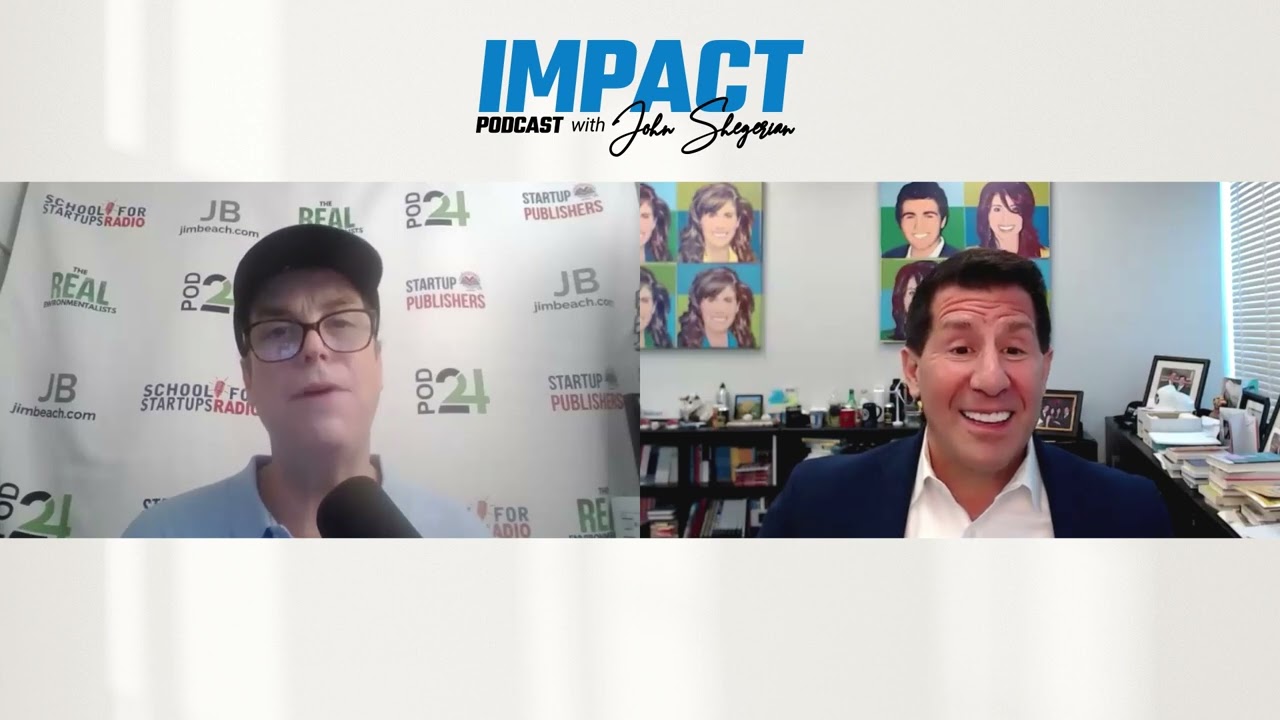

Jim Beach is a long time entrepreneur, award winning speaker, nationally syndicated radio host and McGraw-Hill author. In 2022, Jim met Wayne Elliott, the hero of Jim’s latest book “The Real Environmentalists.” Wayne’s story helped solidify something Jim had noticed: the environmental community argued lots and did little. Wayne risked his life every day, sweating and getting dirty to make the world a cleaner place. With the book, Jim hopes to push the environmental discussion in a new direction, centered on the heroes that are working every day to beat climate change.
John: Get the latest Impact Podcast right into your inbox each week. Subscribe by entering your email address at ImpactPodcast.com to make sure you never miss an interview. This edition of the Impact Podcast is brought to you by ERI. ERI has a mission to protect people, the planet, and your privacy, and is the largest fully integrated IT and electronics asset disposition provider and cybersecurity-focused hardware destruction company in the United States and maybe even the world. For more information on how ERI can help your business properly dispose of outdated electronic hardware devices, please visit ERIdirect.com. This episode of the Impact Podcast is brought to you by Closed Loop Partners. Closed Loop Partners is a leading circular economy investor in the United States with an extensive network of Fortune 500 corporate investors, family offices, institutional investors, industry experts, and Impact partners. Closed Loop’s platform spans the arc of capital from venture capital to private equity, bridging gaps and fostering synergies to scale the circular economy. To find Closed Loop Partners, please go to www.closedlooppartners.com.
John: Welcome to another edition of the Impact Podcast. I’m John Shegerian, and I’m so honored to have with me my longtime friend, Jim Beach. He’s the author of “The Real Environmentalists” book and the host of the “School for Startups Radio”. This is the book we’re going to be talking about today, but first we’re going to talk about Jim Beach. Welcome to the Impact Podcast, Jim.
Jim: John, thank you so much for having me. It’s an honor to see you today.
John: Yeah, it’s an honor to have you on. We’ve known each other quite some time, and I’m just thankful that you’re here with us today because this new book that you’ve written is really important stuff. Before we talk about “The Real Environmentalists”, and people could go to realenvironmentalists.com to check out more about this book and the content of it, Jim, talk a little bit about you. You’re on this fascinating Impact journey of influencing young entrepreneurs and actually budding entrepreneurs around the world. How’d you get on this great journey that you’re on, and then we’re going to talk about the book a little bit.
Jim: Well, I started off thinking that I was going to be the CEO of Coca-Cola, and that was my lifelong dream as an Atlantan. I have a picture of me drinking a Coke when I was four months old and holding onto the bottle with both hands, so I loved Coke. I worked for Coca-Cola in Japan and saved them a billion dollars over 10 years with one of my projects and came back to Atlanta, thinking that I would get a permanent job in Atlanta, and they invited me to leave. They had two big guys escort me out of the building all the way to my car and made sure that I actually left the premises. They told me that I don’t play well with others, and I should go be an entrepreneur, and I had never thought of that. I was entirely a corporate guy and was dreaming of Coca-Cola. At 23, my life was shattered, and I had no idea what I wanted to do. I had a long discussion with a father figure. He said, “I thought you always wanted to be an architect,” so I decided that he was right, and I should try to go to architecture school. My parents were not very supportive and they said, “You could do that, but you have to support yourself,” so I made a list of summertime businesses that I could run during the summer and then go to school during the winter, landscaping, pool cleaning, summer camps. I decided on summer camps. When I was 24, I started a summer camp at Stanford and MIT. We grew that in seven years to 89 locations, Stanford, MIT, Georgetown, UCLA, SMU, Emory, Sorbonne, Cambridge, Oxford, all over, and had a huge success, grew that to 700 employees and sold it at 31 and became a university professor with a small P, non-PhD professor, teaching entrepreneurship. One of my classes, I got into a little bit of an argument, “Oh, this is hard.” “No, it’s easy. Anyone could be an entrepreneur.” “It’s hard.” “No,” we were arguing, and so I made a bet that I could start a business that semester, repay all the startup capital that semester, and make it cash flow positive. The class got to choose the country and the industry that I would start the business in. This was right after 9/11, so they said I had to start a Pakistani furniture company. We actually succeeded. I won the bet, and you can go to my LinkedIn profile and scroll to the very bottom and see the chairs that we developed. We took kilim carpets, Persian rugs, 100-year-old rugs that we could buy for pennies in a local marketplace in Pakistan and turned them into high-end American furniture. A chair would cost $2,000. I made that same bet 12 semesters in a row and won the bet 12 semesters in a row, and an Atlanta newspaper reporter heard that story and said, “You know, that should be a book.” I said, “I’ll make you a bet. If you find a publisher, I’ll write the book.” Well, a week later, we had a deal with McGraw Hill. We sent one letter, one page, and one week later, we had a deal with the most prestigious company, McGraw Hill. That book sold very well, has 140 reviews on Amazon, and I started doing a lot of radio and podcasts to promote it. Eventually, I was offered a podcast on an internet broadcast channel and did that for a while, and eventually, that turned into a real radio station. Now, we’re up to 100 radio stations, five days a week, broadcasting anything about entrepreneurship that we can think of, creativity, funding, HR, how to get ideas, how to have an entrepreneurial divorce, how to raise entrepreneur kids, anything that we talk about, and you were on the show about two years ago and had a great conversation. I appreciate that. During the course of one of my interviews, I ran across an amazing guy named Wayne Elliott and was blown away by his career. He is the world’s largest ISO-certified ship recycler. He buys aircraft carriers and reduces them down to their individual small parts so that the entire thing can be recycled. He can recycle 99% of an aircraft carrier, except he couldn’t recycle the batteries. He spent 20 years and 20 million of his own dollars, figuring out how to recycle batteries, alkaline batteries. He invented that and just sold that business to BlackRock. They were able to get the recycling rate in Canada up to 97% for batteries. Here in the United States, we’re still at 0% battery recycling. In Canada, every store, every Home Depot, every grocery store has a big, orange box, and you drop your batteries in there and they recycle those. It’s a very successful, great thing for the environment. I said, “Wayne, I wanna write a book about you. You’re a fascinating guy. You deserve to be a little better known. Let me write a book.” As I started writing the book, John, I realized that he represented an entire class of people. There are hundreds of for-profit capitalist entrepreneurs out there that are starting businesses to do nothing but solve environmental problems. These are entrepreneurs that are obsessed with some facet of the environment, and they’re making incredible strides to solve the environmental problems. After I interviewed several of them and started writing the book, I don’t lose sleep about the climate change anymore. I’m no longer afraid of it. It’s still a huge issue, and I still believe that we need to combat it as aggressively as possible, but you tell me an environmental problem, and I’ll introduce you to the person solving that problem today, now, and they’re doing it without government help. They’re not out there fighting for funds from the government. They’re not trying to get grants and that kind of stuff. They’re out there, raising money in the traditional VC market or just bootstrapping the business and doing all of the for-profit things that we teach in entrepreneurship, finding a market, finding a niche, finding paying customers, all of the things that we talk about in generic entrepreneurship, they’re now doing to solve environmental problems. It’s a very upbeat, very happy book. I’m not afraid of the environment anymore. We still need to take care of it and we need to conserve it, but it’s not going to kill us.
John: That’s so good. What a journey. You just brought up such a fascinating and important point, Jim. Imagine, you’re covering in this great book, “The Real Environmentalists”, the Wayne Elliott. I never even heard of Wayne Elliott until this book, until you brought him up, and until you sent me this book as a pre-read before this show. To me, I love that you’re covering all these environmental heroes that, see, they’ve never been on CNBC, CNN, Bloomberg, Wall Street Journal, NYT, so It’s so great that someone like you gets to champion them because we need more of them. We just need more of them. I love the story. You’re still doing your podcast and then radio show, focusing on entrepreneurs who solve problems and really make the world a better place from a capitalist standpoint.
Jim: Exactly, yes. We’re still doing the radio show five days a week. We actually have two versions of it, so we’re out there in a short version and a long version, interviewing amazing entrepreneurs. You’re right, we did discover some other great environmental entrepreneurs along the way. As a matter of fact, we have an appendix in the book that lists 216 other American for-profit environmental companies. We show you what they’re doing, what their cause is about, and so I’m quite literal when I say, “You tell me an environmental problem, and I will introduce you to the person solving that problem.” It’s in this chapter, it’s in the appendix of the book, so I’ve already researched it. It’s incredibly encouraging that there’s hundreds of American companies out there, following this same model and making the environment better, all parts of it. Another great entrepreneur in the book is a guy named Gator. That’s his real name, Gator Halpern. He figured out how to grow coral 50 times faster than God can grow it. He can go into a coral reef and replace the reef overnight, can go to a resort and give them a reef overnight, and the idea that the Great Barrier Reef is going to disappear. I’ve actually been diving on the Great Barrier Reef, and I know not to touch it and everyone else does now, too, but there has been damage, but people like Gator can solve the problem. Another name that none of us have ever heard of, an incredible solution, he’s down there in the Bahamas, growing coral in big tanks all around his facility, ready for the next installation, so it’s an incredibly exciting story.
John: Go back to Wayne Elliott. Again, many of the stories you cover in the book were so called historically known as “dirty industries”, obviously, shipbuilding and ship deconstruction, “dirty industry”. How did Wayne Elliott make recycling a responsible recycling process using ISO and other guidelines? How did he do it where nobody else could?
Jim: Well, ship breaking is an incredibly concerning industry. There are no international rules, regulations, anything about what happens to a ship at the end of its life. Many of them are just sunk in the middle of the night and just disappear. Well, that’s thousands of gallons of leftover oil and grease and asbestos and paint sunk to the bottom of the ocean. I’m more concerned about that than an island, disappearing underwater overnight or gradually. I’m more concerned that we have thousands of ships that are just left to rot all over the world. Wayne saw this problem and started doing it with the highest level of quality from the beginning. He also built dry docks so that they can pull the entire ship and get it out of the water so that it doesn’t leak into the water that way, and he decided to spend the money to get ISO-certified. There was no incentive for him to do it. He just did it of his own accord because that’s the kind of guy he is. He’s 72 now, he comes from that great generation where hard work is the number 1 value that you can have. He started working in a shipyard when he was 14 years old. He was acetylene torch-certified at 14 in the bowels of a ship, cutting it up with an acetylene torch. He remembers the river when it was so dirty, you couldn’t swim in it. The joke was, of course, that you could walk across the river, standing on the pollution. He remembers when the factories there in the Great Lakes area would release all of their toxins, and they would just stand there and watch it pour into the lake. He was disgusted by it, and so he’s lived his entire life devoted to an entrepreneurship that’s going to solve environmental problems, even when he’s not required to, not incentivized, and there’s nothing causing him to do it except his own good character.
John: Wow. When did he start on his journey to recycle lithium ion batteries?
Jim: About 25 years ago, and it took him 20 years to get the process perfected. It was very dangerous. That kind of stuff can burn through a concrete floor and leave a 4-foot hole in the bottom. How do you deal with thousands of those in a responsible way? You have to figure out what to do with the elements that come out of the battery, all the chemicals and stuff. He spent $20 million figuring out how to do this. All of his family told him that he was crazy and wasting money, but he persevered and was able to have a solution about five years ago and was able to sell the company pretty quickly to BlackRock, and you don’t get any more prestigious than that. They saw the value in it. They see the value in taking this worldwide and forcing other governments to mandate it, as well. A bunch of legislators from California were just up visiting him a couple of months ago. They’re at 0.1% in California battery recycling, and he’s working with them now to help bring that to California, as well. Hopefully, here in the United States, will have some sort of mandate. I don’t like government mandates, but if there’s a mandate for us to be cleaner and it’s going to save the environment, I will support that.
John: Does Wayne still deconstruct and recycle ships still? Is he still on that business?
Jim: He’s still there. One of his sons is running the business right now, and they’re growing about 40% a year right now.
John: Oh, my gosh, that’s awesome. [crosstalk]
Jim: There’s thousands of ships to recycle.
John: Of course. It makes so much sense. Like you said, what a great thing to have someone like him doing it responsibly instead of like you said, these things just disappearing in the middle of the night, polluting our oceans on an ever ongoing basis, emitting all the toxicities that come out of all the things you mentioned, the oil, the gas, the asbestos, and everything else nonsensical that shouldn’t be at the bottom of an ocean.
You mentioned Gator Halpern. Talk about some of your other favorites that are in this wonderful book, “The Real Environmentalists”.
Jim: Well, let me tell you about Stephen Mayfield[?] from UCSD San Diego. He is an academic, and one of the things we argue in the book is that the academics need to stop worrying about who caused the problem and start worrying about cleaning up the problem. Stephen was working on a project and a company asked, called out of the blue and said if he could help with a project of theirs. He had never thought about working as an entrepreneur or a businessman, but he actually made a lot of money doing that. He’s now on his third environmental business. What he’s doing right now is taking the backbone of chemicals. I don’t understand this, I’m not a chemist, but apparently, all chemicals are held together with some sort of a backbone, and the cosmetics that we use today, the medicines that we use, the paint, the petroleum, the plastics are all made out of chemicals that have a petroleum spine that holds the chemicals together. He’s figured out how to replace the petroleum spine with a spine made out of algae, which is 100% biodegradable. It doesn’t create the microplastics that are accumulating in our brains and our blood systems, and there’s that huge plastic bubble or blob floating around in the Pacific Ocean of plastic that’s so big, it’s the size of Texas. There’s a blob in the Pacific Ocean the size of Texas. He’s figured out how to eliminate petroleum from our products. Everything is made with petroleum. Everything is the basis of cosmetics, medicines, again, everything, paint, and he’s figured out how to do that with algae. He is an algae professor. His specialty was algae. Here’s the real kicker, John. After he was doing this, the dean came up to him and berated him for doing so much for profit work. The dean said, “What are you doing? You’re wasting your time. All we want you to do is publish and perish.” John, here he is, Stephen making tens and tens of millions of dollars with his entrepreneurship and saving the world, and his dean, the boss, is yelling at him. That’s the hypocrisy that we have to beat out of the system.
John: That is just incredible. Talk a little bit about School for Startups. How many people do you think you’ve interviewed over the years, just rough number, just a macro number?
Jim: 13 years times five days a week times two guests per show, I think about 6,000 or so, somewhere around in there.
John: We have a lot of young, budding, or even just other types of folks from all different age ranges that are aspiring entrepreneurs. What are the three greatest truths, two or three of the greatest truths you’ve learned for entrepreneurs to understand before they embark on their entrepreneurial journey that you could share with our audience?
Jim: Well, there are three great ones. I’ll start off with creativity. Creativity is perceived, the media tells us, that it’s an integral part of being an entrepreneur. 93%, John. 93% of businesses are copies of other existing businesses. McDonald’s, Burger King, Chrysler[?], Hardee’s, everyone makes a hamburger. There’s nothing special about that. But if I open a new hamburger restaurant, I am an entrepreneur, even if I copied my recipe from someone else. I don’t believe that creativity is a defining feature of an entrepreneur. I think that copying, borrowing, and stealing without morally stealing someone’s copyright, trademarks, or patents, that’s what an entrepreneur does. They see a great idea and they say, “I could do that better than that other company.” The computer camp that I started in my 20s, we were at Stanford and MIT, like I said, our competitor was at Klar Crest Resort in Connecticut. Do you remember the movie, “Dirty Dancing”?
John: Yeah, of course.
Jim: Imagine that place aged 30 years, then put a computer camp in the middle of it, versus my camp at Stanford.
John, where do you want your grandkids to go, to Stanford, MIT, or to the Klar Crest Resort in Connecticut? It is beautiful.
John: They’re going to Stanford, Jim. They’re going to be in your camp.
Jim: I copied my idea, 100% copied it. We just did it better than them. Number 2, risk. I do not believe in risk. I started that business for under $1,000. I’ve interviewed people who have started any business that you can think of, restaurants, production companies, anything for under $5,000. You can test any idea for under $5,000. This idea, “I’m going to double mortgage the house and all of that,” I think that’s just crazy. That’s bringing risk upon yourself that you don’t need. I’m 100% opposed to risk. I think serial entrepreneurs are the people that find out how to reduce the risk, pre-sell the item, start up with zero money, whatever, so that there’s zero risk in their startup. If you’re over $5,000, I don’t know that I can help you, you’ve already wasted a bunch of money. Stop. My least favorite thing on earth is when I meet a young entrepreneur who’s excited about starting a business. They don’t know what the business is yet, John, but they already have office space, a secretary, and a shirt with their logo on it. What the hell? They don’t have revenue yet. How can you have office space if you don’t have revenue? That’s $5,000 out of your pocket a month, and a secretary? That’s just ridiculous. Risk is something that I’m trying to eliminate. I don’t like risk. I’m not a bungee jumper. I’m not a helicopter pilot. I don’t want risk in my life, and I just try to avoid it at all costs. Number 3, passion. Entrepreneurs do not need to be passionate about the business. They just need to like it more than the job they have now. Again, the media has convinced us that you have to be passionate about your business. I have sold purses, I have sold jackets, I have sold furniture, I have sold lots of stuff that I would never use in my own house or where, but it’s still sold. Other people liked it. I was not passionate about it. If you are passionate about your business, that’s icing on the cake. You’re just doubly lucky. Not only do you not work for the man, but you’re also passionate about it, and that’s a double win. I didn’t develop my passion for my computer business until I had moms writing letters, saying, “My daughter hadn’t laughed in two years, and now she comes home and has a best friend, and she’s as happy as could be.” Now, I’m passionate about that business, but I wasn’t before I started getting letters like that before we realized that we were saving children’s lives and making unhappy children happy for the first time. That became our value proposition, and that’s what we told mom when she called, “Mom, is your kid happy?”, and she would very slowly, sheepishly say, “No. No, they’re not happy,” and then we would say, “Well, our environment is designed to make them happy.” I’m very passionate about that. I’m also passionate about this message and the environmentalist that I’m talking about, but John, I really like you, but I’d rather be at Disney with you and your kids and your grandkids. I’d rather be sailing across the ocean. I’d rather be going down the Colorado River. I love what I do, but it’s not the most important thing in my life.
John: That’s so great.
Jim: Those are the three myths of entrepreneurship. When you combine those, it’s a wholly different model. You’re copying someone else, you have a roadmap in front of you, you know you’re not going to spend money unless you absolutely have to, and you’re going to realize that you can be passionate about your hobby, and that’s good enough. I love woodworking, I’m a woodworker, but I’m really bad at it, so there’s no way I could make a living doing it, but the more money I make, every time I make more money, that’s another week at woodworking school in Maine.
John: Right. That’s awesome. For our listeners and viewers who’ve just joined us, we’ve got Jim Beach with us. He’s the author of “The Real Environmentalists” book. This is the book right here. He’s also the host for the “School for Startups Radio”. You can find Jim at realenvironmentalists.com and “School for Startups Radio”, which we’re going to put, you don’t have to pull your car over or stop doing what you’re doing in the gym or walking your dog, we’re going to put the links both to this wonderful book, and of course, to his “School for Startups Radio”, all in the show notes. It’ll all be there. Of course, you can also find this book on amazon.com, barnesandnoble.com, and all great bookstores wherever you live.
Jim, taking your “School for Startups” and now this wonderful book, what do you want to do next? What’s the next thing? You’re still young, you still got tons of energy, you’re still at it. The world has changed since we were little kids. You look at Warren Buffett, still, arguably the number 1 investor in the world at 93 or 94 years old, and now the richest guy in the world, Larry Ellison, 81 years old. He looks amazing, and he’s got tons of energy, and he’s continually evolved his wonderful brand to now becoming one of the wealthiest, if not the wealthiest guy in the world. This is an ongoing theme. It’s no longer 62 and go “peace out”. What are you going to do?
Jim: I actually have a bookshelf right next to me here on my left, and on that bookshelf, I have my business card. On this particular business card are my goals for the year. This is where I write them down every year, and I give my wife a copy so she can hold me accountable. Right here, it says my goals for the year. I want to double the number of radio stations that I’m on. I’m writing book number 6 and 7 right now. The environmentalists was book number 5. I’m writing a book on the deep state right now, a fiction, the little play thing that it’s just a fun idea, will be book number 6, and I’m writing book number 7 about personality right now, as well. Once you’ve published one book, you realize that it’s easy and you can do it. I’ve got five out now, three that I self-published after switching out of McGraw Hill, and you realize there’s a lot of things that you can write about. Once you’ve done it once, you keep getting new ideas much easier. I have a lot of books that I want to write, I have my primary business I want to grow, and I’m still looking for another idea for myself. I’d love to run another big business myself. I have a couple of ideas that I’m pursuing, sort of, on the side, but I want one more business myself and then to grow my radio show and have some more fun books out there.
John: You’re a great example of, again, lessons of entrepreneurship. Look at you, dreamed of being the CEO of Coca-Cola, which is awesome at such a young age. You’d be dreaming that big to work for Coca-Cola. Obviously, you go to Japan and you help them save a billion dollars over 10 years, and then, which is part of the corporate world, after all these good deeds and all your success, they release you when you come back. You didn’t fall on the campus. All of us eventually end up on the campus and then just cry for yourself. You demonstrated flexibility and resilience and got up off the campus, and look at you now. Look at the success that you’ve created. It wasn’t the original dream. Sticking to the original dream is really the wrong way to be a great entrepreneur. To stay flexible and to stay resilient, it’s just two other qualities I see that great entrepreneurs just keep punching away, and they keep getting up and moving forward.
Jim: I’m an incredible introvert, John, and now, for a living I do radio and public speaking as an introvert. One of the things that I love about entrepreneurship is that it forces you to use all of your talents that God gave you to expand those talents. If he gave you a small kernel of the ability to speak in public, that you then nurture it and work on it, so that you can get good at it, regardless of what your personality is. I interviewed a guy two or three months ago who said that introverts make the best salespeople, which is a really crazy idea, kind of convoluted, because they listen better, and the essence of sales is good listening. He’s trying to promote more introverts to become salespeople. Being an entrepreneur is so much fun. It’s so exciting, but it’s also so good for you as a person. When you have bad things that happen, you have to learn to just let the water wash off your back. I’m really good at dating because I’m really good at having people say no to me. I’ve been told no by so many girls that when a business says no to me, it’s not a big deal. The next one will say yes, and so we have to learn to battle through bad times. The COVID period was horrible for our family. I lost both of my parents. I had a little legal trouble that we all entrepreneurs end up every once in a while. That’s gone now, thank God, but it’s hard to be an entrepreneur, but it’s worth it. It really is worth it. Go copy someone’s idea and spend a little bit of money to get it up and running and go have some fun. Make the world better.
John: So funny you said that. I was listening to Mark Cuban the other day talk about entrepreneurship, and he was and he didn’t paraphrase or quoted directly Steve Jobs, and Steve Jobs is quoted that he actually said, “Everything’s a remix, man. Everything is a remix. There’s really nothing new.” That’s what you said is so gosh darn true and is really great. Any other stories you want to share from this great book before I let you go today? Is there any other great, wonderful highlights you want people to… what do you want them to… read the book. This is a quick read, by the way. I read this in one evening. Our listeners and viewers could read this in one evening or a couple afternoons. What do you want them to take away after they read this wonderful book, “The Real Environmentalists”?
Jim: I want them to become part of the solution where they tell their government, “No, we don’t need the government involved in this.” I want them to go out and encourage entrepreneurs to start a business. I want them to invest in entrepreneurial ideas that they hear about, environmental ideas, particularly, and I want people… you see people on YouTube and stuff, John, who say, “I’m not going to have children because of the environmental crisis.” That’s just the dumbest thing I’ve ever heard. I have four children. They’re the greatest part of my life. Don’t let something worry you so much that you skip out on the best parts of life. Go have children. The world is not going to end. We are not going to dive the environmental crisis in our lifetimes. As a matter of fact, in our lifetime, the world has become infinitely cleaner than when I was born. In the 60s, the rivers, the air was much dirtier. We’re actually getting cleaner, John. The world is getting cleaner, and that’s what wealth allows us to do. The more money we make, the cleaner that we can get. Why is Western Europe so clean? It’s because they’ve had a lot of time and a lot of money to clean it up. Who is the people that produce the emissions and the fires? Unfortunately, the people who don’t have as much money, they’re where some of the environmental problems stop. We need to help those people have the money so that they don’t need to burn their excrement or animal excrement to have a fire at night. We need to have water in all of India. Lots of China still needs electricity. When we bring water and electricity to a place, they’re going to get cleaner. The number 1 thing we can do, grow the economy without the government getting in the way, and let us, entrepreneurs, go solve the problems.
John: I love it. Jim, what I’ve realized over the years with you is the world just needs more Jim Beaches. That’s what we need.
Jim: Oh, that’s too kind. Thank you so much.
John: Well, it’s true. I love what you’re doing with the “School for Startups Radio”. I think it’s one of the most important type of platforms we need because the world does need more entrepreneurs. We do need more solution makers. To get further inspired, please read this great new book. It’s a fast read, but it’s an impactful read, “The Real Environmentalists”.
Jim Beach, I not only thank you for the generosity of your time today to share this wonderful new book with our listeners and viewers, but thank you for all the work you do, and thank you for making the world a better place.
Jim: John, you’re too kind. Thank you for saying all that. It makes me feel good.
John: This edition of the Impact Podcast is brought to you by Engage. Engage is a digital booking platform revolutionizing the talent booking industry. With thousands of athletes, celebrities, entrepreneurs, and business leaders, Engage is the go-to spot for booking talent, for speeches, custom experiences, live streams, and much more. For more information on Engage or to book talent today, visit letsengage.com. This edition of the Impact Podcast is brought to you by ERI. ERI has a mission to protect people, the planet, and your privacy, and is the largest fully integrated IT and electronics asset disposition provider and cybersecurity-focused hardware destruction company in the United States and maybe even the world. For more information on how ERI can help your business properly dispose of outdated electronic hardware devices, please visit ERIdirect.com.
 Spotify
 Apple Podcasts
 Amazon Music
 iHeartRadio
 YouTube
 YouTube Music
 Audible
 Pandora