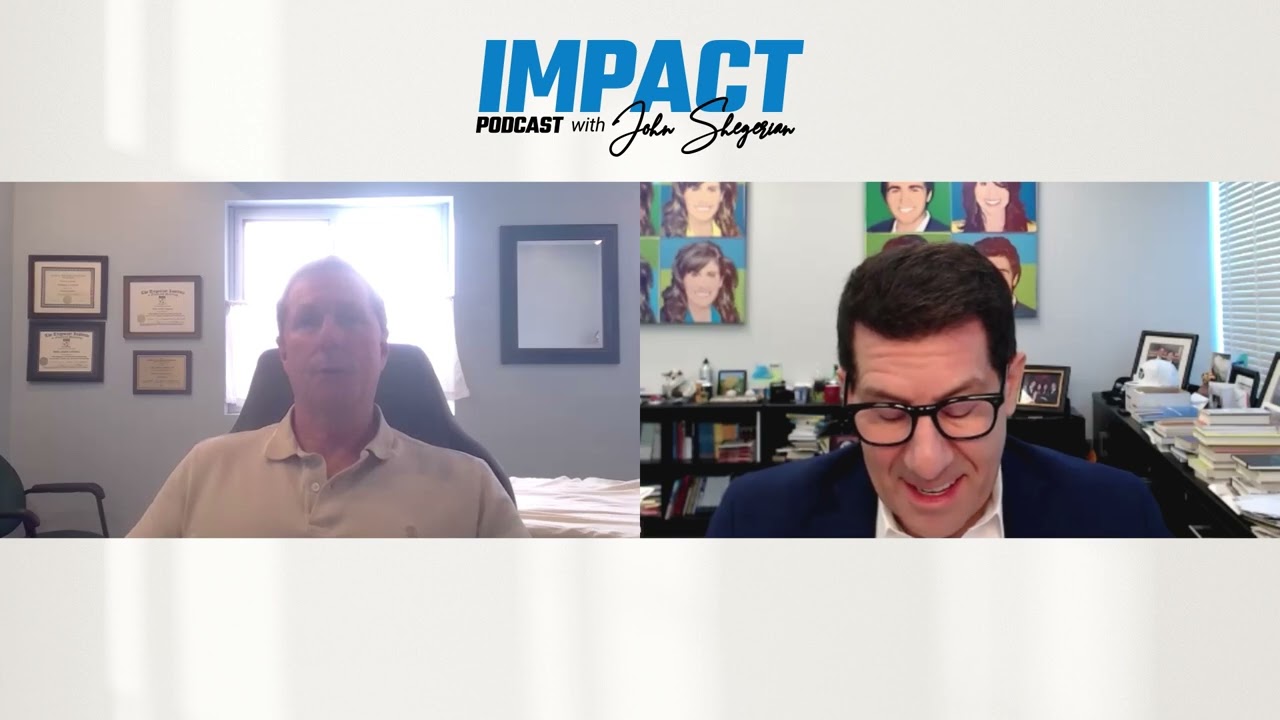
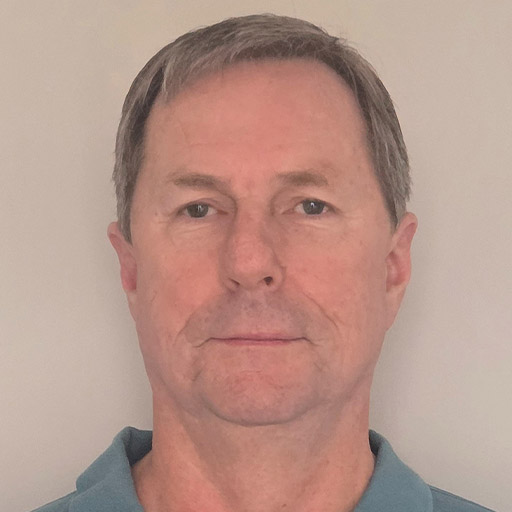
Glenn Cameron, the Founder and President of Innovative Therapy, a chronic pain therapy treatment clinic, is blind and possesses a heightened sense of touch, developed over many years reading braille. This extraordinary sensory capability enables Glenn to feel vital clues ultimately used to identify the root causes of most chronic pain conditions with extreme precision. It also offers an invaluable asset in delivering effective treatments, selecting from a complete collection of the world’s best technologies to solve the causes he detects. Glenn’s training and knowledge of neurology and its highly specialized sub-specialty, functional neurology, and key diagnostic skills allow him to both diagnose and resolve often misunderstood and mistreated neurological pain conditions.
John Shegerian: Do you have a suggestion for a rockstar Impact Podcast guest? Go to impactpodcast.com and just click be a guest to recommend someone today. This edition of The Impact Podcast is brought to you by ERI. ERI has a mission to protect people, the planet, and your privacy, and is the largest fully integrated IT and electronics asset disposition provider and cybersecurity-focused hardware destruction company in the United States and maybe even the world. For more information on how ERI can help your business properly dispose of outdated electronic hardware devices, please visit eridirect.com. This episode of The Impact Podcast is brought to you by Closed Loop Partners. Closed Loop Partners is a leading circular economy investor in the United States with an extensive network of Fortune 500 corporate investors, family offices, institutional investors, industry experts, and impact partners. Closed Loop’s platform spans the arc of capital from venture capital to private equity, bridging gaps and fostering synergies to scale the circular economy. To find Closed Loop Partners, please go to www.closedlooppartners.com.
John: Welcome to another edition of The Impact Podcast. This is a very special edition because we’ve got today with us Glenn Cameron. He’s not only a good friend of mine, but he’s also a professional who’s worked on me so I can attest to all his amazing work. Welcome to Impact, Glenn. Great to have you today.
Glenn Cameron: Thanks, John. Good to see you again.
John: Glenn’s the founder and CEO of Innovative Therapy Canada, and you can find Glenn at innovativetherapycanada.com. But you don’t have to stop driving your car, walking your dog or working out with your weights, this will all be in the show notes, so you don’t have to write anything down here. Just listen and enjoy this podcast today. Glenn, before we get talking about all the important and great and very successful work you’re doing at Innovative Therapy Canada, can you please share a little bit about your story? You have an amazing, inspirational background that I really want our listeners to hear about. Where were you born and where did you grow up? Let’s just start there.
Glenn: I was born here in Eastern Ontario, in Cornwall, which is on the Canada-US border, just near Quebec. I just grew up in rural countryside, nice lifestyle here. Back when winter was winter and summer was summer, very different these days though. We barely get snow in the winter now here in Canada. Imagine that.
John: That’s so crazy. We knew it.
Glenn: Our summers are hotter than ever now. And we just come off a four-month drought this past summer that we’ve never had in history here. So, things are changing.
John: You and I are about the same age. We’ve talked about it. When you were a kid though, you told me stories about walking in the snow. How much snow did you get when you were a little boy growing up in Eastern Canada?
Glenn: We would get snowstorms every week and we would pile snowbanks on the side of the road that could be in some years anywhere between say 6 and 10 ft high. The snow plows would have to wing the banks back to make room for more snow. I lived on a snowmobile before I got my driver’s license. I dated girls on my snowmobile. It was great. The farm field here had fences 4 ft high. We would see these open fields, couldn’t see the fence line, buried with snow, get on the snowmobile and just drive for miles.
John: Wow.
Glenn: Having a great childhood.
John: So, let’s talk about now though, we’re talking about maybe 60 years later. Right now, is there even an opportunity for your grandchildren to use a snowmobile this winter?
Glenn: No. Both my boys have snowmobiles, and they have not been able to run them locally for at least five years now.
John: Wow.
Glenn: I don’t know if you’re aware of it. Ottawa has a canal that was hand dug in the 1800s as a shortcut between two rivers. The canal runs right through the heart of the city of Ottawa. The canal is 7.8 km long, just under 5 miles, and it freezes, and they groom it in the wintertime for the public to skate on. Two years ago, the canal didn’t even freeze. Imagine sitting still, water not flowing, in downtown Ottawa, in the middle of a Canadian winter, and the water stayed water all winter long.
John: Wow.
Glenn: That is unheard of.
John: Right.
Glenn: Now this year we’ve had a colder than normal December. The canal is now iced over. The full length is open. Everybody’s skating. This is the earliest it’s open now since 2017. And hopefully we’re going to have a good year coming up this winter.
John: That’s so interesting.
Glenn: Yes.
John: Climate change is real. Let’s just say that, Glenn?
Glenn: It’s here.
John: It’s here.
Glenn: And we have to adapt.
John: Right.
Glenn: Everybody’s got to adapt to the changing world.
John: Right. It’s true.
Glenn: But humans always had since the beginning of time.
John: Great point. That’s a great point.
Glenn: The great pyramids of Giza, they were built at a time when the area had a flowing river, tropical rainforest, and access to all kinds of huge old growth trees. Now the pyramids sit in the middle of nowhere.
John: Great point. I didn’t think of that.
Glenn: It’s changed that much.
John: It’s changed that much.
Glenn: So, we have to keep adapting. The planet will always change and maybe it always has.
John: Interesting.
Glenn: So that’s the challenges for humans today.
John: So, you grew up in Cornwall, right? Nice childhood, fun childhood. And you graduated high school. What happened after high school? What direction did you go and what was the path you decided to take after high school?
Glenn: Well, I took architecture and I worked in it for two years drawing, building plans and I hated it. It was boring. So, then I went into electronics.
John: Okay.
Glenn: I had the itch to fix things.
John: Got it.
Glenn: So, I started fixing TVs and VCRs back in the day. I look back now and think of some of the stupidness I did as a young technician. What I learned then really, really rings home to me as a therapist today. And then I’ll give you a funny story.
John: Okay.
Glenn: The very first time I get educated, my very first TV that comes in to me to fix, the TV won’t turn on. So, I’m thinking, “Okay, I’m this hot shot fix-it guy, I’m going to fix this TV.” I opened the back panel, the fuse is blown. So, I changed the fuse, put a new fuse in, turned the TV on, expecting me to have fixed the TV. The new fuse I put in blew. And I thought, “Okay, the fuse was no good.” I grabbed another fuse and put it in, and it blew. And it’s like, “Okay, look, you dumbass.” The fuse blew for a reason.
John: Right.
Glenn: Why did the fuse keep blowing? Because there was a short circuit somewhere in the TV. So, at that point I had to start developing my thinking head, “Let’s go figure out why the fuse is blowing.”
John: Got it.
Glenn: So, once I realized that, then every time the TV come in with a blown fuse, I’m not just changing the fuse. I’m looking to see why it blew, right? And that went on with all my electronic service days. I was always asking why. Why did this circuit fail? Why did the video tape jam when you go to put it in to play a movie? In later years, why did the DVD, you press play, the DVD started spinning? Why did the video and picture not come up? Obviously, there was problems that we had to investigate to figure out why.
John: So, you already had the curiosity for figuring out the root cause of issues, not just fixing what was presenting itself?
Glenn: Yes. I had no choice. I mean, I got a product in front of me that needs to get fixed.
John: Right.
Glenn: If I’m going to call myself a repairman, I better be able to repair it, right?
John: Right.
Glenn: So, I learned, and it was a long learning process because I realized I needed more knowledge of electronics, of components, of the combinations in circuitry, how one affects the other that affects the other, the domino effect that can take down a whole system. But the biggest thing that I learned that I carry into my therapy days today is that there are protection circuitry in electronics. So, anything that’s mechanical is monitored with receptors and the electronics and the microprocessor and they’re monitoring the movement of electrical parts. So, look at your cars today. When you get a check engine light, there’s a sensor somewhere telling the computer, “We might have a problem here. Maybe we should get it looked after.” If your oil pressure drops for some reason because you don’t have enough oil pressure, your engine is going to turn off to save your car from blowing your engine. If you go back to electronics to the VCR days, if the tape that was being spooled through the VCR was under too much current load, there was something wrong with the bearing or something like that, the VCR would turn off to protect you from ripping your tape. So, it was a safety mechanism. And once you realize that when a product doesn’t turn on, you can’t just assume there’s no power getting to it. You have to look at the bigger picture and say, “Okay, it’s not turning on because it doesn’t want to. The microprocessor says there’s a problem somewhere. Let’s go find the problem.” Okay?
John: Right.
Glenn: So before jumping into medicine too quickly here, it’s a good analogy when I see someone with a frozen shoulder. The shoulder freezes up for a reason. So, you can’t just tell the person to stretch and get that shoulder loose again because our microprocessor is our brain and our brain is getting information to tell us there’s a problem and the brain is not going to let that shoulder move until we fix the problem.
John: Because the brain is trying to keep the body safe from ourselves. Got it.
Glenn: Yes.
John: Understood,
Glenn: It’s the ancient part of our brain that has nothing to do with modern cognitive general knowledge or anything like that. The ancient part of our brain has to keep us alive as a species, all species. So, we have these safety mechanisms built into our nervous system. And we will talk about them more as we get in depth, but this is the correlation that I brought to therapy from my TV days, VCR days, same thing.
John: How many years were you doing that work?
Glenn: 10 years.
John: Talk a little bit about what happened. You were born with a genetic-
Glenn: I was born with retinitis pigmentosa. It’s a genetic eye disorder that will eventually damage and kill the cells on the retina of the eye, which is the back of the eyeball. So, light comes into my eye through the lens at the front. It hits the retina at the back, but that’s where the problem is. The receptor cells at the back that have to get activated by the light coming in, they’re not working properly. So, the brain doesn’t get a full image of what’s coming into the front in the eye. So, I developed dead spots in my vision.
John: What age were you diagnosed with that?
Glenn: I had trouble getting my driver’s license at 16 because I failed the colorblind test. So, in those days, I didn’t understand what colorblind really meant.
John: Right.
Glenn: I failed the colorblind test, and they said, “No, you failed your medical. You have to go and see an optometrist.” So, I went to an optometrist, and they looked into my eyes and in 1975, they didn’t know what RP was, my eye condition. They didn’t know what it was. It was new.
John: Got it.
Glenn: So, the optometrist looked at my eyes and seen a problem in the retina and said, “No, it’s okay. He can drive.” So, I got my license and then I drove.
John: Okay.
Glenn: In the years after that, when I was 18 or 19, I started flying lessons. And I got my pilot’s license when I was 19. I wanted to be an airline pilot.
John: Understood.
Glenn: But back in those days, it was hard to be a pilot. There were all kinds of people to choose from. So, I got my license and I just flew around casually around building some hours and whatnot, fixing TVs and whatever. Then I went for a commercial flight medical to get ready to start my commercial training for a pilot. And that’s when I failed the commercial medical. They said, “No, you’re colorblind and there’s something else wrong.” And I said, “There’s no way I’m colorblind.” I said, “This is green, this is red. I can see that.” They said, “No, you’re colorblind.” So that’s when I went to Ottawa to get completely diagnosed, all the assessment tests and whatnot. And they confirmed at that time that I had the retinitis pigmentosa. So that was the end of my flying days.
John: End of flying days but you were still doing the electronic repair. How long from that period where the first dream had to be put to the side, which was being a commercial pilot, to now working just as a normal, good person of society, fixing these electronics, how many years did you have knowledge that that was also at some point going to sunset?
Glenn: I worked fixing TVs for five more years.
John: Wow.
Glenn: And then the vision got bad enough I couldn’t see schematic diagrams to fix the electronics. During that time period, if you remember at our age, when Commodore came out with their VIC-20, what a time that was.
John: Right.
Glenn: I was taken into Toronto to fix Commodore computers. Then the Commodore 64 come out.
John: That’s right.
Glenn: I was fixing them. Then the 128 come out. And that was it. By then my vision was bad enough I had to retire from work. And I went on the disability pension then for a number of years.
John: Glenn, let’s be honest, a lot of people don’t come back from that kind of setback. How during those years did you figure out and what made you want to reinvent yourself to what you’ve become today, which is we’re going to get into in a little while, which is a massively successful, as I call you, healer. How did you figure that during that very, I’m sure, emotional and tender period of your life with, I believe, you had a wife already and probably at least one son already?
Glenn: I have two boys, yes.
John: So, now you have family to feed, you’re in the prime of your life, early 30s. How did you figure out a new path forward?
Glenn: There were two factors involved, John. My brain developed in such a way I didn’t plan for it to do this. When I was a teenager and I’m playing pickup baseball with my friends. You get a group of guys together after school or after supper at night in the summertime. You pick teams, you get two team leaders. Everybody picks players to be on your team. And then you just have a game with a baseball between all our friends. I was always the last kid chosen for the team because I could never hit that baseball. I would swing to send that ball to the next county, and I’d always miss it or just nick it and foul it. I could never hit the ball. So, I was not chosen to be a top player ever during those years.
John: Right.
Glenn: And I remember when I was 12 years old, I played hockey for the first year at 12. This was before baseball. I’m going back a bit. I was horrible playing hockey too. So, the one day the coach was picking up any hockey players who couldn’t get a ride to the game, and we had all our equipment on in those days, except for our skates. Anyhow, I’m in the car. We’re going along picking up players. We could put five or six in a car in those days. The cars were a little bigger than they are today. We see the best player on the team, John, standing out that needs a ride to hockey, the best player. I was the worst. So, the coach looks at me and says, “Do you mind going home so we can take the best player to hockey today?” So, I thought, “Okay.” So, I walked back in the house and my mother says, “What are you doing home?” I said, “There was no room for me in the car.” I never played hockey again.
John: Wow.
Glenn: So, between that and my baseball days, I still got to play, but it was horrible, right?
John: Right.
Glenn: So, I didn’t know at the time what that was doing to my brain. But I realized years later, I was slowly developing the f you attitude in my brain. So, I could have either went down in sort of depression, didn’t want to do anything. Or I’d go the other way and say, “F you, I’m going to do whatever I want.”
John: Right.
Glenn: And that’s where I ended up going. So, the day that I was diagnosed with my eye condition, I’m sitting across from the specialist in Ottawa, and he looks at me, he says, “The tests are complete, you have retinitis pigmentosa, you’re going to be blind.” I remember this very clearly. He says, “Go home and get your affairs in order. You’re going to be blind.” He turns to my wife of three years and says, “You may want to rethink marrying this guy.”
John: Oh, my gosh.
Glenn: So, she is crying.
John: This was before they really coach these doctors on any bedside manner. Oh, my gosh. I mean, this is…
Glenn: Yes. But we’re talking the early 80s.
John: I know.
Glenn: He’s a specialist.
John: You’re right. I’m giving them a pass with you, but wow. That’s a traumatic day in anybody’s life. Like to say that.
Glenn: The nice thing is I’m sitting there with a smile on my face. He says, “Didn’t you hear what I told you? You’re going blind.” I said, “No, you don’t understand.” I said, “I suck playing hockey. I suck trying to play baseball. When I would play football, I couldn’t catch that God forsaken ball when I was a halfback unless it was bounced right into my gut.” I said that “When I drove my car at night and I hit the curb, I wasn’t a bad driver. I wasn’t a bad athlete. I couldn’t see.” I said, “That answers everything.”
John: Right.
Glenn: And I’m smiling thinking there’s my answer.
John: Right.
Glenn: Well, he didn’t like that.
John: Oh, boy.
Glenn: So anyhow, we dusted things off. I drove home and I stopped driving the car two years later. And that’s the attitude that changed me for life.
John: How did you choose? Well, let me just read this about innovative therapy. And again, by the way, for our listeners and viewers who’ve just tuned in, we’ve got Glenn Cameron with us today. He’s a good friend of mine. He’s also a professional who’s worked on me so I can attest to his great healing skills. But we’re not doctors and we’re not offering you medical advice. If you want to choose to use Glenn or anybody in this sector, please consult with your personal physician first. Glenn’s the founder and CEO of Innovative Therapy Canada. You can find Glenn and his great clinic at innovativetherapycanada.com. I’m going to read a little bit about what Glenn does, and then we’re going to start unpacking this journey here. Innovative Therapy Canada is an established chronic pain therapy treatment clinic offering very unique and proven custom therapies that effectively treat both painful and disabling conditions that often do not respond to conventional therapy. And by the way, that was me, ladies and gentlemen. ITC offers an innovative non-surgical and non-invasive approach to various pain and other disabling conditions. And this has to do with people who come in to see Glenn from around the world, who have had surgery that have gone wrong, accidents, fractures, all sorts of things that happened to us in our course of life. So, Glenn, you’ve created this healing therapy center that I’ve been to on numerous occasions with huge success in things that doctors have told me were incurable or not going to be able to be fixed and they’d be chronic pain that would be potentially debilitating the rest of my life. How did you come up now? Now you’re blind and you figured out part of your youth, which is like you said, a very liberating experience as to why you sucked at some of these sports where other kids were good. But now you had to turn to the future. You figured out the past a little bit with this diagnosis. But figuring out what to do with this setback and how to use this setback, as my good friend, Jake Olson, says, as a setup for even a bigger future and one that even has more impact than fixing VCRs and televisions, you’re fixing people, you’re healing people who have been given up by traditional medicine sources. How did you choose this journey specifically? And talk a little bit about the process of training yourself. Both professional training but also the inner training that you did to get to where you are today.
Glenn: Well, I got tired sitting at home. I live out in the country, not being able to do anything as several years went by. And I just figured I’m too young to sit here and die. So, I went to school to become a massage therapist here in the province of Ontario. It was a fairly difficult program. It was a long program. It was 3,000 hours. I bought a skeleton, a life-size skeleton, so I could apply what I’m learning to the skeleton. And I became a massage therapist.
John: And that skeleton still hangs in your office. You’ve used it for me when you’ve shown me different things with that skeleton.
Glenn: Yes. He’s still here but he’s broken up pretty bad. I keep having to…
John: I’m sorry. Okay, I interrupted. Go ahead.
Glenn: I have felt that skeleton so much, it’s a wonder, is there anything left on it? But it’s just amazing as the years go by how you think you know everything. And then I’ll get a patient coming in and I’m looking, feeling them and feeling the skeleton and thinking, “Okay, there’s something that I never thought to check on the person with the grooves or contours that are on specific bones deep in the skeleton.”
John: Got it.
Glenn: We could feel that thing all day long and still not fully get it all. It takes years. I mean, I’m learning, feeling the body, feeling what problems feel like, and starting to learn the basics of trying to loosen a tight muscle and find out what’s tight, what’s not, what’s weak, what’s not. But I started feeling things, John, in the body that I didn’t know what they were. And I’d ask my instructors in school at the time and we dismiss it. It’s just whatever. I mean, when I first started working, I bought my first shockwave machine. Shockwave is the same sound wave used to break apart a kidney stone. And I started using it to break apart some of these things that I could feel and didn’t really understand what they were. So, into the research I keep doing, reading more information, feeling stuff. And that was the 20-year odyssey that I’ve been on now. Archiving every single square inch of the human body, what it should feel like when it’s normal and what do I feel in people that have chronic pain. So, it’s been a long, long journey of correlating a lot of the dysfunctions that I’ve felt with the symptoms they’ve caused, the problems they’ve caused, and what I had to do to fix them.
John: Glenn, let’s step back for a second. You became first a massage therapist, a licensed trained massage therapist. I’ve learned as an adult that blind people becoming professional but also very, very talented massage therapist is actually sort of a common practice in societies around the world. Is that a fair statement to say?
Glenn: I think it’s a job that’s meant for us.
John: Okay.
Glenn: Because back in my day, most blind people learned to read braille and I did. But we didn’t realize at that time as we were developing, sensitizing our fingers to read braille, how that would then correlate to what we’re feeling in the body to try to find the source of problems.
John: So, people who are blind that have been trained, is it fair to say, have much more sensitive fingers and ability to understand other people’s problems in their body vis-a-vis their hands, because the superpower of your eyes almost get transferred to your hands in terms of receptors?
Glenn: The receptor activity has to be learned by reading braille.
John: Okay.
Glenn: But when we’re not visual our brain can focus on what our hand is feeling. So, when I have med students coming in here to spend the day with me, so I show them some of the stuff that I’ve learned. And I want them to feel an area that’s very hard to feel. I’ll tell them to close their eyes. Just focus on what your fingers are feeling, and I’ll put them on the region, and they’ll feel something, not as good as me, but they’ll feel something not right there. And then I’ll move them off to the side where something is normal and say, “You see how you slid off it.” So, they can sort of get the vague sense that yes, where I put their hand there was something there, right?
John: Right.
Glenn: But I think our senses don’t change when we’re blind. I can’t hear like a dog. I can’t hear a dog whistle. We’re just more focused on what other senses we have left by not getting mixed up with visual. I think a deaf person would be very visual because they have no audio to alert them for danger or whatever’s going on. So, I think it’s just a coping mechanism of the human body.
John: So, I never realized this part. I always thought sort of the superpowers transferred when the blindness kicks in, the darkness emerges to your hands. But you’re saying, “John, it was really more that, yes, I went blind, but it was my training of my hands with the learning of braille,” that helped to really open up your fingers and hands to the great work that you’re doing today.
Glenn: Yes, by far. Medicine tells us that we have 50,000 touch receptors in every square inch of our fingertip.
John: Oh, wow. I didn’t know that.
Glenn: I’ve got a younger son that’s a mechanic. He can’t feel anything because the fingers are so used to pulling wrenches and stuff like that. But with me reading braille, I sensitize those receptors to the point where they can focus in and look at the braille dots. And it can tell me what alphabetical letter this pattern is. Those dots are small. So, my brain, my receptors, my nervous system, all got trained to be able to feel the Braille. So, when my hands go on to someone with chronic pain, I know what normal is now and I know what’s not normal.
John: So now between the braille and your work as a massage therapist and in your discovery of the shockwave machine, the combination of those three, you started into more of your practice from massage therapy to healing and getting people to live more pain-free if not totally pain-free. When did that happen, you said about 20 years ago, that transformational adjustment and evolution happened?
Glenn: Yes, exactly.
John: Okay.
Glenn: And it went quick. It went quick because once I realized that the acoustic waves on that shockwave machine, the work that it could do, it just elevated me from there. I remember the first bunion that I ever did. I had a lady with a bunion. She says, “Can you fix that?” I said, “No.” She says, “Well, you said this machine is for kidney stones. What’s a kidney stone made out of?” I said, “Maybe calcium, maybe some other minerals that are hardened.” Well, she says, “What’s my bunion made out of?” And I said, “Well, it’s inflammation and some calcification”. So, she says, “Well, do my bunion.” So, I said, “Okay, I’ll try. Whatever.” I treated my first bunion, and it didn’t work very well. So, I said, “Now, you see that? You can’t do bunions with this machine.” So, I went on to fix whatever it was that she had to fix. But then I thought afterwards, “Why couldn’t it? What did I do wrong?” So, I realized with a little practice and a little bit of thinking outside the box, the angle, the settings, the configuration of the machine, the tissue that I’m trying to treat, what am I trying to affect here and do? I had to make all kinds of adjustments and then I started to actually succeed in shrinking some of these people’s bunions, getting the toe to bend pain free, getting it to straighten. And after that, I never looked back. But I realized then when I would get a painful toe bending properly again without pain, that would have a positive effect on their knee or their hip. So, I thought, “Okay, what’s the relationship here?” And from then on, it was wide open. I was not just outside the box, John. I was outside the planet. I went at the entire body from head to toe with no reservations of what’s causing what. I just said, “We’re going to fix whatever I find, what I can feel, and we’re going to learn from and see what effect it had on A, on B, on C.”
John: So, talk about it a little bit. I want people to understand what a pioneer you were though, and really still are. So, when you see you’re outside, not only the box, but the planet. Glenn, shockwave machines were not being used in the application and the journey you started in pain management and healing, right? I mean, this was a whole new… Like you said, it was built originally for kidney stones and things of that such, not for your application.
Glenn: Yes. I was one of the first in Canada to use the technology way back in the day. And I’m being told by the manufacturer, the company in Toronto, I’m still the busiest user in Canada of the technology all these years later. I mean, I know what it can do now, and I’ve evolved quite a bit over the years with it. But it was just a technology sitting there waiting to be used. And today, it’s often used for problems with tendons and plantar fasciitis, a few minor problems in the body, right? But I realized where I need to do the extensive work that needs a machine like that.
John: Let’s talk about that. I come to your clinic and people are there from around the world and they have all sorts of problems. I’m going to mention some, and I’d love you to share some examples of some of your amazing and great success stories. I see people in your clinic with abdominal adhesions, nerve entrapments, head and neck, chronic lower back pain, sacrum problems, and post-surgical scarring and pain. Talk a little bit about some of these amazing stories. And first of all, let’s just start with abdominal adhesions, something that I was afflicted with because of a genetic issue that I had that interrelated with a surgical issue and how common are abdominal adhesions? Why do people end up with adhesions in the abdomen? And what are all the negative effects that they have that regular medicine has failed to address and why people come to you for help with just abdominal adhesions?
Glenn: Okay. Boy, did you ever nail this right on the money. This today is one of the most common conditions that I treat in people from around the world. And even I had no idea how prevalent it is and what it’s doing to people and John, I’m telling you, it’s killing people. They’re actually dying.
John: First of all, how do people end up with abdominal adhesions, Glenn?
Glenn: Well, first of all, and adhesion by definition is the fascial connective tissue that binds the body together.
John: Okay.
Glenn: So, it wraps and surrounds muscle fibers that are living cells. It protects us. So, ligaments and tendons are a form of connective tissue. So, adhesions will form because of two reasons, either repetitive strain on the region, the body has to do something or the soft tissue in the region is going to fail, it’s going to tear, and we’re going to have a major problem to deal with. The second reason is the nervous system for different reasons can actually tighten the connective tissue down to protect an area that’s under repetitive strain, low chronic fatiguing. So abdominal adhesions notoriously form after the abdomen has been cut into by a surgeon. So, whether you have an appendix taken out, a gallbladder, hysterectomy, C-section, cancer, for any reason they had to go into the [inaudible] for cancer surgery, and cosmetic surgery of different kinds.
John: Right.
Glenn: Okay? So, whether it’s liposuction, tummy tucks, whatever, adhesions will form in the abdomen. Stress will cause them to form in the abdomen when people live with chronic stress. If you’ve ever got scared in life and you feel a bit sick to your stomach, that’s your vagus nerve that comes down from the brain to tell all your organs how to function for the digestive process. When you get that sick knot in your stomach, and a lot of people, I’m sure everybody has at some point in time.
John: Sure.
Glenn: If you’re just about to get into a car accident and you seize up and you get that sick stomach feeling, that’s the vagus nerve. So, this is what can happen to people who live with stress, where that constant stress into the abdomen will create adhesions to form. So, the adhesions start to affect the different tissues that bind the organs together, protect them by the outer lining of every organ is connective tissue. So, whether it’s your small intestine, your large intestine, your pancreas, your stomach, where food goes, your esophagus, the abdominal wall, the muscle wall, the ligaments and the tendons that are all down in through the abdominal area to hold all our organs in place, they’re all susceptible to form adhesions. And when they do form, the region loses its elasticity. The adhesions physically shorten and they will pull organs or they will crush portions of an organ. So, I’ve had people coming in where the imaging shows their large intestine is not where it’s supposed to be. It’s got pulled all the way over to the side of the abdomen or it’s got pulled upward. It’s like, “Wow, that’s pretty neat for me to know but not neat for the patient,” right?
John: Right.
Glenn: It can crush your small intestine to the point where you can’t even pass food and you become blocked. Into the hospital, you go to try to unblock. You can get a condition called SIBO where you can get bowel obstructions because of bacteria invading the region because your food is decomposing as it passes through. If it’s taking too long to go through the small intestine into the large intestine, it’s staying too long. You can end up with bloating, obviously, irritation to the lining of the small intestine, the inner wall. Infection can set in causing more inflammatory reaction. So, the adhesions can really have a devastating effect to us depending on where they formed and what part of the abdominal cavities they’re actually crushing.
John: I’m going to just bring up also two or three more obvious ones because again, I went through this journey with you. Also, it can lead to bladder issues and peeing issues, pooping issues as you brought out with the intestines and even sexual dysfunction. So, I mean, you’re talking about missing control of the whole pelvic floor with the abdominal adhesions being one of the root causes of cascading of all these potential issues you’ve just laid out.
Glenn: Yes. Well, what I didn’t mention, and thanks for bringing that up for me, they will definitely pinch nerves.
John: Right.
Glenn: All the nerves that come out of the lumbar spine have to pass down through all this web of tissue. So, if we squeeze the nerve going to the bladder, people are going to feel the urge to urinate when there’s nothing coming out. Erectile dysfunction in men can be caused by pinched nerves, the pudendal nerve, which is notorious and one of the least understood conditions in medicine today and we treat almost every day. Women, enormous vaginal problems that are thought to be gynecological when they’re only adhesion formation after say a C-section five years ago or a hysterectomy later on in life. Adhesions can form in the abdomen up to 15 years later after the procedure was done that caused it. 15 years later.
John: And I’m not trying to bring up a controversial subject, but just as a clinical information, I assume that also women that not only endure C-sections and other surgeries down in that area, but I assume that abortions can also lead to these kind of pelvic floor issues and adhesions that could have horrible negative ramifications as well. Is that true, Glenn?
Glenn: Yes. Any intervention into the abdomen whether it’s done through incisions through the abdomen or vaginally, yes.
John: Right. So, talking about a regular patient, a patient comes in and as I knew personally and others that I’ve met in your office have known, they’ve tried everything. Everything that the real medical world has and even some charlatans have. And then they end up as a last resort at your place. They find your place in Cornwall, and they make the journey over. And now they’re laying on the table behind you, which is in your room, the room you do your work, what goes on then? How do you proceed from there once they’re on your table?
Glenn: Well, I go to hands-on assessment of their entire body. So, it doesn’t matter if they’re coming in with headaches or a sore foot or they’re having vaginal or rectal symptoms, constipation, frozen shoulder, whatever. I’m checking the whole body out so that I can get an overall sense of what their life is like. Because I can tell if someone is stressed by feeling their body.
John: Understood.
Glenn: I can tell you if they’re posturally not where they should be for their age. I can tell if they have degenerations in their spine. In a lot of cases, John, unfortunately, I can tell if people have been sexually abused.
John: Oh, boy. Got it.
Glenn: Yes, I can see that in their tissues. I feel that. So, I have to look at the whole picture and then I start to feel the abdomen, of course. And then in talking with them of what I’m finding, what their symptoms have been, what they’ve gone through, what their personal life is like, what are things like now, what was childhood like, we can put it all together and sort of get a better look at what am I dealing with here? Because I have to be realistic with people when they come here. What can I do and what can’t I do.
John: Right. Understood.
Glenn: I’ve got a lot of technologies in the clinic to help me with a lot of things. So, if I have to treat someone for anxiety while they’re here getting their adhesions done in their abdomen, we do that. We put them on the technology to help their brain with anxiety. There’s amazing technology out today that we have in the clinic to help us do all this stuff. So, we’re not quite a complete one stop shop, but we can do a lot here. So, let me back up one minute.
John: Yes.
Glenn: I just want to pass something over to you. I got a call yesterday from a young girl in the US. She’s 31 years old.
John: Okay.
Glenn: She went through a horrible sexual assault 15 years ago. She developed pudendal neuralgia, which is a problem with the pudendal nerve going to the vagina, the rectum and part of the bladder. She has tried everything and has had nothing help her. She told me yesterday, she says, “I’m going to save the money and I’m going to come and see you.” But she said, “If you can’t fix me, I’m coming home and I’m going to kill myself.” 15 years.
John: So, that’s how the end of the rope. When people say they’ve tried everything and that you become a place of last resort. Truly people are at the end of their rope in terms of their pain, ability to manage pain and the trauma that they endured.
Glenn: Yes. So, I haven’t seen her. But I know by my experience now that the stress of the event 15 years ago will have caused her horrific abdominal adhesions. She will have probably suffered soft tissue damage with the assault that has scarred over and stayed right the way it is for 15 years. The nerves are involved. Mentally, we know where she is. But when I spoke to her yesterday, she had the fighting attitude. And I thought that’s remarkable.
John: Right.
Glenn: I said, “Good. When you come to see me,” and she’s going to come and see me, I said, “you bring that attitude with you.” And I said, “Between the two of us, we’re going to settle this problem.”
John: Glenn, if someone shows up, everybody’s different and we know everything’s contextual and in life in general. So, a young woman like this, who’s 31, has a long hopefully a wonderful and healthy life in front of her after she works with you. She shows up on what day and how many days do you work with her to help start this recovery journey?
Glenn: Yes, good question. I told her in the absence of being able to assess her, I said, knowing what I’ve known from experience, and I’ve treated, John, over 35,000 treatments in my career now.
John: Wow.
Glenn: That’s a lot.
John: Yes.
Glenn: I’m surprised when I do the math, it’s like, “Oh my God, I’m still here.” I know the obvious of what I’m going to see. So, I said, “Look, you got to come for a month. You’ve got to stay and I’ve got to treat you every day, four days a week for four weeks.” Because I said, “I’ve got not just the abdomen I’m going to have to treat, I’m going to have to treat your neck because you’re going to have problems in your neck from the stress. I’m going to have to get all the nervous system dealt with, any pinched nerves that are in the abdomen, any pinched nerves that are coming out of the low back to the gluteal muscles into the bones you sit on.” All the dysfunctions in her entire body are going to have to be dealt with because her brain at this point in time, I can’t just go and say, “Okay, you have problem A, we’re going to fix problem A and you’re going to go home and you’re fixed.”
John: Right.
Glenn: We have A, B, C to deal with now because of 15 years of stress, 15 years of adhesion formation, damage, organ dysfunction, not eating right, vagus nerve in the abdomen not working right, maybe other nerve issues, anxiety, depression, we’ve got all that to deal with in this girl. And we can, we’re equipped to do it, and we will do it.
John: Right.
Glenn: But everything that I’ve done in my career will be used to help a girl like her. So, it’s nice to have done what I’ve done. So, I have the knowledge and the experience now to guide me going with her when she does come.
John: And Glenn, sadly to say, I mean, as I get to see, I’ve seen a lot of your patients come in and out of your office. Her story, although to us, it sounds horrifically traumatic and obviously had massive negative ramifications on her to date is not uncommon. That story you just shared with our audience is not an uncommon story of the patients that come into your clinic, is that true?
Glenn: Most people that come in to see me are in distress of some kind. I had a lady on my table earlier today and we were sort of joking about it, but she says, “You’re not very nice.” I said, “Well, you come in with not very nice things.” We’re trying to make light of it. But this woman, I’m working on a case of pudendal neuralgia with her. And the first thing I did was I went into her abdomen before the holidays, and she reported to me today that her symptoms are doing much better. I said, “Good, we’re on the right track, right?” But she said today, “My neck, my jaw,” she’s in horrific pain. She hasn’t slept for two days now. And I said, “Okay, let’s just move up and do the head today.” She hasn’t slept in two days. She’s 61 years old, she’s retired, no stress in her life now. It’s like, where did this come from? Holidays are over. But I said, “It’s likely coming off my work in the lower part of the body,” because I’m changing everything when I do this work. So other problems that have always been there, when you stop noticing your A problem, your brain says, “Oh, by the way, John, I didn’t tell you before now because I’ve been busy telling you about A, you had B and C and D.”
John: Right.
Glenn: So, I see that a lot in people and it’s actually comical. Oh, I have someone come in with severe left hip pain. And in a couple of treatments, her pain is gone. And they said, “What’d you do? My right hip hurts. What’d you do?” I said, “I didn’t do anything.” I said, “Your left pain hurt more than the right. Now your brain says, ‘Okay, the left is good now. By the way, now you got right hip problems too.'” It’s comical. The brain is amazing.
John: Everything as you said about the skeleton and what you’ve learned over the years is that everything is interconnected. So, for instance, I know I was having some sacrum issues, both from a traumatic experience, an injury that I had, but then also my back issues, I had to deal with my abdominal pain and my abdominal adhesions. So, you fixed my sacrum by helping heal my abdominal adhesions. Talk a little bit about, like you said, you’re working holistically on all your patients. So, although something presents itself when they show up, there’s other things that could be either root causes or manifestations of that traumatic area that you’re going to hit first that you have to work on in later appointments. Is that not true?
Glenn: Yes. So, I mean, you had biomechanical strain on the massive ligaments that are attached to the tailbone. So, the pain that was coming from them was giving you the tailbone pain.
John: Right.
Glenn: But because of the adhesion work in the abdomen that needed to get done, you knew that pain was there, but your A problem was the abdomen. And as that started to settle down and things were doing better, it just seemed like the tailbone pain was getting worse. It was not. It was your brain saying, “Oh, by the way, John, we’re now say 4 out of 10 on your abdomen. But now I’m going to tell you that your ligaments back here are 9 on 10.” So, when I had to treat them and get them settled down so that they stop sending pain, then we can start to see other parts in the area that need to get done. And we slowly pick through them all and get them all to stop reporting pain to the brain, get them all fixed. So, at the end of the day, the brain can finally relax and say, “Oh my God”.
John: It worked. What you did on me worked tremendous. And like I said before, we’re doing this podcast because I wanted to make sure that we put together a living testimonial of your great work, which, again, I’m just lucky to have found you online. And I want people to also be able to find you online. If you want to find Glenn, please go to www.innovativetherapycanada.com. They’ll be in the show notes. Glenn, talk a little bit about pelvic pain syndrome. These are things that aren’t historically talked about in media. Media talks about stroke, of course, and heart, and those are all very important things. But these are things that have chronically debilitated so much of society. Modern medicine really hasn’t done much so far to help them, but they’re some of the insidious issues that millions of people are suffering with, not only in North America, but around the world. Talk a little bit about pelvic pain syndrome and some of the other things that people come into your clinic for you to help them with.
Glenn: Yes. I tell people that the pelvis is sort of V-shaped. Everything falls according to gravity. So down below the belly button, everything falls down in a V shape right down to the pelvic floor. All the ligaments, tendons, blood vessels, arteries, veins, nerves, everything is tightly packed down in there and there’s no room for all the different tissues to just not be compressed. They’re always being compressed. So, when we develop biomechanical faults that affect the position of the pelvis or we go and we upset things by having surgery to cut things. Or we endure a trauma, car accident, or we fall on our tailbone and we fracture the tailbone. Trauma many different ways. The adhesions that can form down in the pelvic area can have widespread cause and effect on anything that’s down there. So, pelvic pain is a garbage can term to just mean we’ve got a problem with the pelvis, whether it’s a pudendal nerve situation, whether it’s a bladder issue, rectal pain, digestive issues, hip pain, tailbone pain, pressure, hemorrhoids. There’s no end to what can happen down in the pelvis when something upsets the balance. So a lot of people who will go to a doctor because they have symptoms down there, unless you’ve had a lot of experience in the diagnostics and actually fixing a lot of the problems that we see, it’s going to be hard to just look at someone and put them on an MRI machine and say, “Aha, there’s your problem.” Because a lot of this stuff doesn’t show up on MRIs. You can’t see adhesions on an MRI machine very well. What you can see in the abdomen is that the large intestine is not where it should be, but you can’t see the adhesion pulling it. So down into the pelvic floor area, you’ve got massive ligaments down there. You’ve got blood vessels all over the place, imagine like highways in California. So, a lot of the work we have to do is based on symptoms, based on what I feel, what the body is telling me, you know, what’s the skin feel like, what’s all the soft tissue feel like, where is the pelvis, where is the hip and all this? And we’re going to see problems with ligaments in the pelvic region if there’s been trauma. I mean, it’s very complicated to diagnose and treat the area. So, this is where we actually have to treat. And I tell everybody who’s coming in from around the world when they have pelvic issues, “I’m going into the abdomen on day 1, I’m going to turn you over on day 2, and I’m going into all the gluteal muscles, the ischium, all the fascia and around the big ligaments to the tailbone. We’re going right up to the pubic bone and we’re going to see how widespread the damage is down here.” So, what I find and feel tells me basically where the root causes are coming from for all this. So, if someone tells me they’re in a car accident, that’s one thing. But in the absence of trauma, we can get a better indication as to whether it was stress related, whether it was surgically caused in the abdomen, it interfered with things, whether they have a degenerating hip that’s affecting the region or degenerating knee. So, it all shows up in the examination as to all the imbalances that are going on. And I know from my experience, the amount of dysfunctions that can form down into the lower pelvis is endless. We can constrict some of the veins that are coming out of the region causing a back pressure, which can cause symptoms of its own. If we have arterial deficiencies going down in there, if we have nerves that are not working right, why? Who’s squeezing the nerve? Who’s stretching the nerve? It’s actually interesting for me to work on because it’s sort of like I’m not doing the oil change on the car. I’m getting into some complicated transmission work. And that’s how I learned over the years by taking on very difficult cases, cautioning the people up front. “I don’t know if I can help you. I’m willing to try if you’re willing to try.” And I learned from all of that over the years.
John: And let me just say this, Glenn, just for our listeners and viewers, because sometimes you and I get this talking shorthand because we know each other now very well. None of your therapies are invasive. There’s no cutting. There’s no scalpel involved. This is all your hands and the shockwave machine and the other protocols that you have at your clinic, but none of it is invasive surgery or anything like that.
Glenn: Correct. So, it’s shockwave, it is magnetic therapy, it’s a form of frequency specific microcurrent technology, nerve regeneration technology. It’s all done through the outside of the body but designed to target specific problems in specific tissues.
John: Including the fact that you also help someone like me who has flat feet, generally speaking. I’ve been told historically that I’ve had chronic flat feet, you even got me a pair of orthotics and walking in a more balanced way to help all the rest of my conditions of my body improve as well.
Glenn: Yes. Well, it goes back to the equilibrium that the body demands. So, if your feet are collapsing, if they’re pronating or one’s collapsing more than the other or you have a toe not bending as much as it should, we have to fix that, correct it so that we at least get you walking and standing property so that we’re not passing on structural dysfunctions from the foundation of the house. The foundation has to be straight. Your two legs support your pelvis. So, a lot of pelvic problems arise because of a problem in one leg or the other. So, when I have people coming in with pelvic problems, so I’ve got a fellow that’s coming over from, I just talked to him this week, he is coming from the UK, I think, with pelvic pain. So, I made sure that he understands that he’s had imaging done, that his ankles, his knees and his hips are not degenerated. That his lumbar spine is not degenerated severely. I need to know that structurally you’re okay so that I can bring you over and I have a chance to resolve the issues. But if a person limps because of a knee that’s waiting to get replaced, I can’t fix you because the strain you’re putting into your skeleton is phenomenal every day. Every footstep you take by limping. So, I need to know that I have structural stability going on so that I have a chance to get the major problems taken care of. So let me go quick when we’re talking about knee replacements like that.
John: Yes.
Glenn: So many people who had hip replacement done, they still have pain in their knee or their hip. And they say that the surgery failed. “I’m no better than I was and I need my other knee done and I’m not getting it done because the surgery failed.” The surgery did not fail. The problem was they didn’t walk right for years before the joint ever got replaced. The adhesions that formed around the knee and the hip, the low back, the gluteal muscles, the adductors, everywhere, because they didn’t walk right. So, what they’re feeling is the effects of the adhesions, not the joint.
John: Understood.
Glenn: So, I bring them in, I clean up all the muscles in the leg, get all the adhesions gone, get the nerves back to normal function, get the inflammation out of everything, and their knee pain is gone and they’re happy.
John: Glenn, I’ve been in your office, and I’ve seen people not only from all around the world, but I’ve seen men and women who come in with chronic pain. We’re going to talk about some other issues. I’ve seen people in their 20s. I’ve seen people in their 80s. Is it fair to say that after you’ve done your initial intake interview with them, you see people from all walks of life, obviously men and women from all around the world, all age groups with all sorts of conditions. You’re unafraid. True?
Glenn: [inaudible].
John: Glenn, we know technology has been wonderful for our lives in many ways, but there are downfalls of technology such as, talk a little bit about head and neck issues that have now come up because we’re all looking down 24/7 at our cell phones. They say that we have over 600 to 800 interactions a day with our technology, and our heads now are being thrust in areas that they weren’t being thrust 20 years ago. How often are you working on head, neck, and back issues now because of the technology explosion that we’ve lived through the last 20 or 25 years?
Glenn: The most common problem I see now every day, multiple times a day is pinched nerves in the neck.
John: Wow.
Glenn: And we’re treating it multiple times a day. Because the head is looking down at the cell phone for hours and hours on end. And I think I had two today. So, the repetitive strain on the neck looking down all the time will tend to want to shift the vertebrae backwards. So, the muscles are tightening up to protect the mechanics, the structure of the neck. But in doing so, they’re starting to squeeze nerves that go down into the chest, the back, down the arm, into the hands. But the adhesions that are forming are now becoming very active and they’re sending pain up into the head for headaches. They’re getting jaw pain. They’re getting pinched nerves that are going on to the face, facial twitching, problems inside the mouth. There’s a condition called Burning Mouth Syndrome, which is actually a form of trigeminal neuralgia, again, all for the same cause. And I’m cautioning people that they have to change. I had a man in here this morning, and I told him he’s working on a laptop on a kitchen table. I said, “You can’t keep doing that,” because he had a frozen shoulder and the early-stage bursitis in his neck. I said, “I’ll get this fixed, but you got to stop doing what you’re doing.”
John: Have hand issues become an issue too because of all the massive texting that people do? Have thumb and hand ligament issues and wrist ligament issues become a thing that you’ve been dealing with more because of the technological revolution and explosion?
Glenn: Not yet.
John: Okay.
Glenn: Because the hands have tremendous lasting ability. My mother sewed clothes for 50 years. She got arthritis in her fingers in the later years. So, we will see arthritis in the hands of people, but our fingers, the ligaments, the joints, the articular cartilage that are in our wrist and our fingers, it is so strong.
John: No kidding.
Glenn: We’re not going to see that yet. I did years ago have thumb problems in people that were not using a regular mouse. They were using the Microsoft mouse that had the roller ball for the thumb.
John: Right.
Glenn: That was causing problems with the thumb because of the rollerball [inaudible] slowly all day long. But that’s gone now. But no, I don’t see many actual hand problems in people yet. It’s coming out of the neck and the shoulders now more because of the posture and the strain that people are on working on laptops and cell phones. So, I had a 17-year-old girl in here last night that I’m treating for numbness in her both hands, pain in the right elbow, pain in the shoulder and headaches, all coming from her cell phone.
John: Wow.
Glenn: So, it’s going to take me three treatments to fix everything. But I told her, I said, “You’re going to have to buy a Bluetooth headset. And if you want to talk to your friends for hours, you put the phone in your pocket and you walk around with your headset on so that you’re not being put into that posture.”
John: Interesting.
Glenn: 17. Now, last year I worked on three 12-year-old girls, all 12 years old. All three of them lost the curve in their neck because of cell phone use.
John: Already?
Glenn: They laid in bed on their back. But instead of holding the cell phone up like this, they put it on their chest. Can you see my chest?
John: Yes, I can see you.
Glenn: They did this.
John: Oh, I see that all the time.
Glenn: Holding their head forward, not pillowed behind their head. These muscles here got so severely damaged they couldn’t put their head back. And of course it pinched all the nerves underneath them, gave them headaches. 12 years old, John. So, I told them, I said, “Look, I mean, you’re not going to listen to your parents. You’re going to do what you want to do.” But I said, “If you don’t straighten up and change something here, you better get used to the pain you have now because it’s going to keep coming back and it’s going to be part of your life.”
John: Glenn, you said something at the top of the show I want to go back and revisit. You talked about your assessment of people, both I know on a phone call assessment, which you and I did before I ever came and met you, but then also assessment once they’re on your table, which is sitting right behind you. What I’ve realized about you, Glenn, as I’ve seen you interact with people from all walks of life and all different age groups and athletes and entertainers and everyone who’s lined up in your office, is that you have a general curiosity about everything. And so, you’re a constant student of life and you’re always taking in information, and you always want to learn, you’re always fascinated by new information, and you love discussing new facts and figures that you learn both yourself as self-learned, but also with your clients. Because your people skills are amazing, how much is it the people side of what you do so you get to really deeply know your clients? But as you pointed out earlier, that this isn’t just about the physical. There are neurological and emotional parts of chronic pain that you’re helping to unravel. So how much is that? As I see people coming to meet you, and this went for me as well, you have this unique and wonderful ability to have instant chemistry with everybody you meet, because you can almost talk on any subject with whoever they are, and you can meet them wherever they are. How much of your work is on the neurological and emotional side as you’re physically working with them on your table? How much are you also helping unravel who they are and able to give them guidance to help their emotional and neurological healing process?
Glenn: What I have to do first, John, is most of the people that come to see me are in pain. And I’m not talking about just a little bit of minor knee pain. They’re in pain.
John: Oh, yes.
Glenn: They’re on pain medication. Life is not good. So, I have to sort of engage them emotionally and get talking about things that aren’t so serious as I’m going through the assessment process and starting the treatment process. We talk about life and everybody’s got stories. And I’ll tell them some stories about what my vision has done to me to joke around. They open up with me. It’s not a power imbalance where I have the power over them. I meet them head on. We’re people. I’m a little different than them. I’m a therapist. It doesn’t matter what they do for a job. I meet them equally. And it’s nice to work on people and find out where they’re from, what they’ve gone through in life, how has life treated them, what’s their job been like. I love treating people from around the world because they tell me what it’s like where they live. And it’s amazing to see the similarities of people today. No matter where in the world they come from, we all want the same thing in life. We want to have just simple, healthy, good lives. We want to have children and be able to raise them in a nice peaceful environment. So, I engage people in that way. So, when you take down the wall at first, and they realize I am an ordinary guy just like they’re ordinary people, then we can open up and talk about different things. And I learn from them, they learn from me, and I’ll show them dysfunctions in the body and say, “What happened here?” And this is where in some cases I can tell that people have been previously abused and we’ll talk about that. And then we move on. I’ve actually told some people, John, that are in their 70s and they’ve had many, many years of hardship and I said, “Look, you don’t have many years left to live. How do you want to spend the rest of your days on earth? You want to change? You want some help? I’ll help you with the physical. I’ll help give you some advice mentally coming from my disability and what I’ve learned to live with and deal with that.” And they appreciate. And in some cases, I’ll tell people that have had hardships in different ways. I said, “We all do. There are days when I wish I could see, but I can’t.” There are days when some people wish they hadn’t gone through a stressful divorce or they hadn’t fallen and broken their leg and had to get a pin put in it or they’re suffering with arthritis today because of the stuff they did when they were young. There’s a lot of emotional component has to be part of it because it does affect healing. It does affect how the brain is looking at what I’m doing. Our brain is extremely, extremely cautious. And when people get into a state of real chronic pain, everything else is affected by it. From the physiology of organ function, blood pressure, sleep, digestive issues, how the sensory cortex on the brain starts perceiving all the stimuli that are coming in. People have to work, they can’t function at work, or they can’t function at home, or their children bother them more than they used to. It’s all part of the pattern that has to be fixed.
John: Glenn, even though you’ve been working on patients that have been historically given up on by traditional medicine and they’ve tried “everything,” and some of them are in their last resort, but you’re still relatively a young man. You’re very healthy. I know you well. And I know your vitamin protocol and your workout protocol. And you’re very diligent about taking great care of yourself. So, you’re going to be doing this for years in the future. Talk a little bit about where chronic pain management and treatment, how it’s evolving in North America, and where does your great clinic fit in to the evolution of chronic pain management as more machines and technology come on board, besides the shockwave, to help with these kind of issues that are now finally getting more publicity, which historically they’ve never gotten over the years?
Glenn: We need more awareness, more education of what’s causing pain in people. So, doctors will do nerve blocks to try to figure out what nerve might be responsible for the pain the person’s having. But in a lot of cases, it’s not that effective because it’s not just one nerve causing one problem. It’s widespread. So, when we go back to abdominal adhesions, as you mentioned earlier, it can affect your bladder, it can affect your genitals, it can affect digestion, it can affect your energy. It can affect sleep, which affects everything as well, lack of sleep. It can cause anxiety and stress. Just something as simple as that can have a profound effect on other systems of the body. So, practitioners have to understand better how all this works, how it’s all interrelated. The brain is involved all the time. If you have a frozen shoulder, your brain knows it. And it’s going to tighten down the muscles in the neck and it’s going to affect the muscles in your low back and it’s going to affect your energy and your mood which is going to affect your digestive system. Do you know what I mean? It’s quite the domino effect. Stress is horrible on people today, at the best of times. So now put pain on top of your stress. Your brain is trying to deal with stressful life, with job, with what we hear on the news every day. Then you go and you develop a pain. Well, that pain is going to be seen by the brain it’s just another problem to deal with and the brain will get overloaded.
John: That’s right.
Glenn: And it will start to shut down things and not pay attention, not keep everything working the way it should.
John: Well, it limits people from having a full life, let’s just be frank.
Glenn: Yes. So, like if you went to see a doctor and you said, “Doctor, I have trouble sleeping. And because of it, I’m tired all the time and I’m irritable and I don’t want to lose my job.” Well, that’s a simple question to ask, but the answer, the solution to it could be far bigger than anybody ever thinks. Because you have to look at the whole body again. Why are they not sleeping? Are they not producing enough hormone for sleep? I forgot the [inaudible].
John: Melatonin.
Glenn: Melatonin.
John: Right.
Glenn: If they’re not producing melatonin, then there’s something wrong with the digestive system. Is it dietary? Is it adhesion? Is it stress? And once things start, they can escalate fairly quickly and start involving other things. So, something as simple as me not sleeping well may not be that easy to diagnose at that moment in time. But with a little bit of knowledge of how everything was put together. If I could ever write a book someday and tell of the experiences and some of the wild stories that I’ve ever seen of how A cause B, C, D, E and F, and say, “Oh my God.” You’d wonder how any of us are walking around normal today not in pain.
John: And Glenn, you get phone calls from around the world. You get phone calls on issues from people all around. I mean, I’ve been in your office and you’re getting phone calls from probably North America and Europe, but Australian people are coming in. They’re coming in from all over to see you. So, there’s not a lot of pain clinics that are doing what you do right now. I came all the way to Cornwall. For our listeners and viewers, it’s a beautiful community but it’s about an hour and a half outside of Montreal. So, Glenn is in a really delicate setting in terms of where he lives and where he gets to work, but it’s not down the street at the corner of Main and Main, but people line up for his great healing abilities and professional abilities because he’s really doing what he says he’s doing. And it’s been fascinating for me to watch. But right now, others have not caught up with what you’re doing. I don’t see a lot of other pain clinics using shockwave the way you are to help unravel adhesions and other entrapments and other traumatic injuries. Is that a true statement?
Glenn: From what I’m hearing, yes. But remember, John, I was not taught this. I had to figure this out. And coming from my TV days of trying to fix that damn VCR that wouldn’t work. It’s like I like the challenges of doing it, but I like the success that I get from doing. So, I’ve taught myself over the years how to do the work that I’m doing. And with all the reading I’ve done, and my God, my wife would tell you, I haven’t stopped reading for 20 years. When I go to the cottage and I sit out by my dock by the water when it’s nice and relaxing, I’m sitting there reading, she says, “What are you doing? It’s the weekend.” I said, “I’m trying to sort out this problem.” She says, “Can it wait?” “No. I want to know why that nerve is doing that or why that brain is doing what it’s doing. It’s not supposed to do that.” Well, she said it can wait. And to me, it’s no, it can’t wait because I want to be able to solve every problem that I see. I’m starting to educate my two boys on this stuff. And I want them to understand what I’ve learned so that when I’m gone my grandchildren can be looked after. I would like other therapists to start to learn what I’ve learned. But I don’t know if it’s possible because everybody’s busy today. Why would anybody want to stop doing what they’re doing and listen to anything I have to say? But I’ve created a niche for myself just because I couldn’t feel. And remember that f-you attitude that I developed when they kicked me out of the car to play hockey? I kept that my whole life. So, with my eyes the way they were and the struggles over the years, I just kept going. And I still keep going. I don’t stop.
John: Well, we’re all lucky. Those who have been seen by you to date are all lucky, because when I walked into your clinic on a scale of 1 to 10, my pain was probably I was already four and a half years down the road and it was probably a 17, a 16, maybe it was a 15. And now you’ve helped resolve it so much that it’s on a regular basis under 3. And I believe after another six months, when I see you again in 2026 and we finish up some work we’re doing together, it will be down to 0. What I’ve seen you do to me personally has been life changing. And that’s why I wanted to have you on the show and give you this platform. And for our listeners and viewers to find Glenn and his great clinic, you go to innovativetherapycanada.com. It’s in the show notes. Even though we’re not doctors and we’re not giving you medical advice on this show, and nor are we telling you to do anything without consulting your own doctor first, please do that. I highly encourage people who are living with chronic pain, whatever your chronic pain is, whoever you are, wherever you are listening to this, get a consultation with Glenn first, that’s what I recommend before you buy a plane ticket. Give his clinic a call and set up a call with Glenn because that’s the beginning of your journey if you’re going to go down this road. And I’ll tell you what, the fees that Glenn charges, and this is not a paid advertisement, are unbelievably reasonable for the amazing and unbelievably talented work that he’s done and developed, the skills that he’s developed over the last 20 plus years, could be life changing. So, I would pick up the phone and at least have a consultation with Glenn but always consult with your own doctors first before you do anything because we’re not doctors and we’re not giving you medical advice. Glenn, you’re not only a great friend, but you are truly an inspiration to me and to everyone that you get to touch in your practice and in your social world. And I’m just grateful to have met you and to have a chance to work with you and become friends with you. And I’m very appreciative how you’ve really helped make the world a better place by helping so many people that I’ve seen personally get out of their chronic and debilitating pain issues. So, thanks again, Glenn, for spending this hour and a half with us today. And I wish you continued great success. And of course, I want you to have great health so you can keep healing people from their chronic pain for the years to come.
Glenn: Yes. Well, thanks for having me, John.
John: This edition of The Impact Podcast is brought to you by Engage. Engage is a digital booking platform revolutionizing the talent booking industry. With thousands of athletes, celebrities, entrepreneurs, and business leaders, Engage is the go-to spot for booking talent, for speeches, custom experiences, live streams, and much more. For more information on Engage or to book talent today, visit letsengage.com. This edition of The Impact Podcast is brought to you by ERI. ERI has a mission to protect people, the planet, and your privacy, and is the largest fully integrated IT and electronics asset disposition provider and cybersecurity focused hardware destruction company in the United States and maybe even the world. For more information on how ERI can help your business properly dispose of outdated electronic hardware devices, please visit eridirect.com.
 Spotify
 Apple Podcasts
 Amazon Music
 iHeartRadio
 YouTube
 YouTube Music
 Audible
 Pandora