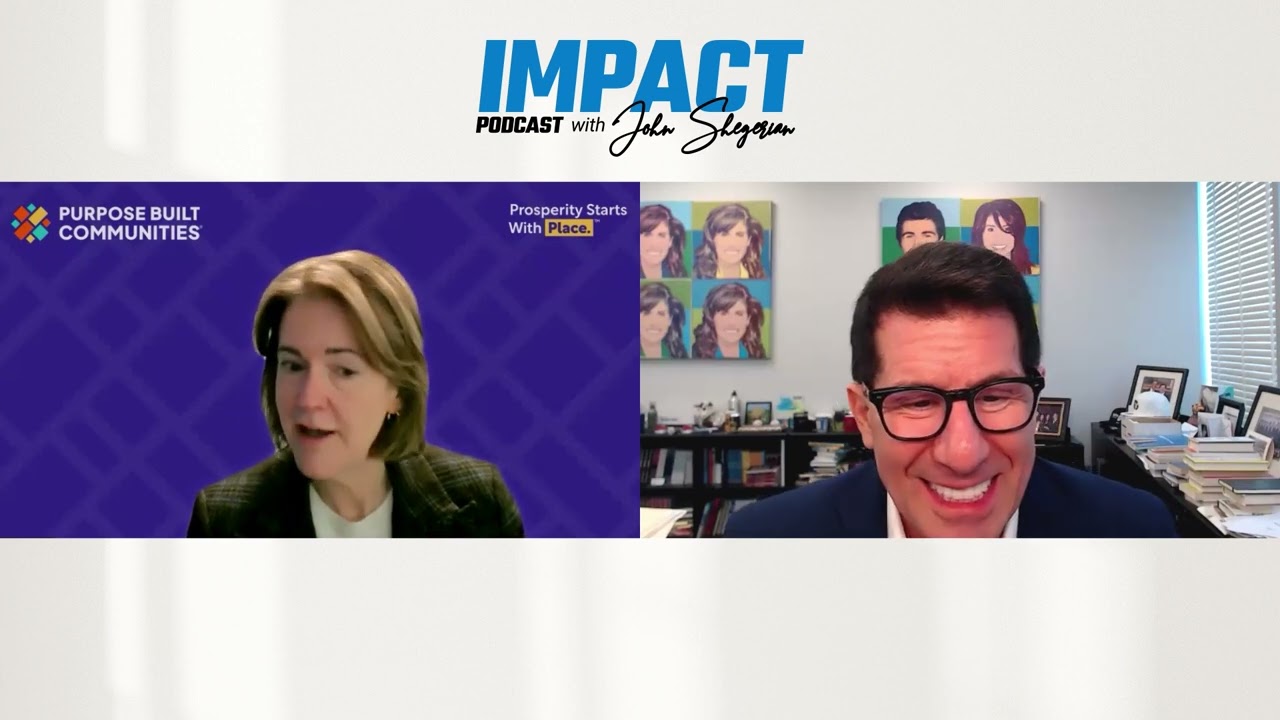
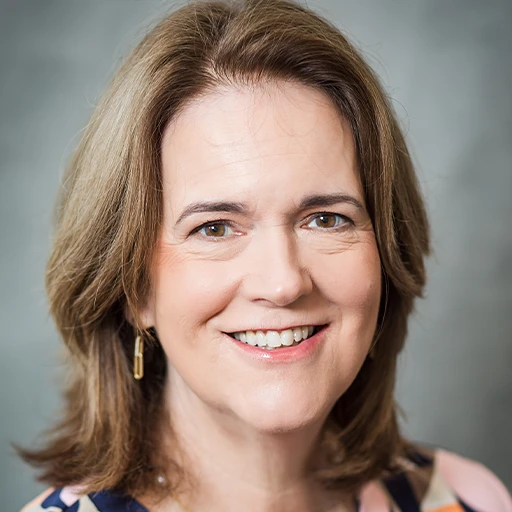
Carol R. Naughton is the Chief Executive Officer of Purpose Built Communities, the national leader in holistic neighborhood transformation. Since joining at its inception in 2009 and becoming CEO in 2020, Carol has set the strategic vision for expanding Purpose Built’s impact, partnering with local organizations to drive economic mobility and better health outcomes. An expert in community development and place-based partnerships, Carol previously led the East Lake Foundation’s revitalization work and has deep experience in mixed-income housing. A nationally recognized leader, she is sought after for her expertise in economic mobility, health, education, and housing transformation.
John Shegerian: Get the latest Impact Podcast right into your inbox each week. Subscribe by entering your email address at ImpactPodcast.com to make sure you never miss an interview. This edition of the Impact Podcast is brought to you by ERI. ERI has a mission to protect people, the planet, and your privacy, and is the largest fully integrated IT and electronics asset disposition provider and cybersecurity focused hardware destruction company in the United States and maybe even the world. For more information on how ERI can help your business properly dispose of outdated electronic hardware devices, please visit ERIdirect.com. This episode of the Impact Podcast is brought to you by Closed Loop Partners. Closed Loop Partners is a leading circular economy investor in the United States with an extensive network of Fortune 500 corporate investors, family offices, institutional investors, industry experts, and impact partners. Closed Loop’s platform spans the arc of capital from venture capital to private equity, bridging gaps, and fostering synergies to scale the circular economy. To find Closed Loop Partners, please go to www.closedlooppartners.com.
John: Welcome to another edition of the Impact Podcast. I’m John Shegerian. I’m so honored to have with us today, Carol Naughton. She’s the CEO of Purpose Built Communities. Welcome, Carol, to the Impact.
Carol Naughton: Thank you, John. I’m thrilled to be here.
John: We’re thrilled to have you. And before we get talking about all the impactful work you and your colleagues are doing at Purpose Built Communities, can you share a little bit about, Carol, where did you grow up and how did you get on this really important journey that you’re on?
Carol: Well, thank you. I’d be happy to. So my name’s Carol Naughton. grew up in upstate New York, graduated from high school at Guilderland and went off to college at Colgate University. I spent a year in New York City between college and law school where I fell madly in love with the most amazing man who’s been my husband for 42 years now. We moved to Atlanta. When we fell for each other hard and fast, I changed my law school plans and we redirected to Atlanta thinking that would be a better place for a couple to be for three years. And 42 years later, here we are. Loving Atlanta, loving what we’ve been able to build here as a family and appreciating the opportunities that we have both had and that our children have had here.
John: You know, I’m so glad you bring it up that way. First of all, you know, the decision to marry the right person is such an important decision. But I think when we’re young and we, as you say, fall quickly and madly, sometimes we don’t understand the magnitude of the decision we’re making at that given time.
Carol: That’s right. And, you know, I married a man who is kind and generous and funny and smart and a great partner. He’s been a great husband, a great father. And some of that I have to recognize was just luck, because when you fall that fast and heavy, you don’t know, are you going to grow up together the right way? And we’ve been committed to that and we’ve done it and it has been the great joy of my life.
John: That’s so important. Literally, my story mirrors yours. This lady over here over my right shoulder here.
Carol: I love the art behind you.
John: Thank you. And that was never meant for Zoom. This was up on my wall since 2007. I tried to tell it all at one point. It’s my children on one side, my wife on the other. we’re same story. 42 years were together. Same thing. And it was really fast. You know, when I look back, I’m like, how did I get so lucky to make a right decision? I didn’t know what I was doing even. But it worked out perfect.
Carol: Well, no, if either of my children had come to me and said, hey, mom, hey, dad, I’m going to marry somebody that I’ve been dating for six weeks. I might not have reacted with the way they would hope. Right. But that’s what we did. And it it’s worked out.
John: Same for us. And then going to Atlanta, again, the importance of choosing where to make a home and a life in a community and a career is another very it shouldn’t be taken lightly. Isn’t that correct?
Carol: It really is. You know, I would say Tim and I could be happy in a lot of places. And I mean, as long as we’re together, we will be happy. But You know, being in a place where the economy was growing, where the opportunities existed, where people were moving here, it felt like we moved to Atlanta at just the right time. You know, I started law school in the spring of 1983. And when I graduated from law school three years later, if you could walk and chew gum, people were throwing job offers at you. I mean, it was going that fast, right? And so that was a wonderful place to be. The economy hasn’t been like that the whole time that we’ve been here, but it’s been growing. And it is a it is a place that I don’t think has seen its best days yet. So we’ve got lots of challenges, lots of problems and lots of people who are committed to continuing to strengthen our metropolitan area to provide more opportunities for more people.
John: Yeah, we just opened up a location in North Cross, Georgia. And my experience over my career is every time I come down to Atlanta, like you said, it just always is evolving towards the better. Always. It’s just fun to go there. I’m always happy to go there. I always feel good there. You know, when you fly around and travel on business or even on any for any reason, family business, and you land in a certain city, you get a vibe for that city. You know, and is the energy positive? Is it negative? Is it going in the right direction? Is it going in the wrong? I always feel when I’m in Georgia, especially when I’m in Atlanta a lot, I feel like the city’s going in the right direction.
Carol: I agree with you. One of the things that, and my job, I have this amazing job that I get to travel all over the country and meet with these people who are change makers, who are not willing to settle for the what is probable, but think about what is possible. And one of the things I notice when we’re invited different places, sometimes you meet with people and they’re, oh, woe is me. It’s bad. It’s always been bad. There’s nothing we can do to change it. And that’s certainly not in Atlanta’s DNA. And it’s not in the DNA of the places where purpose-built ultimately decides to work. We work with people who are clear-eyed optimists who believe that if we work together and we work smartly and bring more people to the table, that we can really create more opportunities for more folks. Again, we look for places that have that. kind of expectation that we can and must do better?
John: I’m going to read what the definition of purpose-built communities. And I want you I want to go into some finer points. Our purpose-built communities collaborates with local leaders and neighborhood residents across the U.S. to transform neighborhoods, prioritizing upward mobility and health outcomes. The model includes mixed income housing, cradle to college education, community well-being, economic vitality, all supported by dedicated local community quarterback organizations. So talk a little bit about this is the mission. When was Purpose Built Communities founded?
Carol: Purpose Built was founded in 2009, but our story starts before that. Our story really starts with the revitalization of the East Lake neighborhood in Atlanta that started back in 1993 or so, is a partnership between the Atlanta Housing Authority a newly created organization called the East Lake Foundation and the residents of East Lake Meadows. And over time, that revitalization became so successful with high quality mixed income housing, a great education pipeline in the neighborhood, community wellness opportunities, economic vitality at the neighborhood level, and this organization called the East Lake Foundation had morphed into what we call a community quarterback organization. That a small group of people who get up every single day and work with local residents and all their partners on how to implement the plan that was created. And over time, how do you change that plan as the community needs evolve? How do you think about what the neighborhood needs, not just today, but in five years, 10 years, and 50 years? So you can be thinking about making sure that this neighborhood is a platform for low-income families to move up and improve their economic outlook and their health outcomes.
John: Were you part of it at its inception?
Carol: I started in 1995. So there are a few folks who are here a few years before me, but I’m the one with the longest tenure, I think.
John: Wow! And so 2009 was officially when Purpose-Built Communities was then- That’s right?
Carol: Inspired by the success of the Eastlake revitalization, so many people kept coming to visit. And they’d say, this is really cool. We want to do it, too. And at that point, I led the East Lake Foundation and we didn’t have the capacity to help all these other folks. And so something happened. Something terrible happened in 2005, Hurricane Katrina. And East Lake Foundation, met three business and civic leaders in New Orleans through mutual friends who had said, you know, East Lake could be the model for the rebuild of part of New Orleans after Hurricane Katrina. And my board freed up about 30% of my time for the next four years to work with these local leaders and their partners and public sector partners and private sector partners to really see if what we had done in Eastlake made sense in New Orleans. Did it resonate with local leaders? Did it resonate with residents? Did it resonate with the public sector? And could it be the model to move forward? And the answer turned out to be yes. And as a result, we really decided that it made sense to create an organization specifically focused on taking this model that had been developed in Eastlake and improved thinking about, what else, right? Because a model is supposed to be better than any one thing. And then how could we help other folks do this around the country? And that’s what we’ve been doing since 2009 when we first started.
John: So 17 years or so later, you’ve created a replicable paradigm?
Carol: Correct.
John: So right now your annual revenue is about 23 million this year, 45 employees, you’re serving this great country we live in. And for folks that want to find or learn more about Carol and her colleagues and all the really impactful work they’re doing at Purpose Built Communities, you can go to purposebuiltcommunities.org. So Carol, talk a little bit about, you know, there’s a lot of data points that are part of your mission, that are part of the general algorithm, the replicable paradigm that you’ve created with your team. Talk a little bit about just a couple of them, life expectancy and economic mobility in terms of when you go in and transform a neighborhood, does life expectancy increase and does economic mobility increase and why?
Carol: Great question. So let me take them separately because I know the answer on one and I don’t yet know the answer on the other. With regard to economic mobility, you know, we know that what surrounds us shapes us. And we know that both from kind of common sense and our own lived experience that our environment matters, the ecosystem that we exist in matters and either it throws up obstacles and barriers to achieving your dreams or it kind of greases the skids for you. And we want more neighborhoods to grease the skids for all of the kids who live there. And so we know that this model of neighborhood transformation, in fact, we call ourselves neighborhoodists. That does not roll off the tongue, neighborhoodists, because we recognize that neighborhoods are powerful engines of change. And if we get the conditions right in the neighborhood, the conditions that people live, work, play and learn in, we know that people will do better. And there’s some great new research that just came out last week from Opportunity Insights looking at a program called HOPE VI, which was the largest community development program ever launched by the federal government from the early 90s through 2010 for public housing revitalization. I think about $17 billion, 262 communities across the country. And now Opportunity Insights at Harvard has been able to go back and look at data and say, what’s happened to people who were part of that revitalization? And some of the data is really exciting and affirms the purpose-built approach to strengthening neighborhoods to put more people on a pathway to prosperity. A couple of the finds out won’t spend my time on all the findings, but one of the things that they found is that children who grew up in these new holistic, mixed income neighborhoods earn twice as much as their peers who grow up in traditional public housing twice as much. That’s more than five hundred thousand dollars more over the course of your lifetime. If you grow up in one of these neighborhoods, you’re more likely to go to college. If you’re a boy, you’re less likely to be incarcerated. All these statistics are available on Opportunity Insights website. And I would encourage your listeners to take a look there because it’s really powerful. And they can go on the Opportunity Insights Atlas and look at their neighborhood and see if their neighborhood is a springboard to prosperity or not. Really exciting stuff. we now have long-term longitudinal data from an independent source that verifies that we can use neighborhoods as real engines of change to put more people on a pathway to prosperity. The mechanism, so interesting to me, the mechanism that this team discovered that is really important in putting more kids on that pathway to economic mobility is building connections between higher income kids. So not isolating people in poverty but creating the conditions where low-income kids and higher-income kids can build authentic relationships, where their world expands as a result of their network expanding and they see other different opportunities. Opportunity Insights believes that is a causal connection, not just a correlation, a causal connection in terms of why lower-income kids who grow up in these neighborhoods do better than kids who grow up in neighborhoods that are still defined by concentrated poverty. Really exciting new data.
John: That makes total sense though, because really when you get to talk to young college students or graduate students and things of that such, my mantra to them all the time is your network is your net worth. I mean, your network is really one of your greatest assets. So it makes total sense that there’s a causal for…
Carol: That’s right. We know this intuitively. There was a paper in the early 1970s, I don’t remember the author, but it was called the theory of weak ties. And the idea was the people who are closest to you, who are in the same basic social circle that you are in, the social and economic circle that you are in, they are not the people who are going to help you move to the next one. The people who are one degree, two degrees beyond that are the ones who hear about the better jobs. They’re the ones who hear about the opportunities. And so it’s important to have our close ties for lots of other reasons, but in terms of economic mobility, the people who are a degree or two beyond you are the ones who might actually be the ones who expand your network and create more opportunities for you. And we’re finding that that is in fact true for kids at the neighborhood level as well.
John: So funny you said that. Recently I heard a statistic about Google. Google, when they put out a description for hiring, they usually get over a thousand resumes for that job description. Over 70% of the time, the person is hired from someone who was inside Google who knew one of the candidates. It’s really who you know in so many ways of life. It’s who you know. You’re now servicing the success that you’ve had is unbelievably impressive over the last 16 years. You’re servicing over 60 plus neighborhoods across the United States. So when you step back and you’re looking for data points to show to others that you’re trying to convince that this should continue to grow, whether they’re politicians or leaders in communities. What are the data points that measure your progress that you’re able to show that people get the fastest? Of course, there’s a lot of data points here, but what are the ones like the highest nails that you love to use as like your stump speech?
Carol: There are a lot of data points and we measure a lot of things. But in terms of, remember this is probably in 2012 or so, having a conversation with somebody in California, in fact. And I was talking to him about how do I know, and it was actually the question on life expectancy and health outcomes. And I said, who can teach me about this? Who can help me understand the correlation between strengthening neighborhoods and opportunities for people at the neighborhood level and what their health outcomes are because I don’t have time to wait for 80 years to know how people were doing. And he said, you need to talk to my friend, Doug Judy. he connected me with Doug, who is a pediatrician and also had a master’s in public health. And Doug, who’s become a very good friend and is in fact one of my board members now, got on the phone with me, I asked him this question, and he said, oh, that’s easy, third grade reading rates. You know, third grade reading rates are a really good predictor of life expectancy. And so if you’re reading at grade level in third grade, so much of the work is already done, right? You are on track for a good outcome. You’re on track for a good outcome economically and a good track outcome for your health. So there are things that we can be looking at early on in a community’s progress, in an individual’s progress that tell us that they are likely on track. So we look at everything from in an education space, we look at third grade reading rates, or kindergarten readiness, third grade reading rates, eighth grade math, high school graduation, college completion, all those things that lots of people look at. We also look at housing stability, for example, because we know in many low-income neighborhoods, transiency is a real issue that people move a lot for a variety of reasons. And what we want to do is lower transiency because every time a kid moves homes, they often have to move schools. And when you move a school, you lose a year. And so, you know, if you’re moving every year, it’s really hard to get traction. So we look at both housing and education as being connected. So working with our housing partners and with education partners to understand each of their businesses, each of their pain points, and then how do we create more opportunities for more families to be housing stable so their kids can be school stable, right? So some of it’s not brain surgery, but it’s block and tackling and looking at how things are connected in ways that oh our siloed delivery of services typically don’t allow for.
John: Well, even when you just say school stability, if you’re leaving the school, not only are you losing a year, you’re losing your network of friends.
Carol: Yeah, that’s right. That’s a really good point. You know, maybe that is one of the things that contributes to a sense of isolation. My family moved around a lot when I was a kid. And every year when we moved to a new school, you know, you have to woman up. And get ready to be that new kid that first day. Or if you move in the middle of the school system and. For my family, it was easier for some of us than others. Right?
John: Right.
Carol: And I imagine that’s the same for other kids who are moving. It’s exhausting. It’s stressful. And it I think contributes to isolation because you’re always in the process of starting over.
John: I applaud the massive success you’ve had with 60 plus neighborhoods being serviced. But as you and I know, this country is really going through a period where more great ideas like this that are replicable paradigms need to get accessed and to need to get deployed. When you’re talking to politicians, is it local politicians, is it mayors, is it governors, is it congressional members, is it some combination thereof?
Carol: It’s a combination thereof. And in fact, you know, in some ways, mayors are mayors are close to people’s pain. Right?
John: Right.
Carol: And so mayors often seek us out. People who are former mayors seek us out because sometimes it’s hard to support one neighborhood over another when you’re the mayor. But when you’re the former mayor, you can dig down deep. And certainly, that was the case in Spartanburg, South Carolina, with Bill Barnett’s leadership. But so mayors are interested and often invite us. We’ve been invited to Maryland by Governor Wes Moore to work with him on implementing the Enough Initiative, which is his statewide strategy to eliminate intergenerational childhood poverty across the state by strengthening neighborhoods. And so we’ve been working with both his office and with grantees in the program to help them figure out exactly how to do that. Also working in the city of Atlanta with the Mayor’s neighborhood revitalization initiative again to take this model of neighborhood revitalization to seven more neighborhoods across the city in order to strengthen those neighborhoods so they really become pathways to prosperity for the lowest income families.
John: I like Governor Moore and I like what he represents. It’s great to hear that someone like him is open and willing to connect with you and to learn from you and to help effectuate his vision as well.
Carol: Yeah, and I want to say that this model also resonates with Republicans. I was on the Hill last year, meeting with a conservative Republican senator who heard our model and looked at us and said, our state needs a hundred of these, right? I mean, so this is one of the things I love about this work is that it resonates with people across political spectrums. And really at the neighborhood level, at the city level, you see people with very different political philosophies working together to solve problems. And in the course of doing that, they build authentic relationships, which I think is really important for creating the conditions so our democracy will survive.
John: That’s really true. mean, this is this is really just like you said earlier, just great common sense being applied to some of the greater issues in this country. Which of course should be politically agnostic. Just like, do we all want to drink cleaner water and breathe cleaner air? Do we want to protect the environment? Of course we do. It doesn’t matter what blue, red, green, whatever, the party affiliation should play no place in this. When you think about mayors that you hope pick up the phone and call you, are there any mayors that you’re looking forward to hearing from, their cities can really use this? I can think of one right now. I grew up in New York City. I went to high school in college in Manhattan. Is a guy like Momdami someone who is good, is well suited to build a bridge with you to help New York?
Carol: I don’t know, to tell you the truth. We have our part of our DNA is we only go where we’re invited. So I do not have a list on a wall somewhere or thinking that we like to be. We go where we’re invited by local leaders and then we help them assess whether our model is a good fit for what they want to achieve. Because while I think there may be 5,000 neighborhoods across the country who need this kind of intervention, but need and readiness and fit are not all the same thing. So we can help them do an analysis to say, oh yes, what we can do really can help. Or maybe you’re in a city that has lost its economic base. Starting with a neighborhood strategy isn’t the right way. You need to start with a broader economic strategy and then move into a neighborhood strategy. So we are very candid with the folks who invite us to say whether what we know how to do is likely to be successful here.
John: I love it. You know, we talked earlier at the top of the show about how you and your husband decided, wisely decided, but of course, our vision sometimes is retrospective that you know, moving to Atlanta was a good idea. But talk a little bit about that. Nothing impacts your life more than where you live. You know, I know that my life was greatly shaped because I grew up in New York City. I would never want anything different. But I also know my children’s life was shaped because they got to grow up in partially in L.A. and partially in Fresno. And they had great childhoods for the most part. And had wonderful communities that they got to enjoy their childhood and talk a little bit about, as you said earlier, bridging the higher income generational children with the lower income children, which then creates great, better outcomes, which is sort of just like, you know, the way I would I would pitch that is you’re democratizing the American dream.
Carol: Yeah, we’re trying to make it accessible to more folks. think one of the challenges we’re struggling with right now as a country is that people don’t feel like they’ve got a shot.
John: That’s right.
Carol: I understand that I have great empathy for people who don’t feel like they have a shot. And we are one of a group of organizations who are focused on economic mobility and place. Our place is the neighborhood level. There are other organizations like Strive Together, for example, our partners for rural impact that work at a regional level, one in cities and counties and another in rural areas. And those are their areas of expertise. We partner with them along with the William Julius Wilson Institute at the Harlem Children’s Zone. But we all offer something different and together. There are a lot of places that we can help strengthen with what we all know how to do together. But we’re all not the right fit for everyone. I want to come back and you know, my husband grew up in New York City as well. He grew up in Queens.
John: Which part of Queens?
Carol: Woodhaven.
John: I grew up in Little Neck, so I know Woodhaven well.
Carol: Okay. So what even was a pretty tough neighborhood. And when Tim shares with us what his childhood was like and from the fights, for example, like fights all the time. And that was just the nature of it. Our kids were never, ever, ever in a fight. You know, I don’t think my 35-year-old son or 31-year-old daughter ever threw a punch. Right? That’s a wonderful thing. Right?
John: That’s a wonderful thing.
Carol: That is a great thing. And I think about the resources that they’ve had access to and the support they’ve had both from their family and from their community. All of these things have wrapped them around, wrapped themselves around them to put them on a great trajectory. I want every child to have that level of kind infrastructure, both of the family and community level, to be able to give them their best shot at life.
John: I love it. You know, when you are welcomed, as you said, very important when you’re invited to a community to help replicate your paradigm, which has already massive success, 60 plus communities, a lot of success and proof. What do you learn the most in terms of how to turn around the mental state of the of the community that is very down on itself after decades of disinvestment. When you go in, what’s your– what’s the playbook to go in and start to turn around and start people thinking positively instead of negatively?
Carol: Yeah, I’m glad I’m glad you asked that question. In many of the places where we’re invited to work, this investment has happened for a long, time, for generations now. Sometimes people have come in promising great things and haven’t been able to deliver, which only makes it harder for the next group because people, again, are more skeptical. Let’s be real. Skepticism is a healthy and predictable reaction to the conditions that families have been living in. And so that is reasonable. So you have to go and listen and start to build relationships. And we coach our network members on how to do that. So many of us are in this work because we’re real believers, right? And we want folks to have happy, joyful lives. And we need to go slow and you need to go slow and create opportunities for people to trust you because, the words are just the words, but people want to see what is your behavior? How are you going to come when you said you were going to come? Are you going to tell us the truth, even if the truth is painful? Like we didn’t get the grant we were going after, right? You’ve got to be able to do those things and be candid. So I think that’s one element of it. The other is that, man, there’s so many great answers in the community. There’s so much wisdom. There’s so much lived experience that if you ignore it or downplay it, you miss the richness. You miss this incredible opportunity to build up. What’s already been working there. It’s easy for particularly white folks coming into a neighborhood largely populated by people of color to think everything is broken, right? And when you look at the statistics, you say, oh my God, everything must be broken. Everything is not broken. Life is hard. People are in pain and they’re struggling. And there’s lots of good stuff going on. And the art, I think, in the beginning is to find some of that good stuff and build on it. We’ve developed a process called Where We Thrive, which is really resident centered and really creates a pathway for neighbors to really think about what do we want in order for our community to thrive? And we start this around little children and around what do parents need to support their young children around early learning and other aspects of supporting kids. And that’s proven to be a really great way. to build relationships that are authentic and meet a need that exists today.
John: I love it. If we were to look at a map at your 60 plus neighborhoods that are in your network now, you know, Purpose Built Community network, where would the dots mostly be? Are they east? they west? Are they south? Are they north? Where are they in the country? Just generally speaking, where is the greatest concentration today?
Carol: Yeah, I would say the greatest concentration is in the southeast from Texas to Florida. And then we go right up the middle of the country from Houston to Dallas and Fort Worth to Tulsa to Omaha and then up to Grand Rapids and Michigan or a few places in Ohio up to Syracuse and then back down the East Coast. So we are not all the way west. But we are concentrated in the Southeast. And I think for a couple of reasons. Number one, that’s where we started. And we had relationships and people knew us and those kinds of things that made it easier to get started. I also think the fact that government hasn’t invested in anti-poverty strategies in these places create a vacuum. And it’s almost, while I’d certainly love to see more public resources be spent on this. this work, it creates spaces for nonprofits and civic leaders to work outside of government to move these projects forward. And I think there’s some truth to that. In places where government has invested more, there’s also then a bureaucracy that’s invested in doing things in a certain way. And when we’re invited someplace, we encourage everybody to do some things differently. And sometimes that’s hard for people who have been involved in work in a certain way for a long time.
John: But I love that you therefore proved your thesis that this is politically agnostic. When you’re talking about Texas and when you’re talking about Florida, I mean, some of the redder States in the nation and the fact that they’re open to this is so to me, great news. It’s really great news.
Carol: Well, and, if we think about creating a country where prosperity is more broadly shared among black and brown folks, you know, more than half of black kids in America live in the Southeast. And still to this day, a much higher percentage of black kids live in neighborhoods of concentrated poverty than white kids. It’s almost 25% of black kids continue to live in neighborhoods of concentrated poverty today. Only 1% of white kids do. So we have to realize that this is real. And, you know, we go where we’re invited and we work to create strategies that make sense around our model to create these economically diverse. neighborhoods that offer every amenity that people need in order to really become who they’re supposed to be. I want to come back to that in a second. Talk a little bit about, you know, obviously, we unless you’re a Martian, it’s not hard to understand that the world is feeling more and more constantly divided. But what you’re doing, because you’re pulling together so many organizations and leaders and people that are important in each community and neighborhood, you’re really the facilitation for collaboration. Talk a little bit about collaboration. I know in my career in business, we’ve made a greater impact that’s longer lasting for our industry and for our personal company when we’ve collaborated. These sort of the days of the lone wolf of the Zürich or the gates, not that those guys are bad. They absolutely have their place in history in Musk. are more rare now than ever before and more of the collaborators are the ones that are succeeding more than ever before. So talk a little about, let’s lean into the word collaboration and facilitation in what you’re doing to also help give velocity to the success that you’re having.
Carol: Yeah, thank you. That’s a great question. So in our approach to this work, we don’t want, it’s not one size fits all, even though there is a model that you can see clearly executed in all these different places. But our model isn’t that one entity does it all, right? It is this community quarterback will really work community quarterback organization. I want to be clear that that’s an organization, not just one person, but we’ll be creating a series of public private partnerships, often around housing and then around education. I mean, those are the two most important bodies in terms of those public-private collaborations. And those public-private partnerships are the ones that actually implement the work overtime. And so if we’re good at creating those, we’re creating win-wins, right? And that’s what we’re looking for is everybody getting mostly what they need in order to keep this moving beyond any one mayor’s term. beyond leadership of any one person, any one funder. It’s like, if we get the structure right, it becomes almost like infrastructure. And this is how we do things, right? And so creating that dynamic is really important. So that will be one aspect of it. And then thinking about, again, because it’s not just one entity who’s executing, it gives them the flexibility to recruit best-in-class partners. So you can recruit a best-in-class real estate developer who really knows how to do mixed income housing really beautifully. It serves everybody as if they can vote with their feet and leave. Because if you do that, the lowest income families are going to benefit the most, right?
John: Right.
Carol: We know that if we create a great neighborhood serving school in a mixed income housing neighborhood, we’re going to create the opportunities for lower income kids and higher income kids to build relationships and their parents to build relationships while they’re sitting there at watching the robotics fair or an athletic event or whatever it might be, right? Those are the places where you create those real opportunities. So again, it’s these community quarterback organizations creating new collaborations, new ways of doing things between public sector, private sector and independent sector partners. So together, we can do a lot more than any one sector or any one organization could do on their own.
John: Carol, is not a day that you and I wake up and turn on some version of the news, whether it’s Bloomberg or CNBC or the Wall Street Journal, or Fox or any of the CNN, and we don’t hear about AI. Does AI have a role in what you’re doing to help inform and accelerate the great work that you’re doing?
Carol: Yeah, of course it will. And I don’t know that we figured it out yet. I remember you can ask AI a variety of questions. And sometimes it gives you great answers. And sometimes it’s way off. So I don’t know that it is smart enough and consistent enough yet that I would turn over any major decisions. But in terms of saying, okay, I need a communication strategy, or I need you know, tell me what are the most important programmatic elements, to do such and such. We can get a lot from AI. That’s a good first draft. And then we can go from there. But I think over time, as we understand more about where the capacity of AI is, we will see different opportunities, even at the neighborhood level, to take advantage of it.
John: How often do you travel in the United States and outside of the United States to study other neighborhoods you’ve been told about or read about to get informed and inspired?
Carol: Yeah, you know, I love going to see other places, both here and around the world. So I’m on the road almost all the time. I’ll be on the road tomorrow in Dayton, Ohio. So, almost every week I’m traveling someplace. And we get inspired both by the leaders that we work with and neighborhoods where we’re invited to work and when we have a chance to see other things as well. In turn, went to in we’re in Italy a few years ago and went to Pienza in Tuscany, where the very first public housing in the world existed. And it was by the guy who was the pope at that point was from Pienza. Of course, I can’t remember his name and thought it is a shame. that the poor people in the Pope’s hometown live in such terrible conditions. And so the Pope built the first public housing in this, what is this beautiful little town in the heart of Tuscany. So there’s lots of ways that you can see what people in the world are doing and what they have done before in order to create a better living conditions for people that they care about. It’s also exciting to go see where people have a sense of community, right? I’m going to pull out now. You may be familiar with Robert Putnam, who wrote Bowling Alone. And I think the other book is All Our Kids that I’m familiar with. Bowling Alone, was the whole idea that m even though more people, the title come from the idea that even though more people were bowling than ever before, nobody was bowling in leagues anymore. And the leagues generations ago, created opportunities for people to get to know each other because you played on the same team and the same people showed up every week and you play on that same team for years and you might have a doctor and a plumber and a laborer all on the same team and they built relationships because they all like to bowl together, right?
John: Right.
Carol: And so Robert Putnam’s thesis is that as people stop joining these kinds of things, we were losing social capital. and we were losing the relationships that were so important to us in order to be able to get through hard times. He identifies a couple of different kinds of capital. Bridging capital is the idea that if you have these relationships, you can bridge across difference, right? And that’s an important kind of social capital, particularly in this day and age. The other kind of social capital is strengthening relationships with people just like you. So when you go to your country club, you’re building relationships. Those are not unimportant. Those are real relationships to your point. Your network is part of your net value, right? But that bridging capital is really important for society. And so if you get a chance, take a look at his movie called, Join or Die, which was basically get out and join something because it doesn’t matter what it is. Join the garden club, join your neighborhood pool, join a book club. Because every time, you’re doing something like that, you have a chance to build bridging capital with people who are not like you. And he got that idea by exploring what was working in Italy during the 1980s when Italy was described as both factionalized and fractionalized. And he looked at some of these new jurisdictions that were doing really well and some that weren’t. And what he ultimately discovered the places that were doing really well wasn’t about a strong economy, wasn’t about tourism. It was about, did they have this sense of bridging capital? And the places where people were joining, where they were joining neighborhood choirs, where they were joining gardening clubs, those were the places that were thriving. And so that’s a lesson for us. We can get out and join something in order to build relationships with people who are not in your own little political bubble, right? But you can find something. We all care about knitting. Go join the knitting club. And it doesn’t matter if you’re knitting next to a red person or a blue person, you’re going to build a relationship.
John: I love that, Carol, because that also fits with my thesis that we’ve become because of the technological revolution. Let’s just call it the start of 1998 when Google was founded and got accelerated through COVID a more isolated and lonely society than ever before. So getting together is only going to be beneficial to not only the people who get together, but to the communities at large.
Carol: Join or die. I love it. That’s it. I mean, I think I think That is important. What are we doing?
John: That says it all. Talk a little bit. You know, Carol, you and I were talking a little bit off the air a little bit about this. The next generation, our children’s generation and even younger that want to be like you. They want to not only make a living, which, of course, we all need to make pay our bills, but they want to make an impact like you and an impact that really is long lasting. What advice would you give to the next generation coming up now in high school and college that really just don’t want to just make money for money’s sake. The days of Gordon Gekko are long behind us. So what good advice can you give them?
Carol: Yeah. So I work with some amazing young people here and I’ve worked with amazing young people for the last 20 years in this space. And I’ve got two amazing young people in my family who are married to two more amazing young people. What I would say to all of them is in your 20s, build skills and build relationships. I know there’s a hunger, right? To get into the work and to make a difference right away, but you don’t know anything yet. And, you know, maybe I say this from my perch as a woman of a certain age, but the idea is like build skills and build relationships and learn how to do things that can make a difference. It’s not just wanting to make a difference. The skills are really important. And some of those are soft skills. Some of them are hard skills. A young colleague of mine who I just loved, I had to coach her to say a few years ago, you’ve been here, you’ve gotten as much out of this job as you can get right now. You need to go learn how to do something. What is it you want to do? And she said, you know what, think I want to be a real estate developer. And now she found a great job. She found a place to go and learn how to be a developer. She’ll be doing this kind of development in purpose-built communities going forward, right? So it is learning those skills and building relationships. So as you get some experience and as you have those relationships, you will be in a position, probably even in your early thirties, to do great things, but build the skills and build relationships at first.
John: Carol, I’m really am grateful for your time today. For those listeners and viewers who want to find Carol and Purpose Build Communities and all the great work that they’re doing, please go to www.purposebuildcommunities.org. Carol, I’m convinced of two things. One, the world needs more Carol Naughtons. It’s just been a delight spending time with you today. But more important, I just want to say how grateful I am not only for the time you spent with us today, sharing what you’ve done over the course of your career, the very important work that hopefully continues to accelerate in the years to come. But thank you for making the United States and the world a better place.
Carol: John, thank you. This was a joy to be here with you and you made this very easy. Thank you very much. I really enjoyed it.
John: This edition of the Impact Podcast is brought to you by Engage. Engage is a digital booking platform revolutionizing the talent booking industry with thousands of athletes, celebrities, entrepreneurs and business leaders. Engage is the go-to spot for booking talent, for speeches, custom experiences, live streams, and much more. For more information on Engage or to book talent today, visit letsengage.com. This edition of the Impact Podcast is brought to you by ERI. ERI has a mission to protect people, the planet, and your privacy, and is the largest fully integrated IT and electronics asset disposition provider and cybersecurity focused hardware destruction company in the United States and maybe even the world. For more information on how ERI can help your business properly dispose of outdated electronic hardware devices, please visit ERIdirect.com.
 Spotify
 Apple Podcasts
 Amazon Music
 iHeartRadio
 YouTube
 YouTube Music
 Audible
 Pandora