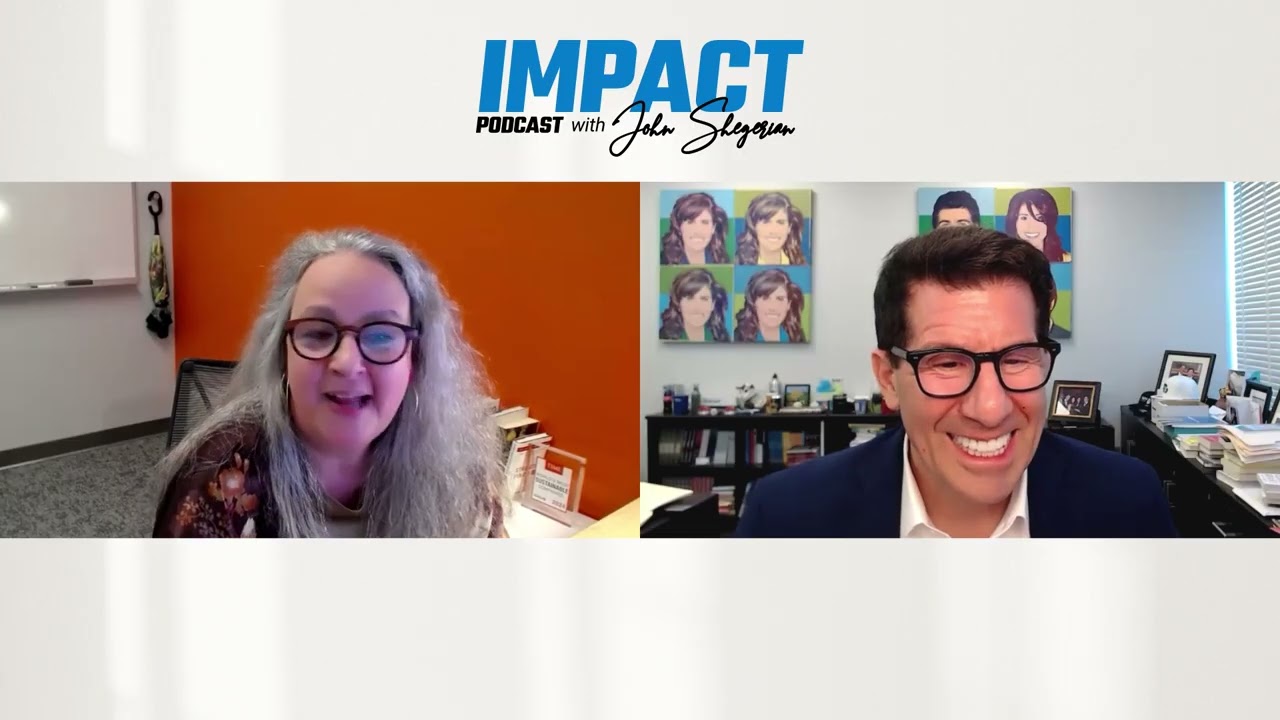

Mary Farris is the Head of ESG and Human Rights at Analog Devices. A passionate, mission-driven strategist, her multifaceted career focuses on developing and driving large-scale purpose-driven initiatives that improve culture and connect to values and brand. She leads Analog Devices’ globally recognized ESG program. Under her leadership, the team has pioneered innovative methodologies—such as a process-based approach to Product Carbon Footprint calculation, empowering customers to understand and advance their sustainability goals. She is known for her integrated systems thinking which feeds her ability to mobilize cross-functional teams to drive systemic change.
John Shegerian: Do you have a suggestion for a rockstar Impact Podcast guest? Go to impactpodcast.com and just click Be a Guest to recommend someone today. This edition of the Impact Podcast is brought to you by ERI. ERI has a mission to protect people, the planet, and your privacy, and is the largest fully integrated IT and electronics asset disposition provider and cybersecurity-focused hardware destruction company in the United States, and maybe even the world. For more information on how ERI can help your business properly dispose of outdated electronic hardware devices, please visit eridirect.com. This episode of the Impact Podcast is brought to you by Closed Loop Partners. Closed Loop Partners is a leading circular economy investor in the United States with an extensive network of Fortune 500 corporate investors, family offices, institutional investors, industry experts, and impact partners. Closed Loop’s platform spans the arc of capital from venture capital to private equity, bridging gaps and fostering synergies to scale the circular economy. To find Closed Loop Partners, please go to www.closedlooppartners.com.
John: Welcome to another edition of the Impact Podcast. I’m John Shegerian, and I’m so excited and honored to have with us today Mary Farris. She’s the head of ESG and human rights at Analog Devices, better known as ADI. Welcome, Mary, to the Impact Podcast.
Mary Farris: John, thank you so much for having me.
John: Before we get into all the important and great work that you and your colleagues at Analog Devices are doing in ESG and human rights, I’d love you to share a little bit about your background. Where did you grow up, and how’d you get on this impactful journey that you’re on?
Mary: Well, I did most of my growing up in Western Massachusetts, in the foothills of the Berkshires, in the Five College area, for folks that are watching some basketball right now. After that, I’ve lived all over the country and did a little spot over in Italy. My love for Massachusetts and the weather is not adored by everybody, but since it snowed this morning, I think I should say that.
John: It’s April. We’re recording this podcast in April, and it snowed in April. Let’s just say that.
Mary: That’s right.
John: God. Talk a little about where did you go to school?
Mary: I went to school in Union College in Upstate New York which was a really interesting place because it’s a really good proving ground for engineers of all flavors. But I was an English major. So it was fascinating, and there’s a good liberal arts division there as well that meant I got to mingle with a lot of engineers. As I’m the daughter of an engineer, it felt very familiar in a lot of ways. So I actually did my undergrad and my master’s there. I was a Master’s of Arts in Teaching with a specialization in English. I started my career as a really hard English teacher.
John: Where did you go from there, and what was the path to Analog Devices?
Mary: I say this a lot to people, that my career only makes sense when I look backwards. So each step was maybe deliberate but important when I turn around and I look at the skills that I aggregated. So I was a very hard English teacher, and I adored teaching, and I worked in several different types of schools. Moved a fair amount and left teaching and went into advertising. Teaching industry at that point was a little tough and I decided I wanted to go cut my chops on writing. I did some work in PR and marketing and found that my get-up-and-go was positive that I could take my educational resources and turn them into a marketing then. Then I left the workforce to have two fantastic kids and was out of the workforce for about a decade, but I did a lot of nonprofit work. So underserved populations, everything from educational programs to emergency resources, et cetera, and I loved it. I realized that anything I did afterwards, there had to be a benefit to it. I had to benefit people. I missed that roots when I was in marketing because I felt divorced from the real benefits of what I was doing.
John: Then how did that lead over eventually to Analog Devices?
Mary: I went into a nonprofit as an official job, no longer being on the board. After a few years I started nosing around and realized that I was looking for something more. I spoke with one of my volunteers. I was working with kids in foster care. I spoke with one of my volunteers, and she said, “Oh, I have a really hard job for you. Let me come back to you.” She brought me over to General Electric, which was funny for me because I’d gone to school in the shadow of one of their biggest facilities in Schenectady never thinking I would work there. I went to go work in a health benefits organization, so both helping people understand what wellness looked like, but also delivering benefits to a union population. Spent more than a decade at GE in different roles, but eventually went into environmental health and safety, hence the environment side. But I loved the safety and the people component and how it married all of that up together. As part of my role there, I absorbed the sustainability component and did that for several years before I left. That was when GE was still central GE was before they were breaking up. An opportunity came open here at Analog Devices, and I knew that if I stayed in sustainability, that I wanted to be at a place that was aggressive, that wanted to really from its core implement better in the world, and did it in a leapfrog way. What I found when I came here was fascinating. Really smart engineers and a CEO and a board and a leadership team that were committed, and it just came and landed like the perfect opportunity. I’ve been here for just a little over four years now.
John: Four years. For our listeners and viewers, first of all, to find Analog Devices, and this will be in the show notes, so you don’t have to stop working out with your weights or walking your dog or driving your car, analog.com. It’s real simple, analog.com. It will be in the show notes. Analog Devices does over 11 billion a year in revenue, over 24,000 employees serving over 31 countries. It’s a big company. So when you came in, what programs did they already have in ESG and human rights, or was it the proverbial white page and you had to start from scratch?
Mary: I didn’t have to start from scratch. There was already very strong commitments, but there was a rub. There’s always a rub. They had just had a major acquisition that virtually doubled their size. They acquired a company called Maxim Integrated. There was the melding, which if you’re in this space takes a lot. People do things differently. They have different programs, different processes, different reporting regimes. So there’s a lot of marrying of data and systems and practices. I was so lucky because the head of our global supply chain came from Maxim, and he was very committed as well. So there was a lot of work to do to do the reconciliation and publish a more fulsome report. So we had commitments out there, and we had in some places really strong programs, and in other places things that needed to be beefed up. But the timing was perfect because the organization built new.
John: Got it. You have this new big platform. Where did you look to for guidance given now this really huge opportunity to come in and make a big impact? Where was your inspiration and guidance coming from? Was it just from the C-suite? Was it from outside the organization? What was your North Star?
Mary: I’m a little irreverence, and there’s a lot of regulation chatter out there, et cetera. And really for us, we make semiconductors, make analog semiconductors that sense the world around us. There’s probably 35 within an arm’s reach from you right now. Cameras and lights and sound and heartbeats and monitoring and in healthcare and industrial. So our customers, and our customers’ need to really drive their own programs was very quickly apparent to be our North Star. There was obviously a lot of leadership from the C-suite which just was wind in the sails. But when I looked at the programs and what people were already working towards in some places there was just incremental things that needed to be adjusted. In other places, connectivity. I call myself the great quilter. Put people together to move things ahead. But really for me, if we get it right for our employees and for our customers, the rest falls in place.
John: I love it. Talk a little bit about the convergence of ESG with human rights and also technology, which is the business you’re in. How can responsible technology companies like yours help advance the sustainability circularity revolution that’s right now underway? We’re moving from consumer-based economies and which are were historically called linear to now circular economies. How does what you do help accelerate this wonderful and important change that’s finally underway?
Mary: It’s such a good question. I am a systems thinker, and it’s very hard for me to divorce things. So if we’re looking at something and we want to make a decision about the environmental side, we also have to look at the flip side and say, “Are we doing no harm on the human side?”
Good examples are parts of the world that don’t have any type of reliable energy production, and so they can’t support wind, solar’s not reliable. Making that circumspect decision in partnership with those parts of the world as they’re in the developing markets as they grow. You can’t divorce the human benefit from the green side, so you have to think more systematically. That’s why the human rights side of this is so important. So really, ESG is the ethical underpinnings of a company. When I think about tech, we’re either going to have to turn everything off or tech is going to have to help solve the climate problem. I think we’re in a really interesting inflection point right now where we’re seeing innovation on top of innovation in ways that are both concerning, people are concerned about the energy consumption and the water consumption, but if we can direct that intelligence and that breakthrough thinking to help solve the world’s greatest problems, which is something we talk about here a lot it’s all the better. Semiconductors are in everything technologically. When you think about the power consumed by a semiconductor, which is really its use phase emissions product. If it can manage downstream emissions, if it can make the whole thing it’s embedded in more efficient, if it can avoid other heavily emissive components to the end product by making something wireless, or even better, use physical intelligence, which is it senses the world, it makes the data and it answers the question right there without having to send it anywhere. The data and the decision making is all happening locally. Think about when your car autocorrects.
John: Sure.
Mary: The thing we never thought could happen in the ’70s. Or the valve turns off or the water turns off. That type of instantaneous low latency decision making is real today. And so imagine what’s possible in five years, in two years, in a decade if we aim the world’s smartest people at this and really partner with our customers, because we make teeny tiny little things to help them make the big things better.
John: You’ve mentioned customers. Then how much are you collaborating on a regular basis with your customers to better meet their needs, which only then helps accelerate the innovation and technologies that are going to help move us to a net zero world to a more circular economy and a circular world that we all are striving for?
Mary: I think I’m a little unique in that I spend personally like half my time with customers or with the customer facing group.
John: That’s sweet.
Mary: Oftentimes we hear about reporting and regulations, et cetera, but the value chain has contracted, and we are our customer’s compliance program, we’re their upstream scope three emissions. We’re their product compliance component. So that contraction of the value chain is really real. Part of it’s regulatory, part of it’s voluntary. Somebody wants to be net zero across all three scopes, they gotta be looking at their suppliers. When we’re able to sit with them and share our knowledge of a very complex space, teeny-tiny little things, very complex, and help them think about the return on investment for the investment in the carbon to include it in their products, becomes a much richer conversation. Then I hand it to the engineers.
John: Got it. Talk a little bit about being a responsible technology company with regards to not only, like you said, the platform of ESG, human rights, and sustainability. How much of that in 2026 is at a great attraction and retention tool for your employee base?
Mary: It’s funny, I just talked to our head of talent acquisition. We don’t have any metrics but we know that the traffic on the report that we publish, for instance is great amongst new folks. We also hear it anecdotally. We just got a big cache of interns in and several of them reached out. So we do know that it is part of talent acquisition. It is important for them. People want to work at a company that has some focus on doing good with their remit, so it is really important. Then from a retention perspective, when we do roundtables or conversations, folks always want to know more. It is really important, and it is across the organization here. It’s not just my little team of seven. It is endemic across the organization, which is great.
John: Mary, there’s not a day that you and I wake up and look at whatever news medium that we enjoy, whether it’s CNN, BBC, Bloomberg, New York Times, Wall Street Journal, and the topic of AI isn’t in some headline. How is Analog Devices leveraging this new AI revolution to help make what they do better and you do better, then also what you do in ESG and human rights and sustainability better, which ultimately, as you say, as you pointed out, is a direct connection to helping make your customers do what they do better?
Mary: Aren’t we at an interesting time? I think about going back and telling my Syrian grandmother who came here at the turn of the century that I’m talking to you on video right now. On the other side of the country. So we are just at the beginning stages of this, I think. For us, our focus is on that physical intelligence that we talked about. That’s low latency, instantaneous decision-making that’s really an interesting tool in the toolkit. So if you think about data, the reason we want data is so that we can make informed decisions. Whether it’s your glucose levels or is the crane over your head and it’s not supposed to be. So in order for you to act on that, you have to see it, so it has to go to you. It has to transport somewhere. It has to transport to a cloud and then be given to you. Or we can teach the chip itself with some software wrapped around it, again, not an engineer to make the decision locally because it’s an easy solution. It’s a safety thing, et cetera. That local decision-making is a version of AI, and that, when you think about all the data that’s being created, not all of it needs to be treated in the same way. For a lot of it, that instantaneous decision-making just allows you to turn your focus to something else. Whether it’s an autonomous vehicle or the valves in your factory turning off when there’s a chemical leak. There’s all sorts of ways that AI is going to be disruptive. I think we’re at the beginning stages of it right now, and who knows what’s possible. The piece that I love about it is that from a sustainability perspective we’re still kind of operating in 1987. People are waiting for their utility bills to roll up their scope 2 emissions when you can slap a sensor on that thing and get real-time output. So this notion of leveling up the sustainability field to turn practitioners away from the reporting, the accounting, and just totally transform that space and change the conversation. Because we have to take a systems-level approach, I think, if we’re actually going to drive emissions down and really change the equation.
John: So interesting. For our listeners and viewers who’ve just joined us, we’ve got Mary Ferris with us today. She’s the head of ESG and human rights at Analog Devices, which is also known as ADI. You can find Mary and her colleagues and all the important work they’re doing in ESG, human rights, and sustainability at www.analog.com. Mary, talk to me a little about, you’re in over 31 countries. How do you manage the, how do I say this best? The diverse and patchwork quilt amount of regulations that exist on different continents when it comes to all the topics that you touch, sustainability, human rights ESG. There’s no harmonization. So how do you manage that process and, staying compliant without letting it drive you nuts and your team nuts and distract you from the real important work that you do on a daily basis?
Mary: Well, the regulatory surveillance it is a circus feat. We are lucky that we have some very good feeds. We have good partners in legal. I have a couple of folks on my team that spend their mornings geeking out, looking at news stories, and have feeds that will indicate for them new regulations. But tearing those down and saying, “How much of this is the same as the new one we saw in Europe? Or as the new one in Singapore? Are we going to have to report differently?” That’s where this gets really interesting. Where right now companies like mine are issuing voluntary ESG reports that may evolve to being a regulatory report at least in part or portions of it. If you’re cutting your data differently because it’s for Europe or it’s for this country or that country, it’s going to get really interesting really fast. I’m lucky that I’ve had some very good conversations with both regulators and some of the big NGOs out there, but also investors, to say, “Right now we give you a clean copy of what we think is important for you. You have told us it is important back. We’ve done it as transparently as possible. It’s feeding you what you need. What else do you need? Because if we have to start complicating this by layering in other pieces, how can we help you understand and get to the information that you need as an investor?” Customers the same, employees the same. Because the transparency’s about getting information into your stakeholders’ hands. The regulators are just one of those. So I’m not telling you I’m not going to be eating Bonbons in a couple of years trying to read regulations, but it’s definitely tough.
John: You mentioned earlier your unique perspective on customer involvement, that you spend 50% of your time with customers. Is that sort of one of your magic superpowers at ADI that you’re empowered to do so, and that differentiates you from your competition, and therefore your customers appreciate you more and stay with you more and keep continuing to reward your company with more and more business?
Mary: Well I hope so. I think we have a commitment to transparency and accuracy. First of all, Analog Devices chips give you really, really good, really accurate data. That’s part of what we’re known for. A customer-centric view where we sit with you and help you think about what’s the next design need to have. What’s the right combination of chips, or do we need to develop something new for you? That’s core to who we are, so I’ve just slotted myself into our existing operating model with customers. But I do think the demand from customers wanting more information and more details from us certainly drove that. I love the sales folks I get to work with and educating them is fantastic. When you think simple things like customers wanting to understand the embodied carbon in a chip which is really tough to understand. It’s not like steel where it’s just by the ton or a polymer. There’s a lot of chemical components and energy, and helping our customers understand how we do it, because there’s no standard out there right now. How we do it, and giving them that level of information so that they can make decisions, that partnership’s so important. It’s so important.
John: That’s so interesting. I work with a lot of wonderful OEMs, and when I started working with them 20 or so years ago, they didn’t used to have, obviously circularity and sustainability weren’t top of mind with everyone back then. Now they all seem to also not only focus on the issues that you’re focused on as well, but also on the engineering side and the innovation side, they have what are called designed for sustainability or designed for circularity departments. Is that something that’s ongoing at ADI as well?
Mary: It’s certainly how we engage with our customers on those things. When we think about their future state design, helping our internal teams understand they’re going to have to deconstruct this at the other side. It’s part of the life cycle assessment. We can’t see our downstream emissions because we’re in too many different end markets. We’re not just in one, we’re in everything. So we don’t see our downstream emissions, so that partnership gives us something back as well. That design for circularity and design for sustainability that we’re seeing show up and in partnership with procurement organizations, when those decisions are being made equally about the carbon emissive properties because of taxes like CBAM or because of goals or because the organization wants to use the EU taxonomy to call it green, us being able to share that information is aligned with who we are, and it can be a differentiator.
John: That’s great. You mentioned earlier that I’m probably an arm’s length away from 60 or so chips in my office and in my little world that I live in. Talk a little bit about how these small chips can make big impacts even though they’re so small on the energy reduction industry and the future of our world. The focus on safety, employee safety, and safety as a whole, and also of course in healthcare. I was listening to Lisa Su the other day talk about the chip industry and healthcare, and she says she believes it’s one of the more profound effects are going to be AI and the chip industry’s going to make on healthcare. How do you see it in terms of the small chips that you get to sell, but the big impacts that you get to make?
Mary: Some of the things, and all of this is findable out on our website. There’s videos and articles and things, but think about in a factory. So when I was at General Electric we had hundreds of factories. They all need to be optimized, and that puts money in the supply chain leader’s pocket if you optimize it from an energy consumption perspective. Think about all the individual motors, whether it’s on a lathe or it’s on a crane. Those things are oftentimes always on. But if you can put something on them that makes them go to sleep when they’re not in use and reduce the energy consumption, the energy draw there, just like your computer goes to sleep because it sucks a lot of energy, think about the savings there. So there’s applications like that then you can expand upon. There’s the safety element, which you mentioned whether it is light curtains or understanding where things are in space, or using something like glasses and cameras to go audit a site where an expert gets to sit somewhere else remotely, which brings me to healthcare. Imagine what’s going to be possible when the doctors don’t have to be in the room with you. That’s just sort of what people know now. What if? What do you want to know next? What would it help you to know, and how can we help you know it? Whether it’s how do you optimize wind turbines? How do you get bidirectional flow of energy from the grid? All of those things are possible when you sit with the right really smart people.
John: Got it.
Mary: It’s fascinating.
John: Does this whole shortage that’s been talked about a lot in the news with regards to rare earth elements and critical minerals, how does your company interrelate with those topics, and are they important to the core work that, and core mission of what AVI does?
Mary: We have been monitoring, because of course with geopolitical issues, there can be challenges with sourcing certain things.
John: Sure.
Mary: I’m lucky enough to be on the feeds from our resiliency team and our product compliance team. Right now we’re not seeing any direct impacts, but we also have to look at it from our customers’ standpoint and see what’s potentially going to disrupt them so that we can help support them as they think about diverting to other product lines, et cetera. So right now, no impact immediately but always an opportunity.
John: When I was doing some homework on AVI one of the things I read about was, what is focused on at AVI is physical intelligence. Can you define that for our listeners, and then explain how physical intelligence plays such an important role in the value chain of sustainability and efficiencies?
Mary: There’s different types of chips, and analog chips sense the world, light, heat, noise, vibrations, chemical components, water flow, virtually anything that in the world around you that puts out a signal. Birdsong. We can use those signals, turn them into data, and then that physical intelligence is that acting on that data right there. It’s giving intelligence at the point where the data’s born so that the decision can be made there. So whether it’s a decision to record, a decision to move a car, a decision to turn something on or off. The benefit of that, as you think about walking through a factory, or you think about heavily emissive parts of a city, part of the beauty is looking at it and saying, “What if we could turn that off? What if that wasn’t always on? What if we could restrict the water flow? What if we understood the chemical compounds that were coming out in the water wash, for example, so that we could reuse that water more efficiently?” All of that data would require a one-time investment to sensor things around you. But once you have that, when you think about the lifetime of benefit to reduce water consumption, to understand the chemical composition, to turn things off, understand emissions coming out of your smoke stack, understand energy consumption, you can make real time decisions then or you can have the physical intelligence make it for you if you already know what your parameters are.
John: That’s the advantage of how ADI does things. They allow the decisions to be made in real time right where they are.
Mary: We can. It is one of the benefits. Sometimes you need to send the data to the cloud. Sometimes you need it for reporting, and sometimes you want to teach something. But you can do both, and not everything needs to go there. So this is a fantastic and growing option that’s just so interesting right now.
John: There’s a lot of things to worry about, Mary, the world throws at us. With all the new innovations that we have and everything else, it’s such an exciting, as you said earlier, such an exciting time to be alive and see these changes happening. But there’s also more profound externalities. Maybe we just know about them more than we ever did. Maybe they existed when we were little kids. It didn’t seem like we were exposed to them then. What keeps you up at night with regards to the issues that you’re working on day and night and which are ESG, human rights, sustainability, which is just a code word for materiality and resiliency anyway?
Mary: Obviously, I would say geopolitical challenges and always monitoring the world. We know so much more about the world than even when we did growing up watching Walter Cronkite. You got a curated little bit of news, now it’s 24/7. Beyond that, and here’s where my irreverence comes in, I will say that I think we’re having the wrong conversations. There’s a lot of focus on reporting, has its space. Accounting, has its space. It’s important that we’re looking at things accurately. But we’re trying to incrementally fix systems that were engineered around old ways of doing things. So systemically when you think about centralized deployment of energy versus individual homes and properties being independent. You think about all the things that would change if you didn’t have to have centralized production of energy. Whether it’s all of the cabling and all of the wires, to outages, to burning things. When there’s no other option. You think about optimizing vehicles, making them electric as opposed to redeploying and thinking about an entirely different way of delivering transportation. Innovation, like inside the rules that exist now that were built for a different time, is not what’s going to get us there.
John: That’s so interesting. On your website it talks about how ADI delivers sustainability differently. It definitionally, does that mean the personal interrelationship you have with your clients, or am I misreading that and you mean something else by delivering sustainability differently?
Mary: I think it is the holistic approach that we take to it. When we look at the climate risk assessment that we did. Like, so many companies are doing climate risk assessments. We looked at that opportunity side and we were already in a lot of those markets doing a lot of the things where we see the emerging opportunities. I think it’s that notion of forecasting, of thinking about sustainability as one of the components when we’re working with our customers, and actually trying to use our position to do some good.
John: I love it. We have a whole generation now, little bit different than our generation, Mary, that they want to be you. They want to not only make a nice living to support their family and keep the lights on and put food on the table, and there’s no shame in that at all, but they also want to be doing what you’re doing, making an impact. To find that magical convergence of money and impact. What best advice looking back can you give to this next generation of sustainability and impact leaders that are now either going into school, just coming out of school, and they want to hear some wisdom from someone who’s lived a very rich and good, great life building a career around impact and also sustaining her own family?
Mary: I think if you want to get hired in this space, you’d have to deliver more than a regulatory report. To think holistically about the value that values-driven engagement can deliver. There has to be truth in the delivery. But you have to execute. You have to deliver. It’s not a fluffy space. If you do this well, you can really deliver transformative change, but you also don’t have to be a me to do that. I work very closely with our procurement organization, the supply chain with legal. There’s lots of different ways to benefit an organization like ours by operating where you are, seeing risk, and helping manage risk. Nobody’s ever going to stop you from managing risk elegantly. The last thing I’ll say is, in the world of AI, in the world of development, build your brain, because quite honestly I can’t find my way out of a paper bag because I’ve been using GPS forever. So make sure that you’re exercising and using your brain so that when you come to the table, you’ve really thoughtfully looked at a new regulation or a new systems or process or a customer request, and you can be thoughtful about it, and there’s lots of ways to bring your brain to that.
John: I have to so agree with you on that, but the other thing I see and a commonality, and you are a part of that commonality, that I think is so important is the really successful people like you love people and love to be able to do this, your interpersonal skills are A++. I think the next generation, given that they were inadvertently, not by anyone’s malice or anything, became a isolated society because of the technological revolution. You and I had no choice growing up. Everything was nose to nose. It was ubiquitous as part of our life. That’s why you got to master it. That’s why people like you that I’ve seen so successful in what you do are masters of that. We need to also enforce that on our next generation more.
Mary: I totally agree. I have two kids in their 20s, and I gave them the screens. They had COVID hits as they went through school as well.
John: Sure.
Mary: But that notion to walk into a room and ask the questions because you don’t have any of the answers, and everybody around you knows more about this than you do, to be vulnerable. I would never be in this position if I did not have fantastic people around me who said, “You probably want to know what that means. You probably want to understand what OSHA 10 is or what the EPA’s looking for with X, Y, and Z.” Learn from the people around you. It’s one of the best reciprocal ways to develop relationships. Ask people for help.
John: I love that.
Mary: You’ll get it back dozenfold.
John: Mary, that’s such a brilliant comment because unfortunately for some ungodly reason, people have ingrained in their head that asking for help is a sign of weakness. It’s actually the opposite. It’s a huge sign of strength and maturity.
Mary: It absolutely is. I’ll take somebody who’ll ask me a bajillion questions any day than somebody who’ll show up with a baked pie when I really wanted a steak. So 100%.
John: Sure. I’m so with you.
Mary: Inquisitive nature, curious, love it.
John: I’m so with you. Hey, listen before I let you go, I know you and I are both, we share the commonality of being recovering bibliophiles. Give a book recommendation to our audience right now. Tell us something that you’ve read that just moved you so much that we all have gotta buy and read.
Mary: Moved me so much? Well, I’ll give you a tough one and maybe a little uplifting one. So I just reread The Handmaid’s Tale, which is something that I read for my thesis in college. That’s tough to read. Then on the other side I have been reading a gentleman called Jeff VanderMeer. He is interesting sort of science fictiony fun stuff, but they oftentimes have an ecological bent to them. He’s fun to follow on things like Twitter and others, because he posts pictures of the nature in his backyard.
John: I love it.
Mary: Those are two recommendations for you.
John: Thank you so much.
Mary: Something a little light.
John: Mary, that’s awesome. To find Mary Ferris and her colleagues and all the important work they’re doing in human rights, ESG, and sustainability, please go to www.analog.com. It’ll be in the show notes.
No need to write it down. Mary, thank you not only for spending almost an hour with us today, but most importantly thank you for a career of making the world a better place.
Mary: John, thank you so much for having me, and thank you for amplifying the message.
John: This edition of the Impact Podcast is brought to you by Engage. Engage is a digital booking platform revolutionizing the talent booking industry. With thousands of athletes, celebrities, entrepreneurs, and business leaders, Engage is the go-to spot for booking talent for speeches, custom experiences, live streams, and much more. For more information on Engage or to book talent today, visit letsengage.com. This edition of the Impact Podcast is brought to you by ERI. ERI has a mission to protect people, the planet, and your privacy, and is the largest fully integrated IT and electronics asset disposition provider and cybersecurity focused hardware destruction company in the United States, and maybe even the world. For more information on how ERI can help your business properly dispose of outdated electronic hardware devices, please visit eridirect.com.
 Spotify
 Apple Podcasts
 Amazon Music
 iHeartRadio
 YouTube
 YouTube Music
 Audible
 Pandora