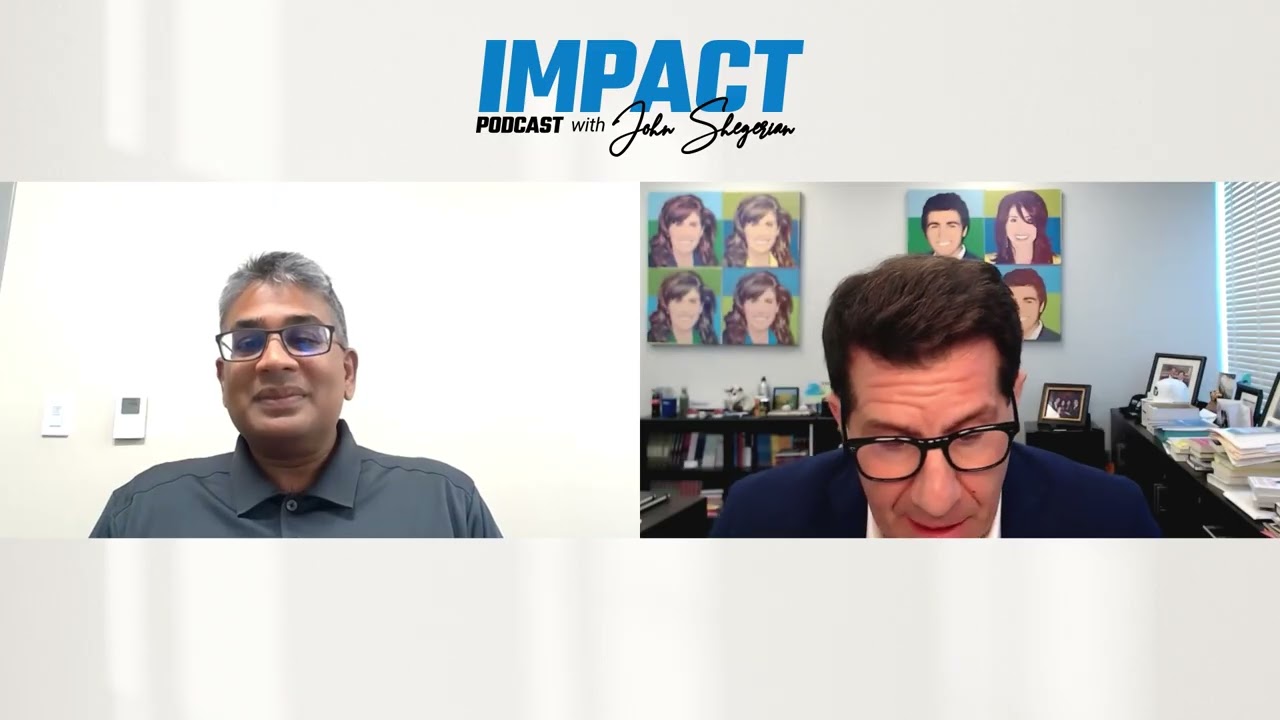

Jay Nagle, P.E., brings experience in the automotive and industrial sectors to his role at Microchip Technology. He is responsible for expanding adoption of dsPIC Digital Signal Controllers in the mass market and leverages Microchip’s broad device portfolio to deliver innovative solutions for embedded system designs. He is also integral member of the company’s Sustainability Megatrend team, focusing on how the company approaches making products for sustainable applications.
John Shegerian: Get the latest Impact Podcast right into your inbox each week. Subscribe by entering your email address at impactpodcast.com to make sure you never miss an interview. This edition of the Impact Podcast is brought to you by ERI. ERI has a mission to protect people, the planet, and your privacy, and is the largest fully integrated IT and electronics asset disposition provider and cybersecurity-focused hardware destruction company in the United States and maybe even the world. For more information on how ERI can help your business properly dispose of outdated electronic hardware devices, please visit eridirect.com. This episode of the Impact Podcast is brought to you by Closed Loop Partners. Closed Loop Partners is a leading circular economy investor in the United States with an extensive network of Fortune 500 corporate investors, family offices, institutional investors, industry experts, and impact partners. Closed Loop’s platform spans the arc of capital from venture capital to private equity, bridging gaps and fostering synergies to scale the circular economy. To find Closed Loop Partners, please go to www.closedlooppartners.com.
John: Welcome to another edition of the Impact Podcast. I’m John Shegerian, and I’m so excited and honored to have with us today Jay Nagel. He’s the technical staff engineer of product marketing at Microchip Technology. Welcome, Jay, to the Impact Podcast.
Jay Nagle: Thank you, John, so much for having me.
John: It’s great to have you, and before we get talking about what you do with your colleagues over at Microchip Technology, I want you to share a little bit about the Jay Nagel story. Where did you grow up? And how did you get on this career path and journey that you’re on?
Jay: So I grew up on the East Coast, and my parents are from India. They immigrated over from India back in the 70s, and they are both medical professionals. I grew up in a very science, technology, engineering, math-orientated household. I grew to really love mathematics, language, and different subjects in school. At the end of the day, I really like to help people solve problems, that’s why I’m an engineer. That’s why I studied engineering at the University of Michigan. I love the challenge of it. I love the fulfillment of being able to solve problems and figure things out. It has directed my career in engineering. I’ve worked at all different levels of the supply chain, all the way from the original equipment manufacturers in the automotive industry. I used to work at Fiat Chrysler Automobiles, working on making cars great and safe. Now I’m all the way down to the level of semiconductors and chips, and so I’ve had the blessing. I’ve had the great fortune of being able to work at all different levels of the supply chain, see how they operate, see how they serve as customers, and see what mindsets with which they approach their work, based off of where they’re positioned in the food chain, so to speak. So it’s been a real wonderful ride, I would say just learning all different kinds of things.
John: I love it. You grew up in New York, New Jersey. Which town on the East Coast did you grow up in?
Jay: So I was actually born in New Jersey, but I spent a majority of my childhood in the great state of Michigan. So I would say I’m a Midwesterner, but then I lived on the East Coast for a little bit after graduating from college. So I would say that I’m on the East Coast, eastern part of the United States, close to New York City.
John: Let’s just say this. You’re a Wolverine who still enjoys Bruce Springsteen. Let’s just say that.
Jay: Yes, I love Bruce Springsteen.
John: Okay, there you go. That’s the New Jersey in you.
Jay: I’m a big fan.
John: So am I.
Jay: So I hope he’s listening.
John: Exactly.
Jay: Hope he decides to reach out to me someday.
John: Mom and dad were doctors, or what did they do in the medical world?
Jay: So in the medical world, my mom was a physical therapist, and my dad worked in prosthetics and orthotics. So he did some really cool things with medical technology, building artificial limbs for amputees, so he had a practice [inaudible].
John: It’s always fascinating, Jay, to hear about people’s parents, because now, of course, looking backwards, it’s easy to put the whole story together. Dad was really an engineer with prosthetics, and mom was an engineer with the human body.
Jay: Exactly, yeah. They both fixed things, and they both solved problems so that people can lead some wonderful lives after whatever calamities, injuries, or whatever have occurred. So they made a real difference in a lot of people’s lives, and so I wanted to recreate the same magic for others.
John: That is so wonderful. Anyway, so how many years ago did you join Microchip Technology?
Jay: I’ve been a member of Microchip Technology for the last four years.
John: Great. So, for our listeners and viewers, first of all, to find Microchip Technology, it will be in the show notes. You don’t have to stop driving your car, walking your dog, or lifting weights. It’s going to be in the show notes anyway. It’s www.microchip.com. Annual revenues are over $4.4 billion. Around 17,000 or so employees covering 65 countries. This is a big company, Jay.
Jay: Yes, it’s a big company.
John: So, talk a little bit about your title, Technical Staff Engineer, Product Marketing. How do you define that? And what does that mean your day-to-day, quarter-to-quarter, year-to-year looks like at Microchip Technology?
Jay: So I work in one of our 26 business units. As you mentioned, we have a large company, and we have a very large portfolio of parts. Anything that can do that one-stop shop type of solution, and creating solutions for the whole system from one end to the other. And so the product line that I work on specifically is the digital signal controller. And so in very simple terms, a digital signal controller is a embedded compute type of solution. So it’s a small embedded PC that has this really awesome digital signal processor attached to it. And what that digital signal processor does is it allows you to do really complex types of calculations that happen in a small PC. And so these embedded PCs, these small PCs, are used in controls like appliance controls, for instance. They’re used in other types of electronic controls that you have around your home, in your car. Also, for renewable energy applications that I can talk about a little bit, as part of our charter to grow in sustainability and being a sustainable corporation. So in essence, what I do is I promote that product as a solution that designers of this type of equipment can use to create efficient applications; applications that work with accuracy, high resolution, that are reliable, that last for a long, long time. So, being able to talk about how the solution can fit the application that they’re working on is mainly what my end goal is in helping potential customers solve problems.
John: So, a couple of things. First of all, so it’s microchip technology, just as a macro mission base is a semiconductor corporation. You’re working during one of the most exciting periods of world history, which is still, we’re still somewhere in the middle of this technological revolution, and now AI is layering on top of it. So there’s more and more applications for your products to fit into all these new subsets of technologies that are being innovated in the United States and around the world, frankly, on a regular basis.
Jay: Yeah, that’s very true. Systems and applications, when we talk about artificial intelligence and machine learning, they’re becoming more self-sufficient. They’re actually collecting data, and they’re learning from that historical data on how to correct themselves, so to speak, or autocorrect themselves to make their operations more efficient and more user-friendly for whatever environment they’re put into. Some great examples of that are predictive maintenance. One of the biggest trends that we’re seeing out there is we’re seeing a lot of automation processes that are happening, especially in industrial plants. You’ll see a lot of the functions that were normally done by humans, everything from material handling to sorting product on a line and routing product on a line and actually doing the assembly work are now being done by motorized systems, like robots and things like that, and automated guided vehicles and things like that, material handlers that go all around the plant like you’d see on the videos. A lot of these motorized systems need a lot of maintenance. These systems are, as an example of this artificial intelligence that we have in embedded systems, these types of motorized equipment are able to sense when they need maintenance or when they need repair, and they’re able to signal to maintenance crews and things like that when they need to have refurbishment or they need to have maintenance or they need to have upgrade before they fail. That’s one of the key things that are going to be in motorized types of systems, to be able to operate at long periods of times and with long life cycles and having this predictive maintenance capability or this self-sufficient capability to essentially take care of itself, it’s going to lend itself well to this industrial revolution towards automation that we’re seeing today.
John: So you’re giving the practical, when you first started hearing about AI, when a layman like me first started hearing about AI five to eight years ago or so, and I’d say, “Well, what’s the benefit?” They were experts, or people who knew much more than me, which was pretty much anybody, including probably the tree down the street, would say predictive analytics. So now you’re saying this is the real-life application of what predictive analytics looks like in terms of preventative maintenance analytics that can then share that back and prevent the total fail, which, as you and I know, in some instances and applications can be an absolute catastrophe.
Jay: Absolutely, and it’s going to cost a lot. It’s going to cost a lot of money. It’s going to cost a lot of downtime. And so in order for these processes and these plants to remain efficient with automation, they have to have this predictive maintenance capability. They have to be able to take information on the operational environment and be able to make decisions on being able to make decisions on if they need upgrade, refurbishment, or improvement, whatever you want to term it or call it.
John: When I was preparing for this interview, I’ve been all over your website, which I love. Again, for all the listeners and viewers, it’s microchip.com. Microchip.com is the website for microchip technology. I read about Microchip’s 360° Sustainability Approach. Can you explain to our listeners what that really means with regards to the materiality to what you do at Microchip Technology?
Jay: Absolutely. Yeah. So at Microchip, we just don’t manufacture semiconductors. We don’t just manufacture and design semiconductors. In general, what we do as well is that we provide a service to the community. We try to make lives better for the community around us. The way that we do this is that we have this encompassed framework, which we term the Microchip 360° Sustainability Approach. It’s got five areas to it, and it really encompasses our corporate responsibility strategy. It provides that framework for integrating sustainability into our operations. I’m so excited to talk about it. It encompasses, as I said, five aspects. The company itself, it’s a focus on our ethics, our integrity, our compliance, and our strong governance. It’s really just a testament to the types of employees that we have. So not only are we selling and designing semiconductors, but we’re selling and designing semiconductors that are safe to use, that include materials that are compliant with environmental standards. It’s also a testament to the integrity and the awesomeness. I’ll say the awesomeness of all the employees that work here. We all work in cross-functional teams. We all work in different business units, and we all have honesty and transparency with each other. That’s one of the greatest things that we have here at Microchip. Not only do we have the transparency inside of the company, but we’re very, very transparent with what we communicate to the outside world as well, and that’s because of the integrity that our employees have. I can’t talk enough about how that, for me personally, makes this company a great place to work. In terms of taking care of the planet, through our operations, we want to reduce emissions. We want to improve energy efficiency. We want to conserve water, and we want to divert more waste from landfills. We want, like other corporations, to get to that goal of net zero by 2040. That’s the challenge that’s been given to a lot of these big corporations, and through our operations, which I want to talk about a little bit. They’re all encompassed in our sustainability. Go ahead, John.
John: I want to get into your operations, but first, I want to go back. I just want to understand now. This is fascinating to me because it’s such a shift in historical OEM scaling and commercialization of products. Traditionally, OEMs, and it’s no malice on them or great shame, wanted to make great products, cool products that their customers wanted. They want to sell the most possible, but now you’re saying the reset in thinking and how you approach being a responsible OEM and microchip technology is you’ve sort of become this, what they now call the OEM industry, designed for sustainability. Your products are themselves, everything is sustainable inside of your own walls. You get to live your ethos. Then you get to sell some of the most sustainable chips, semiconductor chips in the world, to your clients, which then empowers them to also fuel this new circular economy sustainability revolution that we’re living in the middle of. Is that sort of how this ecosystem works and microchip technology?
Jay: Absolutely. All the way, when you’re looking at the design of a semiconductor and including what we do in our operations, it’s like a twofold approach. It’s like a one-two punch. We’re not only cognizant of what we’re producing and how we’re producing it or how we’re designing the semiconductor, but the materials that we use as part of this 360° approach. Some of the other elements of that 360° approach is the supply chain. In our ESG report, in our ESG or corporate responsibility report that’s found online, we talk about our emphasis on human rights and responsible sourcing of material. The materials that we use to put this stuff together, we’re getting them from compliant origins. And then our products, the compliance to global regulations, the RoHS compliant. You’ll hear a reduction of hazardous substances. And so parts that we build not only function great, but they’re built with materials that are not going to harm the environment when their product life comes to an end. Then one of the favorite things is, when I say we just don’t build semiconductors, we invest in people. Not only people within the organization and their development, but we also invest in the community as well. That’s a very, very important aspect of this 360° sustainability approach. One of the really cool things, and I’ll say a personal anecdote here. The first day that I started at Microchip, like four years ago, I attended a volunteering event. It was called “Feed My Starving Children,” and it was like the funnest thing that I’ve ever done, man. I can go on and on about this experience. We had this challenge where we had to fill as many bags of grain, rice, food, whatever, like food product, and package it and ship it. The thing we had to do is I had to work with my new team to fill bags of food, like in a process line or in a production line. Take the bag, fill the food, pass it on to the other person, that person packages it, another person puts it in the box, things like that. We had this competition to see how many bags we could fill in a certain time. That food was all packaged and shipped to places where people needed the food. So it’s that community involvement that we do, and so we have sponsorships, actually. We can actually take time off from our job, paid time off, to go and volunteer and do things for the community. Those are the five things that really encompass what the 360° sustainability approach is all about. It’s a corporate responsibility strategy, and it’s a framework for integrating sustainability into our operations as well.
John: I want HR teams and other C-suite leaders to hear now the answer to this question. Especially, Jay, I assume that this 360° approach, which really seems like it really wants to empower everyone at your company, all 17,000 plus of all the great colleagues that you have at Microchip Technology, to really embrace this approach and be great ambassadors or even evangelists for this 360° approach, both culturally speaking, and then, of course, beyond the four walls of your headquarters in Chandler. So is that how it works? And is this a great attraction and retention tool when you’re recruiting new, talented people to join your great organization?
Jay: Absolutely. It’s absolutely a great enabler for bringing in great talent into the organization.
Because it’s not just about engineering, there’s an opportunity for you to make friends here. There’s an opportunity for you as an entry-level engineer to meet a lot of other entry-level engineers, to network with them, and do all kinds of fun stuff. There’s a lot of things that we do in the lunchroom, a lot of the little events that we have that bring us all together as a community. We have fun. We have a chance to laugh, and we have a chance to do something different than just the regular humdrum of looking at equations.
John: It sounds like everyone’s given the opportunity at Microtechnology to live in that magical convergence of making a living but also making an impact.
Jay: Yes, absolutely. I couldn’t have said it better myself.
John: That’s wonderful.
Jay: That’s a great summary of what we do and how much fun we have here. When we’re talking about our environmental operations and what we’ve been able to accomplish, something that we want all our customers to know about is for environmental sustainability, some of the renewable energy sources that we’ve implemented into our operations. For example, our 3.8 megawatt floating solar farm that powers our Thailand packaging facility. And then our Project Surya, it’s a commitment from our India Development Centre to get power from an off-site solar farm just so that we’re saving energy. And then water recycling and water reclamation. It’s a big thing for semiconductor facilities to do now is to recycle water so that we preserve that special resource. These are all things that we do, all things that we do that we document in our sustainability or ESG report that we’re very, very proud of.
John: What does that publish? And it lives, I assume, in perpetuity on microchip.com. What does your report typically publish?
Jay: So our report is typically published in the second quarter of every calendar year. It’s either the second or third quarter, and it’s very up-to-date [inaudible].
John: So talk about your chip. One of your differentiating factors is basically all of your sustainability initiatives go into helping you make chips that are potentially some of the greenest chips in the industry. Or is part of the process, since I know nothing about semiconductor chips, can you make some of that chip, the new chip, out of circular materials, that stuff that’s been recycled before? Or does it have to be made out of all virgin?
Jay: It doesn’t have to be made out of all “virgin parts”. There’s some alloyed semiconductors that you can have out there, or semiconductors that have alloyed type of recycled materials. That’s definitely possible. One of the things that you have to take into account when you’re designing a semiconductor is you have to take into account things like reliability. These chips are exposed to some very nasty environments, especially when you look in an automotive. You think about putting a chip or putting an electronic circuit inside a vehicle, and then it’s exposure to all kinds of heat elements, nasty gases, and whatever you want to call it, whatever that’s in the external environment. That device has to withstand all of that. So you have to have a highly reliable device that can withstand a lot of heat, that can withstand a lot of current and power going through it. At the same time, the device has to be minimized to it. The device has to be manufactured as small as possible and still achieve the same functionality. So there’s a lot of challenges that semiconductor manufacturers. Now, the reason that you’re seeing this is that, as I discussed earlier, as industrial automation is beginning to scale, as electrification is beginning to scale, as autonomous driving is beginning to scale, the volume of electronics has started to increase. There’s so many different fail points in those electronics. What you have to do is you have to be able to design a pretty robust product that can withstand all of those things, and so that’s definitely the challenge.
John: Not only is there proliferation of the ubiquity of electronics and the explosion of electronics, but also the sophistication, I’m sure, is going up. So you now, you’re focused on sophistication of the product, then also smallness of it. But the smallness is bookended by the fact that it has to make a big impact in durability and reliability. So you’ve got a triangulated group of masters that you have to answer to when you’re basically designing and building these chips.
Jay: Absolutely. It’s a fun challenge. We have very good field teams out there. We have very good field teams out there that go, talk to customers, and engage with customers on helping them to solve their design problems and solve their design challenges, and be able to get the information that we need to be able to create the semiconductors that they want and that are going to work for their system. So we have just an amazing internal and external network to be able to facilitate all of that.
John: If you’ve just joined us, we’ve got Jay Nagel with us today. He’s a technical staff engineer of product marketing and microchip technology. You can find Jay and all his colleagues and all the important and impactful work they’re doing in sustainability at microchip.com. Jay, talk a little bit about the sustainability Megatrend team. I know you’re one of the key players of that team. What’s the team’s purpose and focus, and explain what’s the fine sustainability Megatrend team to our listeners?
Jay: Okay, so if you ever take an opportunity to look at our website, there’s different emerging markets that we play in. There’s different emerging markets that we’re working with customers to find solutions for based off of the strength of our product portfolio and the breadth of our product portfolio. One of the great things about working with Microchip, as I had mentioned earlier, is that you can build an end-to-end complete solution with the full product line that we have. We just don’t have controllers or “mini PCs”. We don’t have just embedded controllers, but we also have power management devices. We also have devices that enable sensing-type applications. We also have devices that do basic monitoring, power monitoring, and current monitoring, and things of that nature. As a Megatrend team, our main function is to basically work cross-functionally with different business units and put together different types of solutions that customers need. So it’s a consortium, so to speak, or it’s a collaboration of knowledge and market intelligence gathered by different business units coming together to really define what customers’ needs are for each of the emerging markets that we focus on developing customer solutions for, just finding out what those requirements are and documenting what those requirements are, and seeing how our products actually fit to meet those requirements, essentially. It’s a very, very fun type of collaboration, great way to meet, network, and learn about some of the technologies that the other business units are working on. So you’re not working in silos, and you’re coming up with system solutions. So if you’re ever thinking about a sense of purpose at work, a sense of purpose, maybe greater than yourself, instead of just trying to promote your own product, you’re actually working to help promote the other products of the company and be able to collectively grow revenue into the numbers and success that we have today.
John: Jay, there’s not a day that you and I wake up and look at either CNN, BBC, or Bloomberg, Wall Street Journal, or New York Times, and there’s headlines every day on all those wonderful news platforms about AI. How is AI making you and your colleagues better at what you do internally at Microchip? And then, how is it also creating more demand for the wonderful products and semiconductors that you create at Microchip?
Jay: That’s a great question. We’re using AI to do a lot of things, to automate some of the processes that take up our time. One of the biggest challenges of being an employee in the semiconductor industry, no matter if you’re an engineer, planner, supply chain person, logistics person, it doesn’t matter, it’s your time and how you’re being efficient with that time. AI tools have really enabled us to become more proficient and more efficient in the deployment of some of our duties and to be able automate some of the tasks that we’ve had to do manually that take up a lot of time, so that it frees up our time to focus on innovation, customer enablement, helping others within the field, and giving more of your time to help some of your colleagues that are in the field working with customers every single day. Whereas, in the past, you’ve had to really, really plan out that time. So the increase in employee efficiency has been very apparent with the advent of AI tools. Now, in terms of the semiconductor solutions that we provide, AI is really contingent or the success of what we call edge AI is really, really contingent on the strength of the compute solutions that we have. I’ll get into some of the deeper aspects of it. You got to have solutions that have an adequate amount of memory in them and then an adequate speed of operation, being able to process millions of instructions per second, and the ability to have a fast compute solution is really critical. And then, if you’re looking at the sensing aspect of things, there’s so many different things in the environment that need to be quantified in order to make artificial intelligence work, because that’s how the models are being trained, and that’s how the models are being learned by its ability to collect information. That information collection is really contingent on how well your sensing capabilities, or how accurate your sensing capabilities are implemented. So you need to have the bit resolution, and you need to have the accuracy in what you’re measuring to make that work. And so, semiconductor solutions that we provide in different parts of the portfolio really, really enable customers to implement that solution, to be able to do those things in all different kinds of industries.
John: What sustainability trends are you paying attention to, and that you think our listeners should be paying attention to now more than ever?
Jay: I think one of the biggest trends that we address is going to be the most prevalent, the one that’s going to be the most visible is the availability of electricity. So, in order for us to live in the world that we do today, and in order for us to live in the world that’s going to be there 10 years from now, 15 years from now, even 30 years from now, the existing power grid is just not going to cut it. It just won’t cut it, and that grid needs to be expanded. And so, the challenge that we have in front of us is that we have to adopt different energy sources into our existing power grid in order to effectively expand it. And so, there’s a couple of ways that you can go about it. One of those ways is increasing the amount of fossil fuels, or increasing the volume of fossil fuels as part of that grid expansion. The by-product of that can be increased greenhouse gas emissions, which doesn’t bode well for the environment. It’s one of the problems that we’re facing today. That increase in the energy source, or that increase in the energy production, is going to come from renewables like solar, wind, and hydro types of sources, from water, or energy derived from the flow of water. So, having the technologies in place to harvest energy from those sources is going to be pivotal, and it’s one of the trends that we’re seeing. We’re seeing renewable energies being incorporated as microgrids into our existing overall power grid. That’s one of the trends that we’re going to see to help deal with the energy uncertainty for the future, because of the fact that the normal everyday living that we’re going to have because of this technology explosion is going to be demanding a higher volume of energy and power. [inaudible].
John: Part of that solution, do you believe it’s going to include hydrogen and nuclear as well?
Jay: Hydrogen and nuclear, as well, will be contributors to that solution.
John: What are some of the design factors or challenges that you are up against more and more with regards to sustainable applications that you’re charged with designing?
Jay: So, one of the biggest hurdles, or one of the biggest problems that customers currently face today that we try to solve for them with our semiconductor solutions, is the conversion of the energy harvested to the energy delivered to the load, or delivered to the devices or the entities, or end equipment that consume that power. What you want to do is, when we talk about power efficiency, and power efficiency is usually the biggest buzzword that you hear, really, what power efficiency means is that you’re trying to take the highest percentage of the energy that you’re creating, whether it’s from a renewable source, nuclear, hydro, fossil fuel-based, whatever you want to call it. You’ve got to take that maximum amount of energy that’s harvested and be able to transfer it to the devices that use it, and the devices themselves have to use that energy efficiently. So, in that conversion process, you have to have the lowest percentage of loss. And so, based off of the design of your system and the components within that system, the devices, it’s really contingent on [inaudible] design.
John: That’s so interesting. For a layman like me, I think that the gross energy produced equals the gross energy that’s allowable and used by the unit, but you’re saying in that transfer, energy can be lost. So, the net could be more, the net could be a greater impact. And so, for reduction of that net, you’ve got to create more sustainable applications that create the lowest margin of net removal possible.
Jay: Exactly. That’s well summarized by you.
John: You’re a great teacher.
Jay: I think you’re more of a great listener.
John: I don’t know about that. Talk a little bit about products and solutions for sustainable applications. What’s new on the horizon that you weren’t doing four years ago that you’re doing now because AI and robotics and all these new cool technologies are coming at faster speeds than ever before? The humanoid robots themselves are just fantastic to watch online. So, talk a little bit about what you’re working on today that you weren’t working on even just a short four years ago. I think there’s a much, much higher emphasis on transferring data to a cloud and then having cloud-based implementations, where you’re transferring data wirelessly, in some cases, to a cloud through Internet of Things applications. That’s one of the biggest promulgations if you’re comparing four years ago. Another one is the design of semiconductors with wide bandgap materials like silicon carbide. That’s one of the biggest innovations. And so, what’s driving that innovation, or a lot of what’s driving that innovation, for example, besides electric vehicles and things like that, is data centers. Data center expansion is going to be huge, especially with the advent of AI. You’re going to need servers that are capable of high power levels, and you’re going to have to have data racks that contain a lot of high power to be able to process all the data that’s going to be needed by AI. So, one of the things that we’re working on is being able to encompass high power in very small volumetric dimensions, which is almost a contradiction [inaudible] for those that know about electronic design. To be able to design something that is capable of high power levels in a small footprint is almost impossible, but it’s very possible, actually, with the use of these wide bandgap semiconductor technologies like gallium nitride and silicon carbide. What we’re designing for is the implementation of those emerging technologies in semiconductors.
John: Since you’re part of the sustainability Megatrend team, talk a little bit about a couple of things. One, how much is this critical mineral shortage that is being discussed on an ongoing basis with regards to countries’ want and need for independence when it comes to critical mineral supplies? How much thought does the sustainability Megatrend team have to give to that in terms of availability of these materials when you’re creating your sustainable semiconductor chips?
Jay: That’s a great question. I can give a great example. I can give a great example of an actual system where we are trying to enable customers to decrease their dependence on materials and critical minerals. All right. So, most motorized equipment, I keep talking about motorized equipment because it’s a specific focus application of our business unit with the digital signal controller. A lot of these brushless DC motors use these permanent magnet-type materials. These permanent magnet-type materials are susceptible to critical shortages, and they’re also susceptible to monopolies because the supply comes from certain specific regions, and it can make it very hard to get those types of materials to create motors. So, the motor control industry, or embedded motor control industry development, has really shifted towards using synchronous reluctance motors. The cool thing about these synchronous reluctance motors is that they don’t need these permanent magnet-type materials to operate. And so, what we do as a semiconductor company to help customers that are using, or deciding to use, switched reluctance motors is that we design embedded control systems that can be used to operate switched reluctance types of motors. That’s an example of the solutions that we provide customers in this specific application area to be able to lessen their dependence on a certain type of materials. And we’re always, just in general, if you’re talking about the actual construction of the semiconductors, as part of our 360° approach, having a lot of vigilance on our supply chain. We’re always having a forward type of thinking and long-term type of thinking in our supply chain strategy to be able to account for any types of shortages that are out there. But then, as you saw during the pandemic, in certain unique situations like that, when customer demand really exceeds what your infrastructure is capable of producing, then it becomes a little bit challenging. We have forecasting systems that are in place to really monitor what the real customer demands are, so that we can balance everything out, so we can properly utilize the existing materials that we do have.
John: Jay, you do business, you have a large organization, 17,000 or so employees, you’re part of the sustainability megatrend team, but you do business in over 65 countries. So, given that the rules and regulations around sustainability and ESG and greenhouse gas emissions actually are, right now, a patchwork quilt of diverse regulations, sometimes in the crosshairs of each other, how do you manage making microchip technology the greenest and most sustainable semiconductor company you can, and the best chips you can, but you’re still dealing with many different cultures and continents and rules and regulations? How do you internally harmonize that and figure out that high-wire act so you could succeed in all the regions that you sell your tremendous products in?
Jay: So, we have a dedicated corporate sustainability team, but we call them our ESG team, Environmental, Social, and Governance [inaudible]. And so, their specific charter is to be able to set our own standards and regulations for how we do business, whether it’s in our operations or whether it’s in our employee day-to-day interactions. That’s really dictated by who we want to be as a company and what we understand to be corporate responsibility. And so, we have a dedicated team that sets those standards and makes sure that, company-wide, no matter what country we’re operating in, we operate towards that standard.
John: I love it.
Jay: So, basically, the short answer to your question is that we have a dedicated team where we set the standards and we [inaudible] our understanding of what proper corporate citizenship is.
John: So, basically, the ESG team is in charge of walking that delicate high-wire act and keeping everything reconciled with the core mission and the core sustainability practices and procedures of Microchip Technology. That makes a lot of sense.
Jay: Yes, sir.
John: Jay, talk a little bit about your favorite initiatives at Microchip. You’ve been there four years, and obviously, you’re still a young man, and you have a lot more to do there with your teams. What are you most excited about? What are you most excited about in terms of what’s going on there, in terms of the initiatives that really make you jump out of bed in the morning?
Jay: That’s a great question. I’m really excited about the increase in the capability of the technologies that we grew up being around. I’m excited to see the promulgation of robotics and AI, and seeing how these things are being integrated into our society today. I’m just amazed when I look out of the window of my own house, and I see a last-mile delivery vehicle just travelling down the road as if it’s nothing. It’s an amazing thing to see. It’s something that, obviously, as a kid, I wouldn’t even have conjured that we would be here today. But to see autonomous taxis, autonomous delivery vehicles, and these robotics in the plants, it’s just absolutely 100% amazing to see the technology progression that we’re going under.
John: I agree with you. I feel like a kid at Disneyland for the first time every time I get into a Waymo. I feel like it’s like being a kid again. It’s wonderful.
Jay: Yeah, it’s wonderful. It’s also very anxiously exciting. The excitement is there as to how we can do our part to make these systems reliable, safer for the human population to consume, and enabling companies to innovate these technologies to just make the world much more efficient, much better.
John: We have a large part of our audience that wants to be part of what you’re doing with your colleagues at Microchip Technology. They want to find that magical convergence that you found, and your colleagues have found at Microchip, where you not only get to make a living, but you also get to make significant impacts in the world to make the world a better place. Talk a little bit about what’s your best advice today, sitting where you sit, to that next generation of young people. Some have gone to college already, some are coming out of postgraduate school, but they’re listening in to the show and would love to hear some of your best guidance to them as they embark upon their careers now.
Jay: I think one of the most important things to be a successful person in technology is having the ability to really listen to others’ ideas and being very, very receptive to what people think, because that’s what really brings out creativity. That’s what really spurs innovation: to be able to be in that collaborative environment where everybody is free to contribute their ideas, their thoughts, their feelings, and their impressions on things, bringing that different perspective. So, I think it starts ever since you’re a kid. When you’re a kid, you’re working with different friend groups or different people within your class to build Legos and build these amazing structures. Then you’re working together on teams, on projects. You’re working together with different people in sports events and things like that. Please, I would say, continue to do those things and learn how to really collaborate and work with others, in addition to all the hard work that you do to learn math, science, and things like that. And just keep reading, keep reaching for the stars, and keep exhibiting that willingness to learn, no matter how old you are. That’s really going to be the key to how we technologically innovate and how well you’re going to do in this field. It really is the difference-maker.
John: I love it, Jay. Thank you. Thank you for not only the hour today, but for our listeners and viewers, to find Jay Nagle and all of his colleagues who are working so hard to make some of the most sustainable semiconductor chips in the world, please go to www.microchip.com It’ll be in the show notes. You don’t have to write it down or anything like that. Great stuff you’re doing. I read incessantly; I’m in the recycling business. I know this industry. I never was familiar with your brand, and not only familiar with your brand, but familiar with your commitment to sustainability. It’s really impressive stuff. This is why I do the show. So, thank you both, A, Kim, for preparing me, and Jay, making me look good with your brilliance.
Jay: Thank you, [inaudible].
John: You guys are a powerful one-two punch.
Jay: It was a pleasure doing this with you two.
John: This edition of the Impact Podcast is brought to you by Engage. Engage is a digital booking platform revolutionizing the talent booking industry with thousands of athletes, celebrities, entrepreneurs, and business leaders. Engage is the go-to spot for booking talent for speeches, custom experiences, live streams, and much more. For more information on Engage or to book talent today, visit letsengage.com. This edition of the Impact Podcast is brought to you by ERI. ERI has a mission to protect people, the planet, and your privacy, and is the largest fully integrated IT and electronics asset disposition provider and cybersecurity-focused hardware destruction company in the United States, and maybe even the world. For more information on how ERI can help your business properly dispose of outdated electronic hardware devices, please visit ERIdirect.com.
 Spotify
 Apple Podcasts
 Amazon Music
 iHeartRadio
 YouTube
 YouTube Music
 Audible
 Pandora