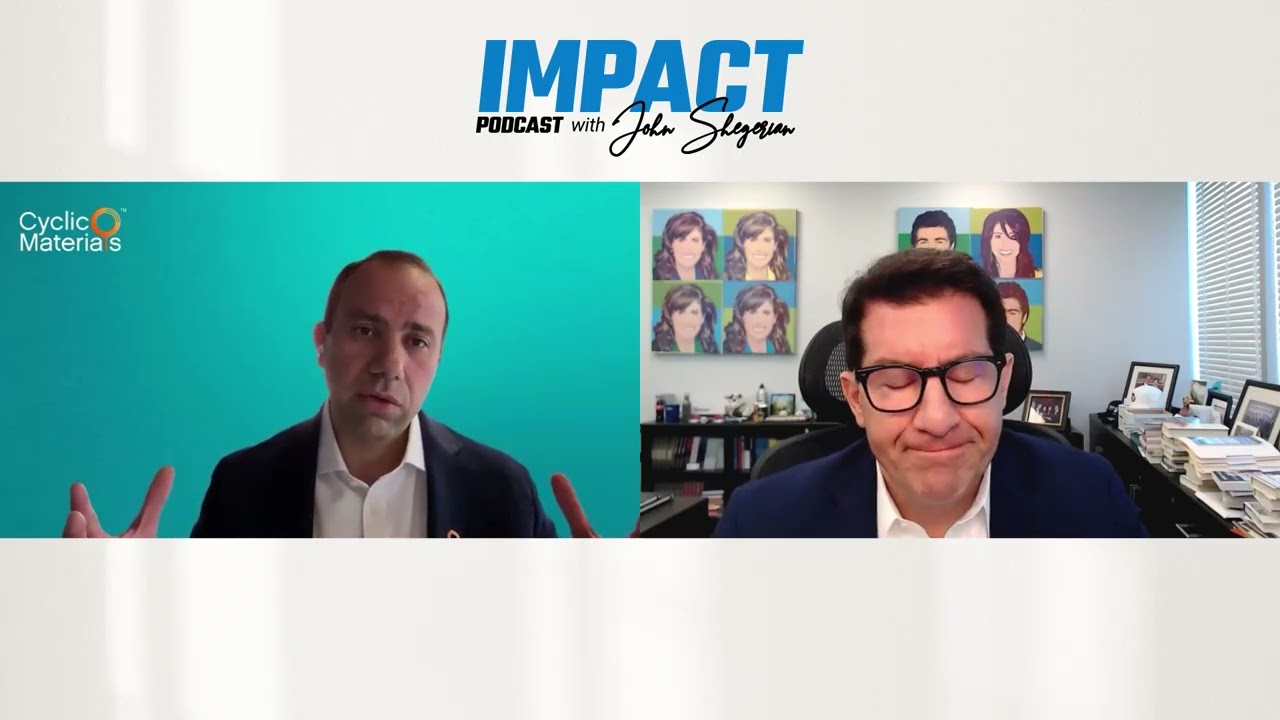
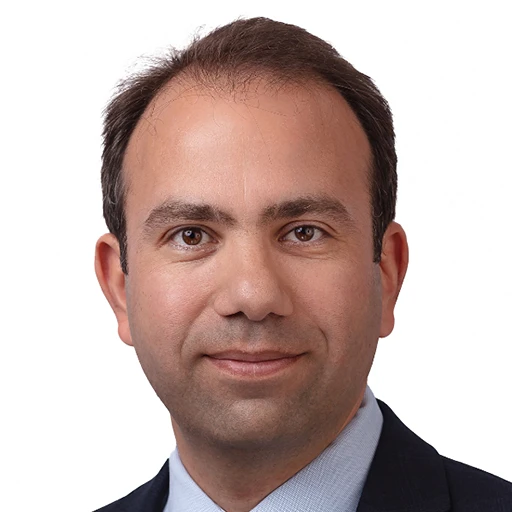
A serial entrepreneur with more than 15 years of experience in developing clean technologies for processing and recycling of resources, Ahmad Ghahreman is the CEO & Founder of Cyclic Materials, a rare earth recycling company that is enabling domestic circular supply of critical materials around the world. With dedication and a strong passion for a sustainable environment, Ahmad leads the company’s vision to transform the rare earth elements market with ethical, economical, and sustainable sourced metals available for the global market.
John Shegerian: Get the latest Impact Podcast right into your inbox each week. Subscribe by entering your email address at impactpodcast.com to make sure you never miss an interview. This edition of the Impact Podcast is brought to you by ERI. ERI has a mission to protect people, the planet, and your privacy, and is the largest fully integrated IT and electronics asset disposition provider and cybersecurity-focused hardware destruction company in the United States, and maybe even the world. For more information on how ERI can help your business properly dispose of outdated electronic hardware devices, please visit eridirect.com.This episode of the Impact Podcast is brought to you by Closed Loop Partners. Closed Loop Partners is a leading circular economy investor in the United States with an extensive network of Fortune 500 corporate investors, family offices, institutional investors, industry experts, and impact partners. Closed Loop’s platform spans the arc of capital, from venture capital to private equity, bridging gaps, and fostering synergies to scale the circular economy. To find Closed Loop Partners, please go to www.closedlooppartners.com.
John: Welcome to another edition of the Impact Podcast. This is a really special edition because I’ve got my friend with us today. He’s Ahmad Ghahreman. He’s the CEO and founder of Cyclic Materials. Welcome, Ahmad, to the Impact Podcast.
Ahmad Ghahreman: Hi, John. Hi, everybody. Great to be here. Thank you so much for inviting me to this podcast.
John: No. You are an innovator, a storied leader in the mining industry with numerous IP. We’re going to get into all the IP you’ve created over your unbelievable career, and you’re still so young. And also, you’ve launched, in the last five or six years, Cyclic Materials. But before we do that, I want you to share a little bit about your journey, where you grew up, and how you got on this very fascinating, impactful, and important journey that you’re on.
Ahmad: So, John, I immigrated to Canada in 2008. But my story on how I ended up here started a bit earlier in my high school years. And in a field trip in my high school years, we were taken to a copper refinery. And that’s where, as a kid, you go into, and you see that a blue liquid water, acidic water comes in, and red metal, physical copper metal on the other side goes out. And for my brain, for my mind as a teenager, this was fascinating. I absolutely was curious to learn how this is happening, how a liquid converts to a metal. And digging through library books and everything, I learned a little bit about electrochemistry, how to use electrons to make metals and all that. That put me on the path for my career, that one visit of a copper refining plant. I studied extraction of metals. I came to the University of British Columbia. Funny story, that wasn’t my very first goal to study what I did at UBC, but I ended up with that. I will tell you that in some other time. I started my PhD at the University of British Columbia on hydrometallurgy. That’s a very fancy word for how to make metals.
John: Wow.
Ahmad: And this is basically somewhere in between of chemical engineering and mining engineering. So you use both areas of knowledge and you become a hydrometallurgist. My focus was on copper, how to make copper. Then I did my PhD. And after my PhD, I joined Barrick Gold, which at the time was the largest gold mining company in the world. They had 27, I believe, back then, mines, assets, and different operations. That was really an interesting time to be there. One of the things I learned was you increase gold recovery by half a percent in one of the mines, and that’s more than $20 to $30 million a year cash flow, potentially, for that one single deposit. And this was eye-opening. But by this time, I was basically becoming an expert in gold and copper, and that was not enough. I wanted more. So I quit my job at Barrick, and I joined Queen’s University in Kingston, Ontario, Canada as a professor. As a prof, I started my lab on extraction of metals, and I spent some eight years in there. And this ended up becoming the largest and probably the most funded research team in North America, in U.S., Canada, on extraction of metals. Throughout those years, I ended up with probably more than 20 patents, many of them commercial today. But one of the key patents was what I discovered in my PhD. While I’m in the lab on a weekend, I discovered that there’s a way that you can leach copper or recover copper much faster. I call it engineered serendipity. And that was really exciting. That idea, that technology became a company later, valued more than a billion dollars. And that was another eye-opening moment for me. Throughout the years, at Queen’s University, I spent a lot of time on different metals. And one of those metals that I focused on to learn more, basically, was a group of metals called rare earth elements. I learned a lot about the industry, how the mining of that works, how the processing of that works. And I think, really, I consider my career from beginning of university, all the way to the day that I started Cyclic Materials, as preparation to start this business. I’m going to pause there, John.
John: Well, it’s fascinating. First of all, it’s so interesting how youth is so important, directionally speaking, to our careers, potentially. Because over and over again, when I’ve had the pleasure and joy to interview innovators like you, inventors like you, who come up with novel approaches and breakthrough approaches that can literally change the world, so many of them hearken back to their youth, something that inspired them in their youth. Now, you got inspired by copper. Let me start by this question. There’s a famous saying, copper is king. Can you explain, even though gold gets so much publicity historically around the world and has been around since time immemorial, why is copper the king of metals in so many ways? And why is it so important where we sit today in 2026 for the future of this planet?
Ahmad: So I’m happy to talk about copper. In fact, copper is one of the products that Cyclic Materials produces. It’s our second pay metal in the company. Absolutely important for our company and our operation. So happy to talk about copper. Copper has two actually different names. Some people call copper king of metals and some other would call it Dr. Copper. And the reason for that is, unlike gold, which some 40% of gold globally, give or take, my numbers are a few years dated, are used in jewelry industry, another 30-40%, basically we mine them and then they go into the banks for storage of value as gold, and the balance is used in industry. But for copper, it’s different. Copper, all of it is used in industrial applications, in appliances, in buildings, in machinery, in products, in gadgets. So if copper market is strong, it means that demand for products are strong in the market in different jurisdictions. And that’s a signal that the economy is working really fine. And if copper market is not doing great, it’s actually a signal back to the market that the consumers of copper, which are the big corporations, big OEMs, big companies, construction companies, they are not buying copper at the volume that they should. And that actually is a signal to the market, again, that sales of products is slowing down and probably market will slow down. And if market slows down, a lot of other things come with it, right? So that’s why they say if you track copper price, I don’t know how accurate this is, but in reality, copper price and economy actually follow one another, health of economy. So copper and health of economy are really correlated.
John: In your early career, when you created the IP and the patents around 20 or 25 patents that you own, and under the heading of the word you use, extraction, did that mean extraction in the classic mining sense? Or was it starting to migrate to urban mining extraction, which we’re going to talk about in a little while, when it comes to obsolete electronics?
Ahmad: So I started majority of my patents on making mining operations a bit more efficient. For instance, the very first copper patent that became a company called JD Resources, this discovery was helping copper mines to increase their copper production with almost the same capital costs. No additional capital costs needed, little bit capital costs needed. In some cases, to even double their production somewhere between 10, 20, 30 to double the production limit. So, initially, my focus was how, with the capital costs that we have already spent and a plant that we already have, can increase copper or other metals production and reduce the environmental impact and operating costs of those specific mines? Make those operations more robust. But gradually, my vision shifted, and I started envisioning a world that recovered metals and materials could be considered primary feedstock for OEMs or consumers of those metals. In a sense that we consume the product, we recycle that product properly, and then those metals are absolutely infinitely recyclable. We put those back into the economy. Now, there is a limit on how much we can recycle things, simply because-, I’m going to rephrase that. There is a limit on how much of material in the market could come from recycled products. And the reason for that is the population on our planet is growing. The consumption habit of people is improving and increasing. For instance, we consume much more metals in 2026 versus 1986. And the last is newer gadgets. We are consuming and using products and gadgets that 20, 30, 40 years ago didn’t exist. Smart speakers, laptops, and computers didn’t exist 40, 50 years ago in the scale that we have them today.
John: These didn’t exist 20, 30 years ago.
Ahmad: True. Yeah. So because of that, we always will need a stream of feedstock to come from mining industry. So recycling, while we have this growth in our demand, is not going to be able to recover all the needs, but can be the answer to majority of our need for the metals that we need. For instance, I will give you some stats.
John: Sure.
Ahmad: And I will confuse some of your listeners. So some 60% of aluminum globally is being recycled and continuously goes back to production. Some 50 to 60% of copper is being recycled. Lead is being recycled more than 90%. Steel or iron is being recycled around 40 to 50%. You can see a good trend of metals are today being recycled and put back into economy. But when it comes to some specific metals, we’re not doing great. And that’s how I was determined to start Cyclic Materials.
John: We’re going to go into Cyclic in one second. I want to ask you two more questions. One, about since you make a great point that so many of these-, because of the technological revolution, which in so many ways has benefited all of us in terms of making our personal lives more interesting, fun and democratized information, and also our business lives more connected and faster than ever. And there’s more people on this planet than ever before. So simply put, and let’s just take copper as Dr. Copper or as the king right now, is the demand for these metals going to outstrip what the mines-, since you’re one of the greatest mining experts in the world right now, does the demand exceed what the mines can produce, and therefore looking to this other sources of responsibly recycled metals, copper being one of them, the right way to go for us as an industry, as an innovator, and as a planet overall?
Ahmad: So the short answer is, I believe, yes. In many of the metals. And some metals probably not. But for some of the metals, that’s why we have the group of metals called critical metals. Each country usually identifies a group of metals and calls them critical metals. Basically, to come up with that list, you look into the availability of those metals in the next 10, 20 years, on how much we expect on our planet or in our country, we will produce that. And then consumption, demand for those metals in the next 10, 20 years. And then if there is a mismatch between the two, then they end up in critical metals bucket. Now, if the supply of those metals exists, but not in the U.S., but in friendly countries, allied countries, then probably those metals don’t end up in critical list. But if the supply chain of those metals that we don’t produce much, and we need [inaudible] of those metals is in countries that are not among the allied countries, then those are called critical metals. For instance, in copper case, the expectation is yes. The need, the demand for copper in the years to come is expected to be more than what we are producing today. That’s why a lot of copper projects on the mining side or value in recovering copper in end-of-life products is out there as projects that are being developed. Same is true for many other critical metals. And of course, one of the key critical metals in this category, basically, are rare earth elements group. Which, again, these metals, for a variety of reasons, which we can look into that a bit deeper later, are among the most critical metals on our planet that have to be recovered and resupplied in the market.
John: You bring up the terminology infinite recyclability. I’m so glad you did. You and I, as we know, have some good common friends, really people that are special human beings. Klaus Kleinfeld being one of them. When Alcoa invested in ERI back in 2010 or ’11, he gave me a master’s course in aluminum, and its infinite recyclability. But I want you to share something that most people don’t know or understand, because it’s really important for the great work that you’re going to do. And we’re going to talk about Cyclic and the start of Cyclic in a second. When these metals are infinitely recyclable, talk a little bit about the massive, the impactful energy savings that you get from recycling metals, as opposed to mining them from this precious earth that we’re all trying to preserve and protect right now.
Ahmad: So let’s look into mining and recycling for a minute and go through the processes that you have to do to get those metals out of mining and recycling, and then make a conclusion on what’s happening there. Let me start with mining. That makes it more interesting. Let’s say mining. So we start with a deposit. Usually it’s either on the surface or underground. So on the surface, we remove a little bit of waste on the surface, and then we get to the minerals that we want. Underground, we have to dig a tunnel, go underground, probably meters or maybe whatever unit you use, half a kilometer, a kilometer deep, and then you get to the deposit, and then you extract the metals and their minerals in there and bring them to surface and process those. Usually, let’s say copper, for every one shovel of copper ore that you pick up in the mine, you have another shovel of waste that goes into the tailings. So you move two shovels and only one of them is ore, but you’re not done yet. The ore you have now is usually probably 0.1 or 2% copper. So 99.5% is other things that we don’t want. But you have to move that mass of material. You have dug the ground. Half of it already is gone. This half, 99% plus, is stuff that you don’t want. Now you have to basically use different technologies and processes to recover that little bit copper from it. Now, our industry has become really efficient in doing that. We are using cleaner energy. We are using cleaner processes to do that. Just to be fair to mining industry. And if the mining is done in the US, if the mining is done in Canada, in Chile, in Australia, in some other countries, it’s done really properly. The companies take care of environment. They do a good job on extraction of those metals. But from 0.2, 0.3% copper, or 0.5% copper all the way down to 99.99% copper, there is a lot of processes to be done to get to that copper percentage.
John: Wow.
Ahmad: Now, I’m going to give you one example from gold mining and then come back to copper. When it comes to recycling, though, the material we start with, for instance, an electric motor, often it has more than 10% copper in it. Now, compare 10% copper with 0.5% copper. So you get the picture, how different…
John: 20x.
Ahmad: Exactly. That’s what you’re dealing with, with mining versus recycling. When you look into smartphones, if you have one ton of smartphones, usually you can expect 300 grams of gold. On the opposite side, when you have one ton of gold ore, you usually expect one gram of gold. Again, one gram versus two to 300 grams of gold in one ton of feedstock. So just because the two do not start in the same level, your power consumption, your labor consumption, your environmental impact, your water consumption, and your cost to recover one ounce of gold from either of those two buckets is really going to be different. Now, to be very fair and clear, when it comes to recycling, though, collecting the end of life is something that mining doesn’t have. In mining setting, your feedstock is in a deposit in one location. You go there, you mine there for 20 years, good, done, everybody’s happy. In recycling, though, we have to collect the material in our cities and bring those for operation. And this, if done smartly and efficiently, ends up being companies like yourselves, John, our company, and other companies, which basically creates that supply chain for efficient transportation of the material, shipping handling to the processing site. And from there, instead of 0.5% copper, you’re dealing with 10% copper and you produce final copper product. One other last bit I will add here is that with recycling, sometimes you can get very close to the final product. But with mining, mostly what happened in the past 20 years, is that we mine in-, for instance, a large portion of the world’s copper is being mined and concentrated in Chile. What it means is that we go from 0.5% in the deposit to 25% in the copper concentrate. So 25% copper, 75% other impurities. Now we ship this all the way to China, mostly, and refine it there. So that shipping and handling is not all loss versus recycling. It’s just a different format of shipping and handling. I’m going to pause there.
John: One last thing, and then we’re going to go on to Cyclic. Talk a little bit about time. The world, things are moving faster. Moore’s law is definitely something of the past, doesn’t really pertain anymore. So the pace of change is faster than ever before. So the need for these metals is greater and faster than ever before. Talk about two things. If tomorrow you and I were going to partner up and some investor gave us a billion dollars to build a recycling facility or dig a new mine somewhere on this planet, how long out in the mine would it take us to go get the specific metal that we’re looking for versus from the time that we built our recycling facility and how fast will we produce usable metals from that facility?
Ahmad: Let me give you two numbers here. So the first thing, capital cost and time to production.
John: Yes.
Ahmad: Let’s start the time to production. This is a study done globally. On average in the US, in Canada, in Australia, in South Africa, and in Chile, these are the countries that basically do a lot of mining, it takes 15 years from the day you say, “Hey, this is a great deposit,” to the day that you produce first ton of product and ship it away. 15 years. But in recycling, you can be incredibly efficient and fast. It took Cyclic Materials, us, three years and one month from the day we started the company to the day we shipped the first ton of rare earth oxide from our facility.
John: So it’s a 5x opportunity on that delta there, 5x?
Ahmad: And this is a company to start from the scratch with no capital, raise capital, hire people, perfect the technology, then build the plant and then deploy the plant. So this is not the same ground level that we start from.
John: Right.
Ahmad: Now, the second thing is capital cost. When it comes to recycling, with a billion dollars, you can definitely build a really robust, efficient, amazing, automated recycling plant and deliver the material immediately after as soon as the plant is up and running. With mining industry, the capital, the intensity of mining industry is so great that a billion dollars will get you to finish your engineering study and do some groundwork, but not even be close to having an operational mine. Usually for a copper mine, you are looking at around $5 billion on average. Well, the mines come in different flavors. You can have a small copper mine at less than a billion dollars, but if you are talking about a mine that produces, let’s say, 200,000 ton per year of copper, this is a good, nice-sized copper mine, then you are talking around $4-5 billion. For a gold mine at that size, you are talking about over $3 billion. For a rare earth mine, you are talking over $2 billion in good size, not even large-sized rare earth deposits. So, really, capital intensity of two industries are also in different leagues.
John: Fascinating. For our listeners and viewers who have just joined us, we’ve got today, Ahmad Ghahreman, with us. He’s the CEO and founder of Cyclic Materials. To find Ahmad, his colleagues and all the wonderful and innovative and impactful work they’re doing at Cyclic Materials, please go to www.cyclicmaterials.earth. It will be in our show notes as well. You don’t have to write it down.
Ahmad, talk a little bit now, you’re going along in your life. You’re a professor. You’re still very young and you’ve now been a professor for many years. You’re also an inventor, a straight-up inventor who has 20-plus IP patents to your name. How did you then shift or cycle or envision yourself and become an entrepreneur founding Cyclic Materials? How did that jump, because it is a jump, happen?
Ahmad: So, in early years of my career at Queen’s University, more specifically in 2014 or 15, I believe, I started doing a work for the government of Canada for NRCan on rare earth mines. The task was to look into basically all the important rare earth projects in Canada and with global view outside China and understand what are the biggest challenges of rare earth mining industry. Why this industry is not growing in Canada, in U.S., in other countries. So this was the task. So I looked into deposits in the U.S. I looked into the deposits in Canada and other countries in Africa. I learned about the challenges of each of these deposits have. I will mention a few. Either the deposits are small, so for the capital you put there, there’s not enough material to recover and basically recover your capital costs back. The deposits are too deep, so you have to remove a lot of waste before you get to the deposit. The deposit is out in very remote areas, so there’s no infrastructure to get there. There’s no power there, there’s no roads there to ship whatever you need and ship the products out. Radioactivities, some of the deposits, many of them actually, are radioactive with uranium and thorium. And this is interesting. The concentration of uranium and thorium often is high enough that causes environmental problem in your operation and waste treatment, and the concentration is low enough that you can’t recover them in an economically viable process within economically viable process that you can recover those uranium thorium or radioactive materials. So they become a challenge for the mine usually. Then this was really confusing. At the end, you invest in this project and then China controls the market, they manipulate the price, they drop the price, all of a sudden your project is not viable, confidence of the investors is gone, the project dies away. And then another company buys that project and then another five to 10 years of same cycle and then again, the story happens again. Then my conclusion was, just being dependent on rare earth elements is going to be risky. We need a baseline for the business to make it stable. Copper, aluminum and steel, in my mind, are the solution. When we start with end-of-life products, there is copper, aluminum, steel, plastics, and magnets. Majority of material are these things. So if we recycle copper, aluminum, steel, and magnet, then basically, we create a baseline of revenue from those three metals, copper, aluminum, steel, and then magnet, or rare earth elements on the top. And then we have a stable business that rare earth elements price can change as it wants. Our profit time to time will change, but we have a solid baseline to sustain the company. And this was the idea. Through this time, I was fortunate enough to be involved in lithium-ion recycling industry and learned a great deal from that industry as well. There are a lot of similarities and parallels between battery recycling and what we do as magnet recycling. In a sense that, let me say you have an electric car, you have a battery in an electric car, you tie up the battery to the electric motor. So if you’re recycling the EV, then you recycle both batteries and the electric motors. So you need to recycle everything. So a lot of end-of-life products that we would want to recycle, in fact, would have batteries in them because they are that group of the products that we recycle. Think of a power tool. It comes with an electric motor and a battery. And many other products. I don’t want to bore you with those examples. So looking into those electric motors and products that have magnets in them, that was the idea that we need to start a business that is stable. Copper, aluminum, steel takes a lot of the risk away and sustains the business for us. Now, how to collect the feedstock, process and produce the products, that was the IP of the company. So Cyclic Materials basically is unique in this space of recycling in the sense that we go way upstream. That we start with an end of product that has magnets and other products in it still, we recycle that and we take the magnet out, we produce a magnet concentrate, and at the same time ,we produce copper, aluminum, steel. Copper, aluminum, steel goes to market, we sell them and magnet goes to our second business unit through a chemical process. Now, we recycle the key ingredients that are inside the magnets, and those ingredients are rare earth metals. Now, a little bit about rare earth metals. Rare earth metals are a subset of a group of metals at the bottom of the periodic table. You can graduate your high school and not learn about them. That’s how much most people would know about those metals. But all of us have touched a magnet at some point. So all of us basically have touched rare earths at some point. When you use rare earth elements in making magnets, you now can make the strongest magnets in the world. And when you have very strong magnets and make an electric motor with that magnet, your electric motor ends up being really efficient. That’s why rare earth elements are absolutely critical and at the core of many of our industries in future. If I want to name a few, I can start all the way from defense to robotics to AI and data centers and cooling units of data centers to energy to electronics and many more.
John: Approximately, Ahmad, how many rare earths are there in the periodic table and how many critical minerals? I’ve heard different things and I’ve seen people definitionally define them all across the spectrum. But since you have this unique history of mining and also being an inventor, you know these numbers better than anyone. So if you were to be teaching one of your classes historically and say, this is how many critical minerals there are that we should all recognize and this is how many rare earths, what are those numbers?
Ahmad: So the number of critical minerals and metals changes almost every year, and I’m going to tell you why. But the number of rare earth elements that’s in the periodic table, it never changes. It is 15 plus 2. 15 of them in one series and two of them sneaked into the periodic table, so 17 of them.
John: So 17?
Ahmad: 17 rare earth elements. So these 17 metals have very similar properties. So in nature, in different geologies, they usually go hand in hand. Of these 17 rare earth elements, many of them we don’t have much use for. So when we mine those rare earth elements, we sell them for less than the cost we produce them. So mining industry loses a lot of money on, give or take, 10 of these rare earth elements. But the other seven makes enough money to cover the loss of the other rare earth elements. But to recover those seven, you have to recover all 17 of them and then refine them to 17 separate rare earth elements. Four of those rare earth elements, basically five, which are the most critical of those and most probably expensive of those, are used in magnet making. And for many different applications, neodymium, praseodymium, terbium, and dysprosium, plus samarium, are used in different versions of magnets. The first four are used in a magnet group called neo magnets, and the last one is used in a group of magnets that are very common in defense industry, for instance, and called samarium magnets. Now, coming back to critical metals, usually Department of Energy in the U.S., Natural Resources Canada in Canada, and other entities in different countries would review the list of the metals that the country has a lot of need for, but not much available in the country, and then they would create the list of critical metals. Now, there is a range of criticality. Some of the metals are critical, such as copper, but the market is so large that you can almost guarantee, or specific needs such as defense, you can always access copper. But some other metals, the market is so challenging and supply chain is so difficult, such as rare earth elements, which they are considered the most critical of critical metals. In the range of criticality, for instance, terbium and dysprosium, two heavy rare earth elements that are commonly used in magnets, are among the most critical of metals in our world.
John: Interesting. So talk a little bit about the aha moment. So you’re, like I said, teaching, inventing. Your patents have been used, as you pointed out at the top of the show, some companies have taken it and created a company around some of your patents and become a billion dollar plus company. When did you decide this invention, this creation of yours, which you already had a long track record of many successful creations and inventions before, you were going to keep and make into a business that you were going to be the CEO and continue to grow now in a new role, a new hat? No longer a professor, no longer an inventor, but now entrepreneur, innovator, visionary.
Ahmad: So, John, I started looking into what if you could recover magnet from end-of-life products? And I will tell you why this is the big question. So when you recycle end-of-life products, think of magnet on a fridge door. Magnets like steel or iron, they attach to it. When you recycle end-of-life products, magnet attached to steel, hand-in-hand with steel goes into steel recycling plant. And you recycle steel or iron, and magnet, the rare earth elements, go into the waste of steel production. I had isolated the problem. I knew this is a problem. I knew this is how we lose magnets. I needed the technology to undo that. So the aha moment was in my garage, actually, when I could recover a magnet from a shredded hard disk drive. So hard disk drives, data storage, everybody has one on their laptop, and actually, I tested this on my laptop, which I, in fact, bought to start my PhD studies. This is that very specific laptop that, John, you and I have spoken about. So the hard disk drive comes with steel, aluminum, and magnet in it. And I was looking for a technology to enable me to separate magnet from steel. An aha moment was when we were able to do that. And then immediately after I said, this is incredible. This is going to unlock a large new supply chain of magnets that doesn’t exist today. To tell you why this is important, John, even today, only 0.2% of magnets globally from end-of-life products are recycled. 0.2%. Basically, let’s agree it’s 0%.
John: Zero.
Ahmad: Or let’s say 1%. 99% goes to waste. 99% of magnets go to waste. So when I discovered this, I was confident this is going to unlock a new supply chain for rare earth elements that today doesn’t exist. And this was the beginning of the company. I also will tell you, John, that very early days, I looked for a CEO. Like the other companies, I looked for a CEO to run the business. I couldn’t find a CEO. I failed to find a CEO. And my conclusion was, this business is so important for the future of different industries in the U.S., in other countries that I can’t not start it. And that’s how I said, okay, I’m leaving university and I’m starting this business.
John: And how many years ago was that approximately?
Ahmad: 2021.
John: 2021? So approximately five years ago. So what you saw is a void in the marketplace that wasn’t just North America based, it was worldwide based. You had a vision and a delta of opportunities. Like to say, 1% being responsibly recycled, you had 99% delta to grow.
Ahmad: Yes.
John: 99%, and on a worldwide basis. You failed to find a CEO, that failure led to the default answer of you might as well be the CEO yourself.
Ahmad: I could not not start the business. It took me a few months to make the decision, but at the end, I was confident this is the right decision, and Cyclic Materials deserves to exist.
John: And Ahmad, let’s also be very frank. You were very, very happy and a very nice life as an inventor and as a professor. You enjoyed being a professor and an inventor.
Ahmad: Absolutely. I did. I did. I actually was doing a lot of consulting work for large mining companies, so I was mostly up in the air traveling, solving problems for everyone. So I enjoyed my career, but this was important. This was a mission. I could see something in future, 10 years from then, that how this can impact different industries. Let me add a note here, John. Rare earth elements, the total market in the world, I don’t have a solid number, so I will give you a range, is somewhere between 50 to 100 billion dollars. In the grand scheme of everything, 100 billion dollars is basically nothing. But rare earth elements unlock trillions of dollars of industry, from auto, to energy, to robotics, to AI, to many, many more, to medical, and to electronics. And that’s how incredibly important, small but important, piece of puzzle or industry rare earth elements are. To give you an example, it’s like the vitamins in our body. We need a tiny bit of them, but without those vitamins, our body will not function. Without those magnets, auto manufacturing facilities will shut down. We will not be able to make robots. Medical devices will not be made. Drones will not be made. And that’s the challenge with not having access to this small segment of metals.
John: So is this a fair statement, that without rare earth metals and making them more readily available and accessible, really, they’re needed for the future of SpaceX, NVIDIA, Anthropic, and all these brands that are literally on the cover of the news every day when you and I turn on Bloomberg or CNBC or the Wall Street Journal and New York Times. All the biggest brands and all the countries around the world need these magnets to power the future of the planet.
Ahmad: So let me expand on it. You’re absolutely right, John. Let me expand on it. The neodymium magnets in the speaker in my earbud, makes it a really quality speaker. The sound quality is fantastic. If I remove neodymium magnets from the world now, and I want the same quality of sound in my ears with an airpod, then I’m looking into a magnet larger than my head with the technology of magnets in 1950s or 60s. So just if you wake up one morning and all the neodymium magnets in the world are gone, our world basically will go back to early 1900s. We would not have any single hard disk drive to store data on. We would not have any quality speaker to enjoy music. We would not have any efficient electric motors that are low maintenance and long term life. A lot of other products would disappear in the world. I don’t even want to imagine that world for a minute. In fact, when people ask me one of the most important parts of our universe, our planet that makes our life modern, without any hesitation, I’m going to tell you magnets. You remove magnets, a lot of things will fall apart. A lot of innovations will not be here anymore.
John: Ahmad, I came out of the racehorse industry as a teenager, so I like to talk about racehorse metaphors. You’re the right jockey, and you have the right racehorse, but you need the best food, you need the best oats, hay and water to win the Kentucky Derby. So let’s talk about what was your fuel, what was your energy. You need capital. Is it okay on this show to talk about the unbelievable capital resources that saw your compelling vision and opportunity with you that then joined in your journey and help start financing this fantastic journey that you’ve been on with Cyclic Materials?
Ahmad: So that has been a big part of our story. So we have a refined vision in our company which has been consistently with us throughout the short life of the company, five years. But we have been able to work with different partners, strategic and financial, and bring in the most amazing investors into our cap table and have them backing us, supporting us in different levels of business. I usually don’t name our investors, simply because there’s too many of them and I don’t want to miss any, but I will name a few. For instance, on the strategic side, BMW iVentures, which is the venture fund of BMW car company, was one of the early strategics backing us. Then we had Microsoft to join us, then we had Amazon to join us, then we had Hitachi to join us, Jaguar Land Rover to join us. I’m sure I’m blanking on a couple of names here, but more. On financial side, we had Energy Impact Partners to back us, they are one of the robust venture funds out of New York. Fifth Wall on early days, ArcTern, Climate Investment, and most recently, two of the largest PEs, one of them, Canada Growth Fund, a $15 billion fund in Canada, and another one T. Rowe Price in the US, which is managing, I believe, $1.7 trillion of assets globally. So those started backing us since end of last year, simply because what we do is incredibly important for the future of industries in the US and other countries. What we do is absolutely the right thing for future cities, if we want to be the right citizens of the world, and also makes these critical metals available to the industries that desperately need these. So when you put all those together, and have a vision of building the infrastructure for this industry, then incredible people come and back you. And that has been our story here.
John: Has any governments also invested in your fascinating journey?
Ahmad: We have conversations with governments, but we don’t have a government investing in our company. Our company is a private company owned by private investors.
John: Understood. Well, that’s one of the greatest rock star lineups of investors I’ve ever heard in my life. Microsoft, Amazon, Jaguar, BMW, T. Rowe Price. Did you say Hitachi? Wasn’t Hitachi also in there?
Ahmad: Hitachi is there as well. We love them. Absolutely.
John: So talk a little bit about the journey. So you’ve been on this for five short years, but listen, as entrepreneurs go, five years is a long time in terms of, it’s a lot, it’s day and night, it’s seven days. You know, Jensen Huang talks about this. He’s a very big family man, he loves to take his wife and children to dinner and movies. He goes, “Listen, my company’s on my mind 7/24.” So it’s a lot longer. Although, physically, from a calendar perspective, five years is a long time when you’re dealing with someone like you who’s a visionary, who’s got big, big visions for what you could do with Cyclic. How has the journey been? Talk a little bit about, has it been the straight line that we all want it to be? Or talk a little bit about the left and the right hand turns that you’ve had to make along the way.
Ahmad: So first off, I will say I absolutely agree with that. I would sit at a dinner table and thinking of Cyclic Materials. I would be in a movie theater with my family, I’m thinking of Cyclic Materials. I would be on vacation at the beach, and I’m thinking of Cyclic Materials. This is probably one of the most important things ever in my mind. No, the journey hasn’t been a straight line. I always tell my entrepreneur friends the 24-hour law: In every 24 hours, you hear a good news and a bad news. So good and bad surprises are always around us.
John: So true.
Ahmad: Because, really, we are building something from scratch, that there is no playbook for it. We are writing the playbook. So to run a startup, to start a company, basically you need to be a machine of learning. You need to be a learning machine. You need to be willing, very fast and rapid in learning and taking action on that. So the early years, we started really small. So in 2021, in fact, at some point, I think we crossed the street and bought some power tools from Home Depot and brought them back and recycled those. Or some drones from Best Buy.
John: Humble beginnings. Humble beginnings. You started in your garage.
Ahmad: Yeah. Absolutely.
John: That’s the Hewlett-Packard classic story. You started in your garage.
Ahmad: Yeah. And that was our beginning. Then later on, we raised more money, of course, in different years, and we increased the capacity. As I said, we have two technologies in the company. So the first technology, the first business unit receives end-of-life products as is, that they have magnets in them. This could be a hard disk drive, this could be a smartwatch, this could be an electric motor, this could be an electric motor of an EV, this could be a generator of a wind turbine, this could be a drone, this could be a robot, and many more. E-bike, e-scooter, many different products. We received those as is, we process those in our first business unit, and we produce copper, aluminum, steel, and magnet. Copper, aluminum, steel, we sell away; magnet goes to our second unit. We process that with a chemical process, and we get rare earths out. Now, the first business unit we started piloting really large scale in September of 2023. And we shut down the pilot after learning a great deal of everything we wanted to in November of last year. For the second business unit, it’s a chemical process, so you have to run it 24/7, you can’t shut it down simply. So we did start a demonstration plant, which is an amazing plant for 100 ton per year of magnet capacity to be processed, in June or July of 2024, and we did run it until April of 2025 that we learned everything that we needed from.
John: Got it.
Ahmad: So that was basically how we matured the technologies. We made sure that we understand the chemistry really well. At the back end, for instance, in the chemical plant, in the last three months, we decided that, “Hey, we know everything about this process now. We’re going to run it like a Swiss watch for three months back-to-back non-stop.” We did that. And then we shut down those plants simply because we outgrew those. And the next thing for us was to raise more money and build commercial scale plants. We did raise the money, the funds that we needed. The first plant, which is absolutely incredible, and I can’t wait for it to start commissioning and running, is in Mesa, Arizona. That’s a 150,000 square feet space filled with machines. John, you have been there. The plant is…
John: Mind-blowing. It’s mind-blowing what I saw there. I walked in the door and I went for a tour, thanks to you, your generosity and graciousness, and it’s like seeing the future right in front of your eyes.
Ahmad: Thank you. Thank you. I appreciate that, John. We’ll have you come back again when it’s operating. I can’t wait for that date. So the machinery is basically installed now, ready to operate. We are soon to commission the plant. So we are in that last little bit of checking a few boxes before we start the plant. So this plant is to process 25,000 ton per year of feedstock and produce copper, aluminum, steel, and also 750 tons per year of magnet. We are building a chemical plant in Kingston, Ontario, Canada as well. That plant is to be commissioned later this year. That plant basically will take the magnet and process and produce rare earth elements. December of last year, we raised a bit more money from new investors, and that enabled us to start a really substantial project in South Carolina, which we are absolutely excited about. So this plant is going to be a complex of the first business unit and the second business unit. So this will be a combination of everything we have. This will be a flagship operation for us in future in South Carolina in the U.S., basically. This plant is going to be in McBee, which some of my team actually are there today as we speak. And the project is to be commissioned in 2028. So we are in the early stage of the project. We are finishing up engineering and construction to be starting either towards end of this year or maybe Q1 of next year. And the fundraising last year also enabled us to expand our projects line to Europe as well. We have been looking into a site that we have identified. We are in the paperwork stage right now. As soon as that’s finished up, we’re going to announce that as well. That also is going to be our first business unit to process 25,000 tons of end-of-life products and produce copper, aluminum, steel, and magnet. Which, for the time being, would come to South Carolina for processing.
John: So, Ahmad, as an entrepreneur, you have the right idea. You’re at the right time. Timing is everything. We’ll talk about that in a little bit. And you have the capital. What’s the algorithm you used as an entrepreneur who’s used to complex issues and coming up with the best solution at that given moment? How did you pick those locations and what’s the algorithm you used on a location choice decision making?
Ahmad: So for two different business units we have, we have different algorithms, and I’m going to tell you a bit more about that. For the first business unit that we are building, one in Mesa, Arizona, and about to commission the plant, as I said, access to feedstock, access to talent, and access to efficient shipping and handling roads is really important or train tracks. Simply because we bring in some larger volume of material, we process that, 25,000 ton per year. I have to say, though, in the grand scheme of things, 25,000 ton per year is not really a substantial number, but still, for one site, it’s quite a bit. So Arizona checked a lot of boxes. Considering from Arizona all the way to the west of the U.S., adaptation of hybrid cars happened in early 2000s. I’m talking about early edition of Toyotas, for instance. Then in Arizona itself, the data centers are popping up everywhere because we need more and more cloud computing and data centers for AI reasons. Those data centers are really dependent on access to hard disk drives and cooling units, and those products carry magnets in them. So circularity could support those. Auto industry being another industry in Arizona that we can rely on. Those were all on the feedstock side that we decided Arizona is a great place for us.
John: Got it.
Ahmad: When it comes to our chemical plants, talent is incredibly important, but also access to reagents, chemicals that we want, access to the talent pool that understands chemical processes is important as well. In South Carolina, for instance. And also access to feedstock, of course. In South Carolina, we are in the triangle of different auto companies that have their basically really large plants for different products, from [inaudible] all the way to auto manufacturers are there. And also, we have a very robust partnership, 10 years exclusive, with a German magnet making company called eVAC in the US, that they are building a super amazing plant that is very much an automated magnet making plant. It’s incredible. And this plant is in South Carolina. It’s only 40 miles away from our site, 45, 50 miles away from our site. And having conversation with their CEO, I was looking into the Google map on how far the two sites are and everything. And this actually is going to be the shortest circular supply chain of rare earth elements anywhere on our planet. It’s going to happen in South Carolina.
John: Wow. That’s awesome. So over there, the algorithm changed a little bit in that you wanted to pick the right collaborative partner in proximity of you for more circularity. I love it.
Ahmad: One of the biggest reasons for us to be in South Carolina, a lot of reasons, but one big one was the partnership we created with eVAC and wanted to be close to our partner and support their efficient operation in there.
John: You and I know an entrepreneur’s journey is never over. There’s no finish line, it’s just an ongoing journey. Talk a little bit about, you’re going to open these three facilities in North America. You said one, next time you come on the show, you’ll announce your new location on the European side. Talk about other continents and other opportunities. What else is going through your mind right now in terms of other opportunities? Because, obviously, the need and demand is great around the whole world. Where are you thinking of next after Europe and after North America?
Ahmad: So after North America and after Europe, the logical next destination for us is Asia. And there are good reasons for that, John. End-of-life products, the sheer population, the large population of Southeast Asia, let’s exclude China, for instance, Southeast Asia, those countries are large consumer of different products. For instance, in Japan, electrification is really… Adaptation to electrification, different gadgets, tools and products in South Korea. Manufacturing in different countries is in different levels. You go in some other countries, e-bikes are absolutely massive. And each country has its own angle that we are looking into. And that’s our next logical destination, to be in Asia. Of course, creating partnerships and building on those partnerships to enter those new jurisdictions is going to be incredibly important. For instance, John, I won’t mention the names unless you mention on this podcast, your business is looking into some Asian destinations as well. And those partnerships you have created are absolutely credible and important for you to be able to have a successful launch of your business in there. And the same is true for us as well. So we are looking into the same opportunities in those destinations.
John: Yeah, it’s a different time. You and I have had this discussion off air before. Going back to the era of the sole innovators, the Bill Gates of the world, the Google boys of the world, the Mark Zuckerbergs of the world, even the Jensen Huangs of the world, or Elon Musks of the world. It’s time now more than ever as a responsible, fiduciary and smart CEO and entrepreneur, to collaborate with the right partners. The people who have and countries that have the shared vision that guys like you and I do in shared integrity and commitment that we have. And I think that’s why we’ve aligned together and are working together closely, our brands strategically, and we also see the world similarly in terms of picking the right countries that welcome us and welcome our vision to support their vision of having a greater circular, more resilient, and more independent future.
Ahmad: I fully assign to that and I agree with that. One key word you had in those partnerships was integrity. Integrity of the partners is absolutely important, and it’s really the important piece of creating those partnerships. You want to partner with people that you are proud of being partnered with them today and you’re going to be proud of being partnered with them 10 years from now. That’s really the important piece of the puzzle. I’m not really much of a complainer, John, but one thing I will say, some of the entrepreneurs out there, they really want to do the things the easier way and shortcut some of the challenges. I’ve never seen a shortcut really. It doesn’t exist. We, in our company, do things the hard way and get things run the right way. With that vision, when we find partners that they actually understand the value of integration and partnership, then the partnership becomes absolutely the easiest thing to do. And figuring out how to tackle the projects and problems is the next thing on the agenda. So that’s the vision. That’s how we create partnerships. And John, absolutely and incredibly excited about the partnerships that we have forged between ERI and Cyclic Materials, and can’t wait to see how this partnership is going to evolve in the next five to 10 years. You sometimes say asymmetrical outcome of relationships and partnerships, I’m going to hand it back over to you because that’s one of the smartest sayings that I’ve heard any entrepreneurs say.
John: Yeah. Our relationship is going to be both symmetrical and asymmetrical, and that’s the fun of it. Because we know a lot of the outcomes that we’re going to have, but we don’t know other great ones, the happy accidents that are going to happen for us along the way. And that’s what makes it exciting every day to get up and keep doing the great work that we’re doing not only solely but together. A couple of more questions before I let you go today. You’ve been so generous with your time, Ahmad.
Ahmad: Of course.
John: If I were to ask you the three today-, and again, this is obviously because life as a CEO changes, like you said. I’ve never heard that before, but I fully agree with your analysis of every 24 hours we get some good news and we get some bad news. What’s the three greatest sources of demand the next 12 to 24 months that you’re going to see for the products that you’re creating?
Ahmad: Just so I understand the question, the demand sources, what industries are going to consume these materials?
John: Industries or governments? [crosstalk].
Ahmad: Oh, sure. Absolutely. I’m not going to talk about the volume…
John: No.
Ahmad: … but significance of demand.
John: Yes.
Ahmad: Defense, by far, is going to be the most important one. Probably the volume is not going to be the most significant one, but the need in defense is absolutely the most critical one. And from there, AI and robotics. Robots are simply the biggest driver that we’re going to see in the next while to be for these rare earth elements and products. Perhaps auto industry and energy industry combined together in the next 10-15 years will have an impact as well. But if you ask me for three, I would say defense, AI, robotics.
John: Got it. Love it. Speaking of AI, there’s not a day that you and I wake up and turn on Bloomberg or CNBC or read the Wall Street Journal or New York Times, where AI is not a cover story somewhere on the left side of the page if we’re reading. How much is AI going to enhance and accelerate the great work you’re doing at Cyclic Materials?
Ahmad: In three different levels, AI is helping us already and will even help more in future in different levels of the company and operations. From operations side, for instance, in the office, we use AI for different reasons. For research, for many other applications, sourcing of material, variety of opportunities in operations and plants for identification of material in the processing and many other applications. AI supports us to basically make the plants more efficient. Processing of our chemical plant, AI basically immediately comes in, and instead of a person making a decision or a simple computer model making a decision, AI enables us to make more efficient, better, refined decisions at different times. And those things are going to be incredibly impactful on Cyclic Materials operation itself. But if you ask me about impact on Cyclic Materials from feedstock side all the way to consumption of our product side, I can tell you that a lot of these data centers that are being built are going to depend substantially on magnets. Every single hard disk drive in the corner has a magnet. Those cooling units in the data centers depend on access to magnets for energy efficiency. Even the chips you make are made with equipment and instruments that rely on these critical rare earth metals. So supply chain of AI is fully dependent on that. But the other day, there was an article that AI gets physical. I don’t know if you read that. And I think by AI gets physical, what we mean is robotics.
John: That’s right.
Ahmad: And robotics are going to be an incredible source of magnet consumption as well. If a robot moves around with your vacuum cleaner in the house, it has an electric motor. Electric motor very likely has magnets in it. If the robot has an arm that moves around and does things for us, that’s an electric motor, that’s a magnet. If the robot talks to you, that’s a speaker, that’s a magnet. You see, every corner of that, there is a little bit of magnet everywhere.
John: I was recently with a CEO of a humanoid robotic company, one of the leading CEOs. He tells me at the conferences where they gather, the conferences on robotics and especially humanoid robotics, their discussions right now in terms of predictions for the future, is by 2040, there will be anywhere from 10 to 15 billion humanoid robotics helping us in our factories and our homes around the planet. 10 to 15 billion. They’re all going to need your magnets.
Ahmad: So [inaudible] a few years ago, probably four or five years ago, there was a graph, and I’m going to visualize this so your listeners can visualize this in their mind as well. There was a graph that was showing the portion of demand from different industries for rare earth elements or magnets in the next 10 years, 2020 to 2035, 15 years. And then this was auto industry, this was energy industry, this was industrial applications, many different applications, and the growth was incredible. The rare earth chart was growing 3 to 5x in the next 15 years. This is insane. And then a year ago, someone redid this graph and added robotics. And the need of robotics industry is now basically dwarfing all the other industries together. That’s how much magnet is needed by robotics by 2040. Your number is right. By 2040, I think it will be 9 billion, 10 billion people on our planet, but more than 15 billion robots around. And each of those robots will depend on these magnets. And you simply can’t imagine industries building again products in the US if you don’t have a secure supply chain of those magnets in the US. Right now, 93% of those magnets are being made by Chinese companies, give or take, plus minus. So if that doesn’t change, the companies that are going to build those robots are going to say, “Wait a minute. If I don’t have access to the most critical part, tiny, but most critical part of my robots in the US, that’s going to be a big challenge.” And that’s really one of the reasons that the US government is spending enormous amount of time and energy to get this right and build the supply chain within US. And this is happening all over the world, but US is leading [inaudible] on how they think about it and how actually they act about the industry.
John: You know, Ahmad, as I go back to my horse racing metaphor, in terms of picking a horse that you think is going to win the whole biggest race ever on the planet, the Kentucky Derby, for sure, my bet is on you and my bet is on Cyclic Materials. But practically speaking, you and I have lived through a world where valuations have become outsized. A mere six or seven years ago, there were no trillion dollar companies. And now you and I, as we record this episode, we’re on the verge of seeing two or three more trillion dollar companies come online. SpaceX is going public very soon, OpenAI is, Anthropic is, potentially all trillion dollar companies again. To add to the list, I think there’s 12 today, maybe 13. The list changes, is ever changing. But it’s going to be a growing list. Am I silly or foolish to believe when I’m placing my bets that Cyclic Materials, in the future, could be one of the next trillion dollar companies? Because the vision and the delta of opportunity is global. The opportunity to recycle, to take it from a 1% rate to at least a 20% or 30% rate, the delta of opportunity is so big that, really, am I silly or foolish to believe that you’re sitting on top of one of the next trillion dollar companies on this planet?
Ahmad: John, no, not at all. The execution is going to be key. How to execute this and get this to the ultimate goal is going to be key. But you’re absolutely right. The ultimate circularity is going to be an integral part of our future. We can’t live without circularity in our future world. We are consuming so much now versus 50 years ago that circularity has to play a key role in there. And also circularity is the shortcut or the proper way to access a lot of these critical metals without depending on other countries for it. So circularity has substantial role to play and a large role to play. At Cyclic Materials, we are starting with rare earth magnets, but this is not where we stop. This is our first goal, but this is not our last goal. And you will hear more and more about Cyclic Materials in the upcoming years. We really are focused on execution. We are heads down busy with things that we are building and working with partners to make their supply chain more robust to add value. The only goal we have is make these metals while we are creating value for our partners. And that’s what we are focused on.
John: I love it. And with that, I’m going to say this, Ahmad. Since you and I know the circular journey, the entrepreneur’s journey is never really over, there’s no finish line. I just want you to know you’ve been so amazingly generous with us today, with me today, to share your fascinating story of Cyclic Materials and your own personal journey as well. I want to say thank you for that, for the last 95 minutes. But I also want you to know, I want you to come back continuously on the show and continue to share this very important and impactful journey that you’re on with our listeners and viewers who are very interested and excited about what you’re doing. For our listeners and viewers, to find Ahmad, his colleagues and all the very important work they’re doing at Cyclic Materials, please go to www.cyclicmaterials.earth. Ahmad, thank you, not only for being a great friend, thank you, not only for the work that you shared with us today, but thank you for making the world more circular, sustainable and a better place.
Ahmad: Thank you, John. And it has been an absolute pleasure to be here.
John: This edition of the Impact Podcast is brought to you by Engage. Engage is a digital booking platform revolutionizing the talent booking industry. With thousands of athletes, celebrities, entrepreneurs and business leaders, Engage is the go-to spot for booking talent, for speeches, custom experiences, live streams and much more. For more information on Engage or to book talent today, visit letsengage.com. This edition of the Impact Podcast is brought to you by ERI. ERI has a mission to protect people, the planet, and your privacy. And is the largest fully integrated IT and electronics asset disposition provider and cybersecurity focused hardware destruction company in the United States, and maybe even the world. For more information on how ERI can help your business properly dispose of outdated electronic hardware devices, please visit eridirect.com.
 Spotify
 Apple Podcasts
 Amazon Music
 iHeartRadio
 YouTube
 YouTube Music
 Audible
 Pandora