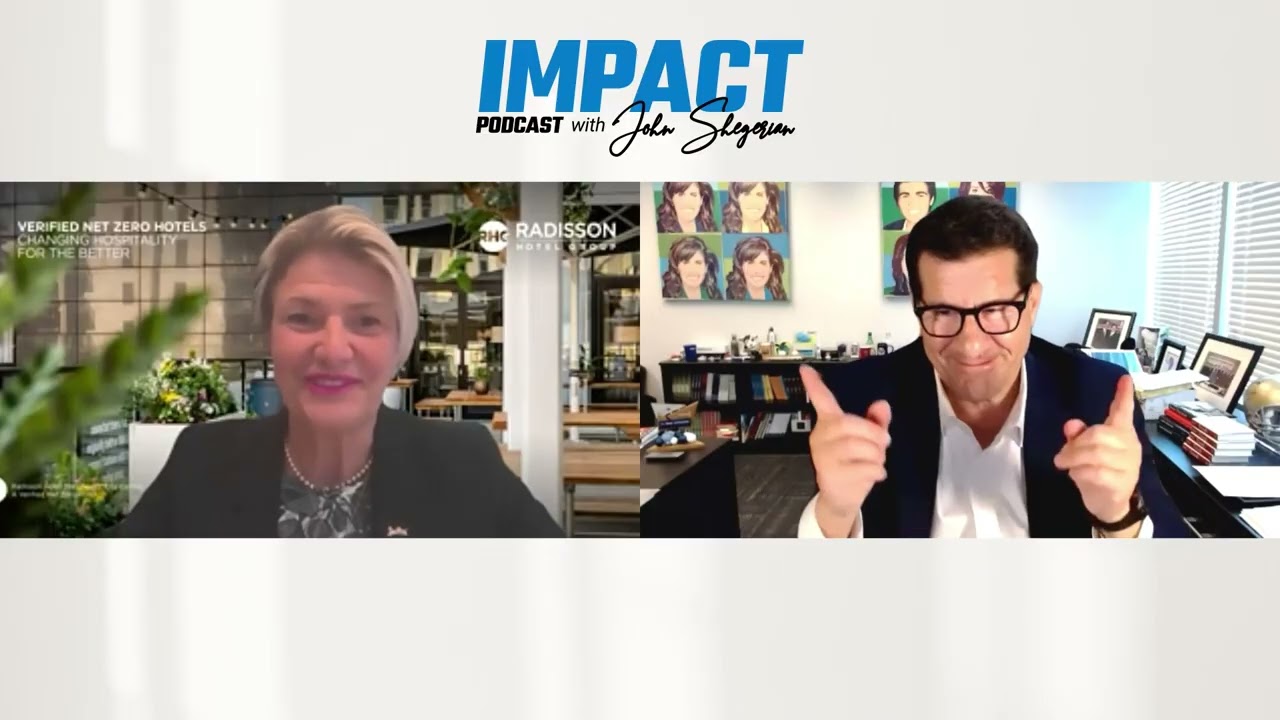
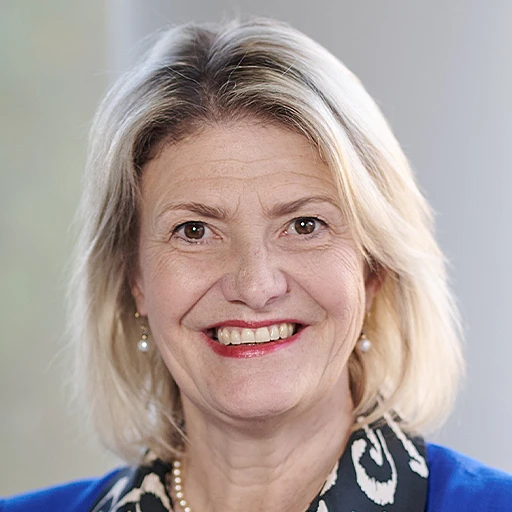
Inge Huijbrechts is Chief Sustainability and Security Officer for Radisson Hotel Group (RHG) – developing the Sustainability and Safety & Security programs in the group’s close to 1,600 hotels in operations and development in 95 countries around the world. She leads the group’s Net Zero 2050 transformation based on approved science-based targets. In 2022, she was one of the key leaders involved in the definition and launch of the Hotel Sustainability Basics. The standard is supported by the World Travel & Tourism Council and hotels groups, destinations and associations representing over 50,000 hotels. In 2025, under her leadership, the company introduced the industry’s first Verified Net Zero Hotels, a concept for which Inge was recognized in the Skift Climate 10 leaders.
John Shegerian: Get the latest Impact podcast right into your inbox each week. Subscribe by entering your email address at impactpodcast.com to make sure you never miss an interview. This edition of the Impact podcast is brought to you by ERI. ERI has a mission to protect people, the planet, and your privacy, and is the largest fully integrated IT and electronics asset disposition provider and cybersecurity-focused hardware destruction company in the United States, and maybe even the world. For more information on how ERI can help your business properly dispose of outdated electronic hardware devices, please visit eridirect.com. This episode of the Impact podcast is brought to you by Closed Loop Partners. Closed Loop Partners is a leading circular economy investor in the United States with an extensive network of Fortune 500 corporate investors, family offices, institutional investors, industry experts, and impact partners. Closed Loop’s platform spans the arc of capital from venture capital to private equity, bridging gaps and fostering synergies to scale the circular economy. To find Closed Loop Partners, please go to www.closedlooppartners.com.
John: Welcome to another edition of the Impact Podcast. I’m John Shegerian, and I’m so honored to have with us today Inge Huijbrechts. She’s the chief sustainability and security officer from Radisson Hotel Group. Welcome, Inge, to the Impact Podcast.
Inge Huijbrechts: Very happy to be here, John.
John: Thank you for being here. I know it’s a little later in the day for you over in Brussels, but thank you for being here, and this means a lot to me. For you to come on. It’s your first time on the Impact Podcast, and we’re going to talk about your story career and all the awards and everything you’re doing, but also what you’re doing at Radisson Hotels. But before we get into all of that, which is important, I want you to share a little bit about where you grew up and how you got on this very important journey that you’re on.
Inge: With pleasure, John. I’m in Europe. I’m born and raised in Belgium so a big lover of chocolates, as you can imagine. I actually got on the sustainability journey, I started my career always in an international context. But I really got into sustainability about 20 years ago because I made a long, long sailing journey, and that allowed me to see actually how beautiful the planet is. But at the same time, also, people were starting to have quite a detrimental impact. So when I came back, I kind of restarted my career and I made a promise to myself to do that in ESG, and the rest is history. Here we are. It’s succeeded in a few different roles, and then I joined Radisson Hotel Group 15 years ago. Now in the meantime, have added safety and security and public affairs to my remit.
John: Wait. You got inspired from your sailing journey.
Inge: Yes.
John: Classically, when it came to your education, were you focused on this at all when you were getting educated in undergraduate school and also university?
Inge: I’m an engineer by training, so of course it’s a combination of business and engineering. But I must say I’m a bit older, so in that time there was nothing about sustainability per se.
John: That’s right.
Inge: Or at least it wasn’t framed as such. I think some of the principles may have come back, but certainly not a specialty, not a specific subject, and even as I was getting started into the ESG journey, it was still pretty much early days.
John: You’re right. I’m going to be 64 years old in a couple years, and in a couple months actually, and back when I was at NYU there was no such thing as environmental sciences [crosstalk] and environmental engineer.
Inge: Exactly.
John: Didn’t exist. This wasn’t part of our upbringing in the United States. Europe is ahead of us when it comes to sustainability, so it’s just so interesting how generationally things have changed so fast, for the better.
Inge: But I think honestly, if I may, I think sustainability is just a bit about thinking long term about the world we want to have, and maybe reconnecting to some of the good habits that our grandparents may have had. I think it’s about that. We frame it, it’s become a technical subject, it’s become part of compliance, but in a way it’s also that.
John: Agreed.
Inge: It’s common sense, very often.
John: I fully agree with you. People like to overcomplicate it. I think you’re exactly right. I think you’re spot on. You joined 15 years ago, the Radisson Hotel Group. Now, before, just for our listeners and viewers, first of all, just to understand Radisson a little bit, over 100,000 employees over 1.3 billion in revenue, and serving over 120 countries. If you want to learn more about Radisson, please go to www.radissonhotels.com, Radisson Hotels. We’ll put it in the show notes. You don’t have to write anything down. Inge, when you joined them, what was your role then? What was your title then when you joined 15 years ago?
Inge: Yes. I’ve joined as, at that time, director for sustainability for Europe. It was already very exciting at that time because the company had quite a tradition. The roots are in Scandinavian countries, so sustainability started even earlier there. So there was already this mindset towards sustainability, at least for Europe, Middle East, and Africa, what I was doing at the time. But at the time, we were, like, 300 hotels, maybe 320, 330, something like that. Now we are more than 1,600. So the company has evolved and grown spectacularly. And so in a way I have grown with it to get a global responsibility in sustainability first and then seven years ago security and safety as well.
John: Were you answering to a chief sustainability officer when you took on the director role? Was there a chief sustainability officer 15 years ago?
Inge: No. I was actually working directly with the CEO at the time.
John: What I’m trying to get to is when you were hired 15 years ago or so, you were coming in answering directly to the C-suite, and it was the proverbial white board. This, you were the first sustainability leader at Radisson.
Inge: Not exactly. I did answer to the CEO. There were people before, but I must say the big difference is at that time. Mind you, we started really early. We had already a program on what we call responsible business in the early two thousands. We had our first environmental policy in the company in ’89.
John: That’s early.
Inge: This is amazing.
John: That’s early.
Inge: That’s because of the Scandinavian origins of the company. But there were people before me. I would just say that what I managed to do is put it higher on the agenda, structure it, give it targets on top of the program that already existed. There were really good foundations, but it needed to be lifted to a more executive level, and I think from there we built with targets, we built with our first successes. In the first five years that I was there we managed to reduce our energy intensity by 25%. We created a target and then a whole engagement program across the company, which was smaller at the time. If we’re talking about that now and it’s 1, 600 hotels, it’s a different dimension. But still, it was the first steps to make it more into an integrated program. And today responsible business ESG is part of the company’s strategy, of the five-year plan, of the regular strategic reviews, et cetera.
John: When you came in you put KPIs and you started measuring things. Talk a little bit about narrow or wide. As you and I know you know, I have the unique position where I get to interview chief sustainability officers across the planet for the last 17 years, director of sustainability, chief impact officers. They are called all different things. It could be either read narrowly or very broadly. In terms of your reading of it, how would you term your role at Radisson now in terms of wide or narrow, and how do you choose now what to focus on? Because it’s easy to get distracted in this world. A lot of things are being thrown at us, and there’s a lot of new trends, old things. There’s all different things. Talk a little bit about, as you said, how do you stick to the common sense and materiality of the main mission of Radisson Hotels when you tie sustainability back to it?
Inge: I think first of all, you need to realize that a hospitality company, is a people’s business. So thinking about our people is essential at our core, and we have different elements in that. It’s keeping them safe, giving them development opportunities, making sure that we have diversity, et cetera. Then you have, of course, we’re part of communities in so many places where we are. You said it, we’re in more than 120 countries. We are sometimes the only branded hotel in that area. Or you may be in an area that faces challenges in terms of conservation, nature preservation. You may need a connection to your community for different reasons. So thinking about the community, contributing through employability and meaningful interactions is key. And employment, of course. And then lastly, of course, the planet because if there’s no nice and fantastic planet that we call home we cannot travel. So we are connected to all aspects of our business, and of course, we work very intensely with departments like procurement, HR, people in culture operations across the board. Now, what Radisson is strong at is on one hand doing the fundamentals. So for example, we have approved science-based targets. That means carbon reduction targets on a goal to decarbonize to become net zero by 2050, and the steps are known, and they are approved by the Science Based Targets initiative. That’s the fundamentals. That’s the framework of which path we need to go to decarbonize. On the other hand, we also, and that’s fantastic about working with Radisson, is that we, with our ESG, we can also be part of the value proposition and of pioneering initiatives. Like a few years back in 2019, we were the first company to say we’re going to make all of our meetings and events footprint worldwide carbon compensated so that when people or businesses host events in our hotels they know that the location footprint is actually compensated and is zero. Then we went on to launch an entry-level sustainability certification called Hotel Sustainability Basics, which we make part of our entire portfolio today. It’s more than half of our hotels that are sustainably certified. Then last year, we launched a pioneering program called Verified Net Zero Hotels, where we offer the best of the best of sustainability to our clients, B2B or B2C. So it’s not only doing the, let’s say, technical sustainability and making sure that we have our targets and our reporting and our compliance and everything in order, but it’s also about how can we make it easy for guests to stay in a sustainable way and connect it to the marketing and value proposition?
John: That’s fascinating. So let’s go back. I love what you just said. I want to break it down a little bit. You talk about people. Obviously, these two groups of people that you’re constantly thinking about. One is your wonderful 100,000 or so colleagues that work at Radisson. Two is the wonderful people you get to serve, your client base, your guests. So when it comes to your 100,000-plus colleagues, in the world now that is more crowded with communication, social media, traditional media, all sorts of things are coming at people faster than ever. Everyone has a big distraction in their pocket. Everybody has their own cell phone, and family and friends are constantly barraging people with text messages, and then they’re on all different social media platforms. How do you successfully communicate with your colleagues and in terms of what you’re intending to do and what you are accomplishing in sustainability at Radisson, so they’re not only aware of it, but they become ambassadors for what you’re doing and eventually evangelists? How do you successfully do that in a world where so much communication’s coming at everyone on a daily basis?
Inge: Well, that’s the exciting part about being in a hotel company. People love to interact. People love to serve. We say we serve with our Yes I Can service ethos, ethos.
John: I love it.
Inge: People love to interact. So they’re not necessarily stuck behind their cell phones all the time. They love to be part of networks. What we did since the beginning, and that’s something that’s super powerful, is that in every hotel we ask that there is a responsible business ambassador or champion. That champion then is part of a country network, or sometimes it’s a regional network if we have less hotels in that particular region. But then they work together with what we call an area responsible business champion, and then those people are also coming together with us. So in general, we have about 30 area or regional responsible business champions, and we have in every hotel someone. Every hotel has someone. Those roles are also seen as a way for people to grow in the hotel if they want to take a responsibility that’s beyond their, let’s say, functional role in the hotel. We have people who are executive chefs, front office managers, housekeeping executives, the general manager sometimes, the salesperson and the engineer, of course. So it depends. Sometimes financial controllers. It can be anybody in a hotel. Anybody who steps forward and says, “Yes, I like this. I like the program.” Everybody is trained as well. So when we have new hires, and that happens quite a lot, we open a lot of hotels, and of course sometimes teams change, so the new hires also get first an online training and then a classroom training on responsible business. When they like it, they can be part of it. So very often, people who first then became the hotel champion or the area champion you later see them evolve in their careers because it’s a way to be part of this network, to connect to the headquarters and to area leadership, to also have conversations about campaigns we do. So it’s like a little pyramid, and it works bottom up and top down, and the good stories reach us, and we launch campaigns, and it’s always super engaging. So for example, now in September a colleague of mine is launching, and our team is launching what we call the Move to Zero campaign that’s all about decarbonization. But it’s a fun campaign. We give them access to like a detective game to find hidden savings that they, they don’t see, and so it’s a bit of fun. We engage people. We have a little mascot that we’ve been using since I joined, basically. So these kind of things they make it fun and they make it engaging because it’s a people’s business. So if you do that, but you also make sure that everybody has the right content, it’s not only fun, it’s also based on facts and [crosstalk]
John: Substance.
Inge: how we perform, and you see the company advance. I think we’re doing pretty good at reaching an ever-growing international network.
John: As we’re talking about your colleagues, before we move to your guests in terms of communication, do you find what you do in sustainability and your colleagues and the accomplishments that you’ve achieved over the 15 years, is that a great recruiting and retention tool for your employee base?
Inge: More and more. Actually if you look at market figures it’s said that from the Gen Z, like 70% or 70-plus percent, they look at the purpose of a company, and they look at the fact if you’re actually not just greenwashing, but if you’re actually doing what you’re saying you’re doing. They’re very savvy. We’re getting more and more. First, the recruiter always speaks about it, but secondly, also that they really get questions about it. So yes, it is something that increasingly matters to generations, and I would say yet the younger generation more than before.
John: Interesting. Now let’s flip the question and talk about your guests, your clients, the people who stay at your hotels. How do you communicate with them effectively as to what you’re doing?
Inge: Yes. We do, but it’s a delicate balance. So it’s always a balance of don’t overload them. Of course, we don’t want clutter and paper all over the room. We don’t want that, so we are using technology also to communicate better, and we need to find a balance. And of course, the things that we talk about that are technical, like a scope 1 and a scope 2 and a scope 3 carbon footprint a traveler couldn’t care less.
John: Yes.
Inge: Unless, of course, they are the sustainability lead of one of our B2B clients. That’s a different story that we can talk shop over a coffee or a tea. But people don’t want that. We need to find that balance of bringing the message, showing that it’s real, and then also informing guests correctly. So I think the best place where we’ve done this the best is actually with our Verified Net Zero hotels because this is really a program where we go as far as we can go. We eliminate the emissions from energy, and we reduce the emissions from our operations as much as we can, and then we carbon remove through certificates the rest. It’s never been done before. It’s done according to a methodology, and it’s verified by a third party. Now, that technicality is all good and well, but you need to bring it to the customer. The way we did it is we changed the name of the hotel. It has an appendix. It’s called, for example, the Radisson RED Oslo City Center, which is a hotel, and then it becomes, a Verified Net Zero Hotel. And every hotel when you book you’re going to see it’s a net zero standard room, suite, whatever.
John: I want to slow you down for one second. So let’s pause on what you just said earlier. It’s never been done before. Does that mean never been done by Radisson or in the hospitality industry as a whole?
Inge: In the way we do it, never in the hospitality industry before.
John: This is truly Radical and breakthrough in terms of you leading on something that’s never been done before in hospitality. So all eyes are on what you’re doing. Where did you decide to beta launch this. Explain then pick up where you just left off. What does it look like if I walk in? Give me the whole experience.
Inge: Exactly.
John: Where did you do the first one?
Inge: We did the first ones in Oslo and in Manchester, so Manchester in the UK. Where you say it’s the birthplace of the Industrial Revolution. Now it’s the birthplace of the net zero revolution.
John: Love it.
Inge: Then in Oslo, of course capital of Norway, very sustainable, by the water a very sustainable destination. When we talk to our clients, the whole technicity of what I said on scope one, two, and three footprints the novelty is that we include scope three footprint. The novelty is that we’re doing this according to an industry methodology, and the novelty is that it’s verified and checked by a third party. That’s all the novelty. Now, when we talk to clients, we say the hotels run, they are verified net zero. It’s in the name as we said. They run on 100% renewable energy. They offer low carbon menus, and they are a minimal waste operation. In all transparency on our website, you can read about it technically how it’s done. But that’s the core thing, and you know that your stay and your meeting is going to be net zero. So what do you see when you walk in? For example, you see that these hotels they don’t use paper. They are fully relying on, for example, an e-concierge, which it’s not even an app that you have to download. It’s actually a QR code. You scan it, you go straight to the information of the hotel on a website, and it has a whole section on net zero. Of course, when we’re talking about 100% renewable energy, that’s something you cannot necessarily see, but we explain you how it’s done. When you’re talking about low carbon menus, when you’re on the breakfast, breakfast buffet, or you go to the restaurant or all-day dining, or you’re a meeting and events guest, what you see is that the footprint of every item is scientifically calculated with a partner, and we label the items. So just like you know the energy star ratings in the US, you know them from your appliances, it’s the same kind of thing, but for food. So we have the total carbon footprint of every food item on the buffet graded from A to E. A is the best and E is the worst, and we increase the A to C items. So for Manchester before, for example, we went from a menu that half of it was C, D, and E to only one item on E and everything A, B, and a few Cs. So that means that we still give the choice. If people still want to have a steak, they can have a steak, perfectly normal and of course we have guests who want that. But we offer very tasty alternatives, and the guests can make the choice. So it’s the low carbon in the rating. It’s the low carbon in the way that the menus are engineered or put together. And then, of course, it’s the low carbon in the measurement and the nudging that we do. And then also for minimal waste, I told you about no paper, but there’s also, for example no single-use plastics. You get water bottles, but they are glass either refillable or takeaway. For example, the bathroom amenities, of course, they are bulk, which is more typical in the places in Europe where we have started to do verified net zero hotels. They are bulk, but all these bottles are 100% recycled with a specialist partner. The dry amenities, if, for example, you forgot your shaving kit, or you need cotton bud pads or whatever all those are single-use plastic free. They’re plastic free because they are wrapped in stone paper, and they’re made out of other materials, whether it’s bamboo or other items. So nothing is actually plastic there. Everything’s recycled. We maximize the recycling rates. We make sure that there’s zero waste to landfill. So all these things of waste are actually visible quite throughout the hotel. Then your check-in, your checkout can be online if you want, and we don’t print the paper. There’s other things we do on transportation, et cetera, but those are the essential items when you are a guest and you walk through the hotel.
John: What does zero status mean?
Inge: Zero status? Net zero status.
John: That’s basically what you’re saying, when you say verified net zero hotels, is that what net zero means for hotels? Like that the best baseline ever been done in the world before right there, what you just explained.
Inge: On all footprints, and including scope three, because when you take a hotel, there’s many hotels, or many. There’s an increasing number of hotels in the world that have a zero footprint from energy, because they run on renewable energy. That is something that you see more and more, and that’s good. We see that more and more. What we said is a hotel stay is not just the building. A hotel stay, when you look at it at least in a typical hotel without renewables, a footprint is easily 1,000 tons of CO2. When you add the footprint of the food and beverage, of your services, of your laundry, of your waste, you’re going to get another 1,000 on average. So we said we need to look at that operational footprint as well, and that’s what never has been done.
John: Got it.
Inge: It’s never been accurately measured. It’s never been reduced through the low carbon menu and the waste in such a consistent way that we also measure, we reduce. And then, of course, because you’re using products, you can never have a zero footprint on the operations. We need to remove part of it. But for example, with the low carbon menus, a menu that is changed in the way I said before from Manchester, you’re reducing 60% of the footprint of the menu, of the way it is.
John: That’s great.
Inge: If you would eat everything on the menu, it’s 60% less footprint than if you just have the D’s and the E’s on there that we had before. Sometimes it’s a very small change. You know that a beef hamburger, if you eat a beef hamburger, I’m sure that speaks to a lot of the listeners. We all like to eat.
John: Yes.
Inge: I’m vegetarian, but people like to eat their beef hamburger.
John: Yes.
Inge: But that’s equivalent, if you have a hamburger made out of chicken meat, you can have five of the chicken hamburgers for one of the beef in terms of carbon footprint.
Inge: Really.
John: It’s not about taking away choices in a sense. It’s still about having the choice. But just making the choice a bit better.
John: I love it. So when did Oslo launch, and when did Manchester launch?
Inge: Both last year. They just celebrated their first anniversary. Manchester launched in May last year, end of May, and Oslo in July. We’re just in the first year, and the good thing is we’re also measuring [crosstalk]
John: That’s what I was going to ask.
Inge: the business case, the revenue. We’re measuring that.
John: Let me just understand the business proposition. So now I’m a well-known event planner in Europe, and I have a whole cadre of Fortune 300 companies that I typically book for events all throughout Europe. That’s my profession. So now my clients, a certain percentage of them are saying, “Hey, John, book my event and make it as carbon neutral as possible.” So now I would have a place actually to help make the event for this Fortune 300 company as carbon neutral as possible. That’s the whole thesis here?
Inge: That’s absolutely correct, and when people stay at a hotel or they meet at a hotel, it’s verified net zero. So that means that it’s transparent, it’s verified, it’s trustworthy. You can trust it.
John: It’s also reportable.
Inge: It’s also fun to experience it because the food is tasty. It’s super to have.
John: The bed is comfortable, the towels are clean.
Inge: Exactly.
John: The food is tasty. So now I’m the chief sustainability officer at that Fortune 100 company that booked at one of your beautiful hotels, either in Oslo or Manchester. Now I’m able to take what we did at one of our very important retreats every year, and I’m able to report that as a story in my annual sustainability report. Because everything you’ve done is not only transparent, but it’s transferable, and I can report on that. Is that not correct?
Inge: Correct. Because [crosstalk]
John: Perfect.
Inge: a stay in our hotels or a meeting in our hotels is a scope three carbon footprint of that company.
John: Perfect. Understood.
Inge: The best thing is that we have two that have celebrated their first anniversary, but in just 10 days we’re going to open three more in Norway, and then end of September we are making one of our flagship properties in Denmark, in Copenhagen, and three of our flagship properties in Stockholm also Verifine Net Zero. Then later that year, there’s three more following, of which the first one in Africa. I can’t reveal which one it is, but you will hear it in due course.
John: First of all, congratulations. Obviously, it’s working because you’re scaling it. But now let’s go back to the numbers. You’re you’re an engineer. You’re a numbers based. What you can measure, you can manage. So you’re a measurement person. Talk about what were your key KPIs that you were looking at to see, is this successful or not? What was your team looking at in terms of the indicators that were most important to review and measure if this very bold and radical decision was a successful beta test?
Inge: We have to look on the cost side, and we have to look on the revenue side, and then of course also on the guest recognition and booking value and conversion and all these things. So first of all on the cost side, important to note is of course that the hotels we choose are hotels that are already energy efficient, and water efficient to start with. You won’t find them in a Radisson hotel, but if they, figuratively speaking, would be throwing out energy and just pumping it out and that’s not a verified net zero hotel. A verified net zero hotel needs to be efficient to start with [crosstalk] in energy, water, and resources.
John: Understood.
Inge: That’s the premise. Otherwise, you cannot even be part of Radisson, I would say, but be part of the program.
John: That’s table stakes.
Inge: That’s table stakes.
John: Got it.
Inge: That’s one thing. So it means cost control on your HLP so utilities costs, and I don’t have to tell you how volatile these costs have been. The pricing has been in recent, let’s say months. You have the volatility under control. You are an efficient hotel on the cost side. There’s other costs, of course, which we keep an eye on. Like, for example, if we make low carbon menus, of course, we want to make sure that the profitability we make on a food and beverage, that profitability is maintained. If we have less waste, of course, that’s going to cost us less to treat the waste. So all these cost factors come into play. Then you have the revenue because this, as said we’re part of the strategy, so you can imagine that the conversation with the executive committee was also about, well, if we’re making it this visible and this clear to guests, is it also going to drive business? We see that actually it presents a three to four percent uplift in revenue per available room, so it’s successful. That also it allowed both hotels. There’s an indicator in hotel business which is called RGI that is actually the market share compared to your comp set.
John: Understood.
Inge: It’s an industry-wide indicator, and if it’s above 100 then it’s good. Both hotels just skyrocketed way above 100. They have now both become number one in their comp set consistently. So they are number one in their comp set consistently. Their RGR is amazing. We made a very ambitious forecast and the hotels are over-performing on budget. We have asked the guests after their stay, the satisfaction survey that we ask our guests to fill out. We ask them if they recognize that they are in a verified net zero hotel, and more than 70% consistently, it’s even higher in some months and typically the awareness is highest in Manchester, so they’re even higher. But let’s say on average, 70% of guests say that they know that they stayed in a verified net zero hotel, and 20% on average, so also sometimes higher, say that they booked because it’s a verified net zero hotel. It means that there is a flow, there is an awareness, there is a booking flow. It is something that B2B clients, the example you gave, they love it. They love it. Why? Because they can trust it’s real. They have the numbers. We can give them the numbers if they want. It’s calculating in their Scope 3 carbon footprint. So this it’s working. It’s really working.
John: Then take it one step further. Was my mock example, is that starting to happen yet? Are event planners learning about it and actually booking in large corporations on a B2B basis specifically because this is what you are? You’re the groundbreaking, radical net zero hotel, first in the world. Are they booking you because of that, do you think?
Inge; I think they’re booking it because they want to do an event there. Typically, event planners, they choose their location. They say, “We want to be in Manchester because it’s relevant because you have event concerts and things like that.” So they do that because they want to be in Manchester, but if they chose a location they want to be in Manchester, then they really, really want to be in the Radisson in Manchester City Center. In Oslo, same thing. Meeting and events performance is amazing. Both hotels, one hotel is 252 rooms, one is 150. So Oslo is 150 rooms, and Manchester is 252. They’re not small, but they’re not our biggest. The ones we’re launching now, the three in Norway, the one in Copenhagen is 500 rooms. Is a huge meeting and event space. So of course, these are markets where sustainability awareness is very high, so you need to be trustworthy. You need to be the best of the best to be able to even compete and to be that attraction. One thing that I really want to add is, of course, there are very sustainable buildings being built. You have very new sustainable buildings who will do the best on the building envelope, the insulation, the energy performance and everything. But do you know that 80% of the buildings that have to decarbonize by 2050 are already built? If I look at our hotels, the ones that we’re talking about, these are not new buildings. The building in Oslo is a building from the ’30s. It used to be a bank before. We had it as a hotel, and we converted it to a Radisson RED and then to a verified net zero hotel. So we all have a responsibility to also work with the buildings that we have. That’s what we’re doing. So these are hotels that have been around for a long time, some of them.
John: What an accomplishment.
Inge: We’re converting them and proving that you can do the best of the best of sustainability there.
John: Congratulations, and I gotta just say, just what an accomplishment. It’s just so impressive. I was just so excited just to chat with you just about that and have our audience hear about it. For our listeners and viewers who’ve just tuned in, and to our audience as a whole, we’re so honored to have with us today Inge Huijbrechts. She’s the chief sustainability and security officer for Radisson Hotel. You can find her and her 100,000 or so colleagues at www.radissonhotels.com. We’ll put it all in the show notes. You don’t have to write anything down. Inge, hold on one second here. I want to read a couple things here to you. You’re the vice chair of the Sustainable Hospitality Alliance board of trustees, you also serve on the board of the Global Sustainable Tourism Council, the GTSC, and of Flanders Special Venues. You’re also the co-chair, which we’re going to get into right now, of ASIS Europe Conference, which is the leading cross industry organization for security. You’ve also been named one of the 100 most influential people in global hospitality, and also a part of the top 100 European chief sustainability officers. You’re a very humble person, because you’re a pretty big deal, by the way. You’re a pretty big deal.
Inge: I’m blushing but not really.
John: It’s very bold of you, though. It’s very humble, but also for you to take this kind of leap of faith and be the first to do verified net zero hotels I think is wonderful. Because already you’re a very big personality in terms of visibility. So it’s easy to toil away in obscurity and do radical things, but to do this kind of transformative change and do something that’s never been done before, my hats are off to you. Because you already were a very well-known person throughout the world in terms of hospitality. So even more credit to you for taking this kind of risk.
Inge: Well, thank you. First, I want to say, actually, I love a quote by Paulo Coelho, and it says, “The world is changed by your actions, not by your opinions.” I think that’s kind of summing it up in the way we are also as a company. Secondly, I really want to say thanks to all the colleagues, and of course, our CEO, Federico Gonzalez, for supporting this.
John: Thank you.
Inge: Because it’s not a leap of faith just of me. It’s a leap of faith of the company to say, “Hey, you know what? Let’s try.”
John: Absolutely.
Inge: “Let’s try to see how far we can go, how good we can get, if the clients will respond. Let’s go all the way. We’re all in. Let’s do it.”
John: I love it. I agree with you.
Inge: The preparation of it, identifying the hotel, doing the electrification in Manchester, preparing the brand, everything, the branding, the partners, everything behind it, it took us more than a year.
John: Really? That’s good.
Inge: I think that this is kudos to the company in a way for saying, “Yes, we’re going to do this. We are entrepreneurial.”
John: Absolutely.
Inge: “We’re going to try. We’re going to check it out. We’re going to see.” And now we see the success, so now we’re stepping it up again, in numbers, in the size of the hotels, in the locations, in the way they are known.
John: Well, it gives me great hope for the future of our planet, that when you and your great organization, your CEO, and your 100,000 colleagues do something as wonderful as this. Something as new as this, and the world responds to you at a 3 to 4% increase in revenue per room, that’s great news. That’s great news for everybody.
Inge: I think what we hope John, is that, and that’s what we’re seeing now. We’re seeing that some of our hotels come to us and say, “Hey, can we be a verified net zero hotel?” And then we say, “Yeah, we have an assessment tool. Check it out. There’s requirements. You need to check it out. Check it out. It takes half an hour with your engineer.” So that’s what we’re getting. Because hotel portfolios grow, and hotels may change flag, as they say. So they may be a [crosstalk]
John: Yes.
Inge: I don’t know, a Hilton before and become a Radisson, or it may not be a hotel, it may be a bank or an office, and then it becomes a hotel. So that’s happening all the time. And of course, we also hope that we get the attention and we get the business of B2B clients, B2C clients, and asset owners who want to be part of this journey. Then, of course, you start seeing the multiplicator effect. That’s what we hope. And it’s not secret. It’s all out there. This is also something we share with colleagues. This methodology is a shared industry methodology, so it’s not a secret.
John: Well, let’s step back to what I just talked about. I purposefully not to embarrass you, but I purposely brought up your very unbelievably impressive leadership across Europe and the world with regards to hospitality because, as you said, it’s great that other Radisson brand properties are now asking to participate, but I’m sure, and I want you to confirm this, many other brands around the world were watching these tests. Since you’ve now succeeded and are about to scale this in your company, are now going to follow your lead.
Inge: I think what you need to know by reading out all these associations and acronyms that go with it, in sustainability we are a trusting community.
John: I agree.
Inge: People know each other. And a lot many and if not all of the chief sustainability officers of all the big hotel brands, we know each other and we exchange, and we learn from each other’s best practices. There’s so many times that we have learned from our peers, let’s say, or have done things together, like with Hotel Sustainability Basics. On exchanging on sustainability, we really know each other, we exchange, we learn. So yes, let’s do this. We also learn from others in what I said before. If you look at the very advanced new hotel buildings that are being built according to passive house standards or what have you, those things are also things we can learn from and advance on. I think if we advance all together, that’s the best that can happen.
John: I’ve said this many times before during my 17 years hosting this podcast, that I’m the luckiest guy on the planet because I get to host and welcome and share the journeys and stories of what I call the greatest fraternity on the planet. All of you chief sustainability officers are special people, and the fact that you share information not only inter-industry but cross-industries, I think is just for the greater good of this world, and we’re so lucky and blessed to have all of you doing your great work and being the leaders that you are. I now want to switch a little bit and for a second leave the wonderful success of your verified net zero hotels and go to your interesting title. Because I get to do this regularly. Rarely do I see in the title. Now, I see impact officer in the title with sustainability. I see ESG. I see all different titles. Rarely do we see. But I see the wisdom, and I want you to explain it, of chief sustainability and security officer. You said that happened about seven years ago or so? That change happened about seven years ago?
Inge: Yes, it did. I was actually asked. I didn’t ask for it. I was asked out of the blue kind of to take over operational security and safety for this portfolio in a lot of hotels. I love it. I think it absolutely makes sense, but I had to think about that for a second so that it would make sense, more than a second, that it would make sense to me.
John: Well.
Inge: It makes sense to me. Why? Because I think they are really operating in a nexus or in a combo, if you want. Of course, the technical specialty is very different from operational security, crisis management, fire and life safety. That’s a specialty on its own like it is on the ESG side. But if you think about it, if you are a hotel in a community, both influence each other. If you are a more responsible actor in the community, you’re going to be more safe. And of course, if you act in a safe way, then you’re also responsible. Sometimes, I always take this example of our hotel in Sierra Leone, which opened three months before the health crisis there. So the point is, when that happened then the hotel started to act and train everybody on how to be safe in this epidemic there. And that’s how they got the trust, and they were very responsible actors, so that really goes together super well in the local communities. Then also in the way we work with the hotels, you started by asking me about that, but actually for security, it’s exactly the same thing. Because if you think that security in a hotel only depends on the security person touring the grounds or being at the door, you’re wrong. Security depends on every single employee. It’s about noticing suspect behavior. It’s about protecting youngsters maybe from trafficking even. That’s the kind of thing that requires the awareness of every single team member in the hotel. And so those things are related. They work in the same way, even though their expertise is very, very different.
John: Agreed.
Inge: After some thinking and it still feels, of course, the first thing is keeping people safe, so it feels like quite a responsibility. But it makes sense.
John: Well, if I was the CEO of Radisson, I’d say, “Inge is killing it as our chief sustainability officer, so therefore no good deed goes unpunished. Let’s make her the chief security officer as well.” That makes sense to me. But in all kidding aside, I’m in the sustainability and cybersecurity business as well, and people don’t understand a company can’t be sustainable. Think about the definition of sustainable, one that can go on and continue to thrive and be everlasting. If it’s going to be open to security breaches on a regular basis and their employees and their client base are not going to be safe, therefore, security is highly interrelated with sustainability. But most companies and most people don’t make that interconnection and understand how interdependent they really are, and they’re very interdependent, I believe.
Inge: Yes, absolutely. We can go into crisis management. We’ve had our share, of course, with COVID-19, but those things also you have to do it in a responsible way. You have to do it in a right way. But all these things come together and that’s how these values are also connected.
John: What I’m so impressed by you, Inge, is that you just don’t do things and take them lightly ever. You not only accepted that responsibility, and like you said, it’s truly a big responsibility in terms of keeping your employees and your guests safe. Not easy and it’s really something that’s ever-changing as well. But you also became the co-chair of the ASIS Europe Conference, which is the leading cross-industry organization for security. So you’re all in. You’re not only all in on sustainability, you’re all in on security.
Inge: You have to be. In all these fields, whether it’s in sustainability or in security, you need a trusted network to be stronger and to have actually access to resources in a way that you don’t have on your own. You’re always stronger together. If I take the start of the Russian invasion into Ukraine, thanks to these networks like ASIS, but also thanks to the OSAC network in the US run by the State Department for overseas businesses. That’s a trusted network, so it means we were in touch with each other to start to help inform each other about the local situation because it was, of course, a very intense crisis, especially in the first weeks, days, and weeks. We were in touch with airline companies, we were in touch with Mastercard, we were in touch with the people who are in our network of trusted security leaders to say, “Hey, what do you know? How can we help?” This is what gives you resilience.
John: Agreed. I totally agree with you. Do you produce every year a sustainability report that lives on your website, radissonhotels.com?
Inge: It does. When you go to radissonhotels.com, you need to look a little bit for the corporate section, but yes, it is very public, and it is there. Absolutely.
John: We’ll get that specific link. We’ll make it easy on our audience. We’ll put that in the show notes specifically so they can just click on from the show notes and find it easily so they can see all the great work you’re doing. There’s not a day, Inge, that you and I wake up and look at the news, whatever our choice of news sources are, and AI is not one of the top stories. Talk a little bit about even though you and I are from a generation where we’re digital immigrants, we’re not digital natives, how are you using AI to help both on your sustainability mission at Radisson Hotels and also on your security goals and security mission at Radisson Hotels?
Inge: Yes, I think that’s a key question. First of all, I think we’re still a people’s business. This is important to know that in terms of awareness, you need people on the ground. Services is a people business. But we are in a process of reinventing ourselves. In reinvent I mean looking at the way we do security assessments of new projects, in the way that we work with owners, for example, to evaluate floor plans that we are getting for new hotels or existing hotels or giving recommendations. Those kind of things, of course, we can reinvent and automate and optimize. I think we’re very much in that sphere. In the sustainability sphere, we’re very much also into data processing recommendations, reinventing the way we can provide expertise to our hotels. So those things are really changing, and we’re making great progress on that.
I wouldn’t say that from my departments we’re already there, but we are in the middle of it. It will allow us to give better information, better calculated business cases, better advice, better expertise, whether that’s on security or on sustainability to our hotels and to hotels that come into our portfolio. That’s really changing. That’s really changing the whole efficiency of our work. And then, of course, there’s a lot that’s still going to happen with AI that we don’t know. But I do want to emphasize that we are a people’s business, and that is still the core of what we are.
John: Because I get to interview so many chief sustainability officers every year what I found over the last two or three years is, again, things shift always. There’s always growing shifts and changes, which is the fun part of sustainability. It’s ever-evolving, and there’s no finish line, as you and I know. One of the shifts I’ve seen is the back in, let’s say 2019 to 2022, there was this politicization, for lack of better terms, of the alphabet soup of acronyms that got tied into sustainability, such as DEI and ESG, and there’s a whole list of alphabet soup of those acronyms. But now I’ve seen a shift where people are leaning more into macro terminology, back to sustainability, more into circularity, very much so into materiality. How much have you seen that shift, and how much has that affected your messaging. Because words matter and messaging matters. In terms of how you message both inside your organization and externally to your stakeholder base the use of the alphabet soup versus the use of materiality and circularity more than the acronyms. How is that shifting or not shifting at your organization?
Inge: It’s a good question. I think the acronym soup definitely is still there in the compliance sphere. Just talking about, for example and I’m happy with the compliance environment in Europe for sustainability. This is good. We’re driving forward, but there’s acronym soup. Yes, absolutely.
John: Which got politicized around the world actually.
Inge: It did. Yeah. Anyway, regulation to the level that it exists is good because it’s going to protect people. For example, today there was a European regulation on packaging that came into effect, and the important thing is that it’s going to phase out harmful substances in food packaging. But of course, it’s not explained that way. If you read it, it’s acronym soup but that’s what it is. And then other things that are coming along, but that’s good. So acronym soup on compliance still existing. But the good thing is that from the start we have called sustainability and the three pillars of people, community, and planet responsible business.
John: It is. I love it.
Inge: We never had to change that.
John: Got it.
Inge: No matter if it’s ESG or if it’s sustainability or if it’s whatever, it’s responsible business. It still is responsible business. So that is something we didn’t have to change. I think you have the technicalities always of institutions who are basically, like, a science-based targets initiative. Of course, that’s an acronym. But on the other hand you always have to be able to explain what you do. You have to do your elevator pitch or explain to your grandmother, explain it to your five-year-old, 10-year-old, and they will ask the difficult questions. That’s what you need to be able to do, no matter what you are promoting.
John: That’s right.
Inge: Whatever you’re doing [crosstalk]
John: Yes
Inge: it has to be fundamentally correct and in line with all the acronym soup, but you have to be able to explain it in very simple terms. Because even as a consumer, that’s also how I consume. You go somewhere, you see a label, you want to be able to trust that label of sustainable fishing or whatever it is. Or sustainable palm oil. You need to be able to trust that, and that’s how you shop. You don’t want to go read all the fine print and bring glasses and whatever, magnifying glasses to do that. That’s not how it works. So we need to be able to explain it in a simple way, and I think it’s common sense in so many ways. It’s about not throwing something away that can still be reused or repaired. That’s common sense. Caring about more diverse opinions, that’s common sense. Giving people a chance in life so they can get employability chances, common sense. These are not things that are rocket science so we can explain them in understandable ways.
John: You brought up compliance, and I’m glad you did. You operate in over 120 countries. Talk a little bit about the various compliance structures and regulation structures across the world, and do you foresee, you’re one of the real leaders in hospitality, sustainability, and security. Will there ever be a harmonization to make it easier for organizations like yours who want to do the right thing, who are committed to integrity and responsibility? But these patchwork quilt of compliance and regulatory schemes across the world seem to be sometimes at cross purposes and make things actually more cumbersome and burdensome to actually adhere to and to manage from leaderships positions like yours. Talk a little bit about is harmonization coming, or is it even on any type of visible horizon? Or what do you feel about all the patchwork quilt that exists around the world?
Inge: I think first of all, AI can help us in keeping up with the patchwork it is. I would say that there is some degree of harmonization. You see that some jurisdictions then, for example, you have a CSRD reporting in Europe on European sustainability reporting, while it’s being kind of followed in some way or form in other parts of the world. So there is in that sense, some kind of harmonization. There is also some common sense recently, I think coming in operating with our headquarters in Europe. There was, for example, to take CSRD again. In its original form, it was thirteen hundred KPIs to report on. Well, that’s not reasonable by any standard. So after a bit of pushback and then the overall drive towards more competitiveness that was reduced and made much more reasonable. So there is both, I would say. There is advancement on regulatory compliance frameworks that copy each other or in the same style. There are still regulations that pop up here and there that are a bit exaggerated. That’s how it works. That’s often how also the culture is. For example, safety is very regulated in the UK as an example, very much more than in other places.
John: Interesting.
Inge: I think that’s also the culture of the legislative framework there. But one thing that we do work hard on, and that’s why I’m in all these bodies that you mentioned before, is also to make sure that across the value chain of hospitality.
John: Yes
Inge: Because you have the booking platforms, you have the hotels, you have the asset owners, then you have all other partners that operate in that universe of stakeholders, that at least in our industry we don’t duplicate, that we are harmonized, that we are in agreement on the tools we use to measure a hotel carbon footprint, that we are in agreement about what are the important environmental and social KPIs. That we can say, “Okay, we’re all tracking that performance, and we’re loading it into a system that can then go to business travelers, and it can be served on the booking platforms, and it can go to represent the impact of the industry.” Those kind of things are very important. And that’s maybe where, if I may do a call to action, that’s where I can do a call to action is if a destination or a country is thinking of launching its own sustainability label, please don’t. There’s enough out there that is verified, supported by the industry, used for many years in a certification governance. So that is out there. There’s no need for more. There’s need for using what we have.
John: I like it. Inge, you’ve had already an amazing 15 years at Radisson Hotels, both in sustainability, now also the last seven years in security. What gets you excited today? What are you looking forward to the most in terms of accomplishing in the next 24 months at Radisson?
Inge: The 24 months is a bit short.
John: Fine.
Inge: But I was going to say reaching 100 verified net zero hotels, but that’s not going to be done in the next 24 months.
John: How many years is that going to take? Let’s open up the [inaudible]
Inge: If I’m optimistic, I’m going to say by the end of 2030 we should get there.
John: That’s great.
Inge: That’s not 24 months. But there’s much more that’s going to happen. I haven’t spoken about this, but we also have a people foundation in our company, a Radisson People Foundation. So we’re supporting our colleagues everywhere around the world. I hope to build that into an even bigger program. It has existed for two years. We’ve supported more than 400 individuals and families around the world. We hope to do more there. We hope to also be able to then expand excellent programs on, for example, employability that we have started in some countries, to expand that more. We have an employability program in India where we have in a public-private partnership, we have trained over 300 people, youngsters from vulnerable regions to give them jobs and to provide livelihoods for their families. There’s so much potential in all these programs to do more.
John: That’s wonderful.
Inge: That’s what’s exciting. I don’t have trouble getting up every day, but that’s what’s exciting in the coming twenty-four months.
John: I love it. Inge, thank you. For our listeners and our audience that want to find Inge and her colleagues, and all the great work they do in sustainability and security, we’re going to put it in the show notes, but you can go to www.radissonhotels.com. We’ll give specific links in the show notes to her sustainability report and other information you learned about today. Inge, thank you for the time you spent with us today. The generous amount of time, and your graciousness, and your ability to articulate all the success that you and the Radisson Hotel group are having with regards to sustainability and security. We’re very grateful for that. Even more, thank you for you and your CEO, and a hundred thousand colleagues for making the world a more sustainable and better place.
Inge: Thank you so much, John. It’s been a real pleasure to be part of your show, and of course, I’m going to tune in to every single episode going forward.
John: Thank you.
John: This edition of the Impact Podcast is brought to you by Engage. Engage is a digital booking platform revolutionizing the talent booking industry. With thousands of athletes, celebrities, entrepreneurs, and business leaders, Engage is the go-to spot for booking talent for speeches, custom experiences, live streams, and much more. For more information on Engage or to book talent today visit letsengage.com. This edition of the Impact Podcast is brought to you by ERI. ERI has a mission to protect people, the planet, and your privacy, and is the largest fully integrated IT and electronics asset disposition provider and cybersecurity-focused hardware destruction company in the United States and maybe even the world. For more information on how ERI can help your business properly dispose of outdated electronic hardware devices, please visit eridirect.com.
 Spotify
 Apple Podcasts
 Amazon Music
 iHeartRadio
 YouTube
 YouTube Music
 Audible
 Pandora