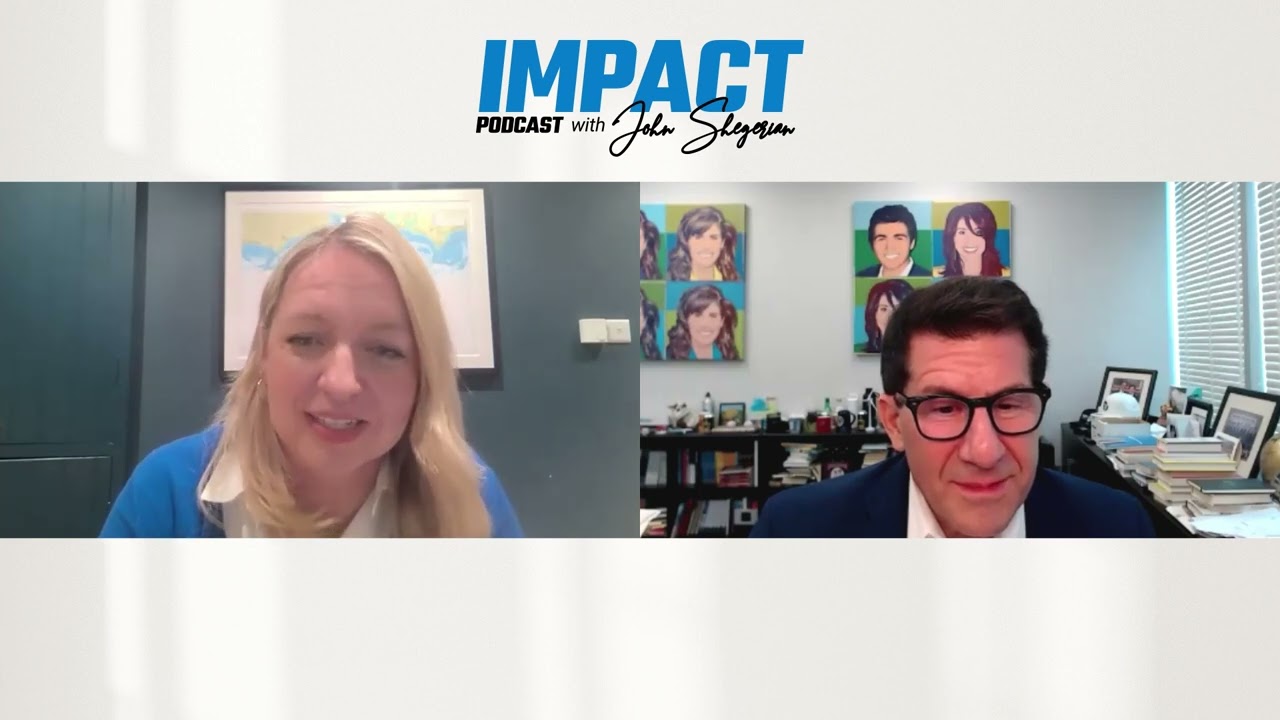

As Global Vice President of Corporate Affairs and Sustainability for Mars Food & Nutrition, Emma Reynolds sits on the Global Food & Nutrition Leadership Team and leads Corporate Affairs for the Segment. Home to a portfolio of global food brands including Ben’s Original, Dolmio, MasterFoods, Kevin’s Natural Foods, and Seeds of Change, Mars Food & Nutrition is guided by its purpose to make food tasty, accessible and healthy – ‘Better Food Today. A Better World Tomorrow.’
John Shegerian: Get the latest impact podcast right into your inbox each week. Subscribe by entering your email address at impactpodcast.com to make sure you never miss an interview. This edition of the Impact Podcast is brought to you by ERI. ERI has a mission to protect people, the planet and your privacy, and is the largest fully integrated IT and electronics asset disposition provider and cybersecurity focused hardware destruction company in the United States and maybe even the world. For more information on how ERI can help your business properly dispose of outdated electronic hardware devices, please visit eridirect.com. This episode of the Impact Podcast is brought to you by Closed Loop Partners. Closed Loop Partners is a leading circular economy investor in the United States with an extensive network of Fortune 500 corporate investors, family offices, institutional investors, industry experts and impact partners. Closed loops platform spans the arc of capital from venture capital to private equity bridging gaps and fostering synergies to scale the circular economy. To find Closed Loop Partners please go to www.closedlooppartners.com.
John: Welcome to another edition of the Impact Podcast. I’m John Shegerian, and I’m so honored to have with us today, Emma Reynolds. She’s the Global Vice President of Corporate Affairs and Sustainability at Mars Food and Nutrition. Emma, welcome to the Impact Podcast.
Emma Reynolds: Thanks very much, John. Nice and lovely to be here.
John: Well, it’s lovely to have you. It’s your first time on and it’s actually Mars’s first time on the Impact Podcast, and we’re going to get into all the important and impactful things you’re doing at Mars Food and Nutrition in a second. But before we get there, I want to start with you, Emma, your journey. Where did you grow up and how did you get on this very important and impactful journey that you’re on?
Emma: Well, I grew up in the UK which is where I am still based. I actually started my professional life after studying history at university, working in a political party. So doing policy work and then decided I want to take that policy work and translate it into a business environment. So started off in a consultancy, a public affairs consultancy, and then had a fantastic time, learned about lots of different sectors. But wanted to make that move from advising companies to sort of doing the doing. So went for an in-house role first at Tesco retailer here in the UK as government affairs director, then moved to AB InBev the Global Brewer, then to Vodafone which is a telecoms company. Then more recently here to Mars Food Nutrition as corporate affairs lead globally.
John: Those are all iconic brands that you made career stops in. I’m sure you learned a lot in all of them. Before we get there though let’s go back to your childhood. Growing up in the UK, what were your dreams as a young lady that you had when you went to university and stuff? Were you thinking about sustainability? Were you thinking about impact or did you have other dreams and aspirations with regards to your career?
Emma: I started off actually very interested in politics. Sort of like precociously interested in politics in a way that sort of young people aren’t normally interested as like a 10 and 11-year-old saying you want to be prime minister. And that was obviously a bit peculiar. So very much interested in politics. Then decided to study history, but actually at that point I decided it’d be a good route into the law. I actually really wanted to be a barrister. Then while I was studying history at university, I then met some politicians sort of rekindled my interest in politics and then did some work experience during my time at university for this political party. Then actually started a full-time job afterwards. So ditched my plan, which was to become a lawyer or a barrister and actually went into the political world. I think that really got me excited again about the policy environment and the potential there. But as I said once I did that for a couple of years actually, it was like how actually do I translate that into a business environment see the opportunity that you can make change and have that sort of impact that you often associate with politics through business instead.
John: Those are all amazing brands. I’m very familiar with them. I spend a lot of time in the UK and in Europe, and of course AB is around the world. Vodafone is an amazingly iconic brand and so is Tesco. When you went to each of them, what are the different roles that you had when you made those career stops?
Emma: Because I started off in politics, my first roles when I went in-house into these companies was in the public affairs space.
John: Got it.
Emma: Doing policy, government affairs, advising them on how to interact with the political environment. But then as I progressed throughout my career, I then broadened that to the wider corporate affairs scope. So that encompassed communications, so both internal and external communications and media brand PR regulatory. So when I was at Vodafone a lot of time actually was spent on the regulatory agenda as a regulated industry and also importantly sustainability. So that’s been part of the brief right rep to Tesco actually.
John: Were you recruited and came over to Mars Food and Nutrition?
Emma: I’m just coming up to my three year anniversary.
John: Then were you recruited for this exact role, or was this is [inaudible]
Emma: Yes.
John: Got it.
Emma: Yes. I joined in this role.
John: Let’s talk a little bit about Mars. For our listeners and viewers who are not familiar with Mars, Mars was an iconic brand of course, when I was even growing up, and I’m 63 years old, so Mars Inc. did about $55 billion in revenue in 2024. But then when it comes to Mars Food and Nutrition, you have about 2000 colleagues and associates that you work with around the world and you also in about 30 markets around the world. So Mars itself is a very big enterprise, but even Mars Food and Nutrition which you’re the leader of, is also quite a big enterprise around the world.
Emma: That’s right. I think there are three segments of Mars. So we have our Mars stacking segment then we have Mars PET Care, and then we have Mars Food Nutrition. That’s where I work. So we have brands like Ben’s Original, Tasty Bite, Seeds of Change, Dolmio, MasterFoods, lots of wonderful brands that you’ll find in markets around the world.
John: Let’s talk about this. So Mars Food Nutritions, while I was doing my homework for this show, it says your purpose is to deliver tasty, accessible, and healthy food to all. How does that translate into the practical commercial world of what you do?
Emma: Where we started in terms of our purpose statement was, Better Food Today, A Better World Tomorrow. And obviously that sounds great. It’s a clear, inspiring vision. But what we really wanted to do is translate it into something that was really practical and meaningful, and we could deliver through our strategy. Which is where tasty accessible and healthy comes in. If we take a step back, I don’t think purpose should be about nice feel good stuff that you do at the edges of the business. I think it really should be about what you’re here to do as a business. So I want to reclaim the true meaning of the word purpose. That’s what we’ve got to with making food tasty, accessible, and healthy. We landed on those three things because we know that’s what customers are looking for. Consumers they’re looking for that. Food that tastes great, is healthy, easy to prepare and access. It’s also what we know our stakeholders expect of us and how we think we can deliver real impact and value. I think it’s something really powerful about having something that’s very simply articulated and meaningful. So rather than have something that sounds sort of very highfaluting, something that actually it does what it says in the team, we can go up there and deliver that. It galvanizes our associates around a very clear purpose and objective.
John: I want you to talk a little bit about the brands. The transformation of your food portfolio was to go from the side to center of the plate. Explain what that means. I never heard that terminology before. To go from a side to the center of the.
Emma: We’re lucky in our portfolio to have brands over the years have become synonymous with sources and sides, spices, herbs. They continue to play a really important role within our portfolio. But we also see an opportunity to extend and broaden that offering. We know that consumers are increasingly time poor. They’re looking for quick, easy solutions for a complete meal. We also know that the ambient ready meal category, as an example, is growing. I think it’s around 7% caker in the US so we know there’s a big opportunity there. So we’re looking at how we can maximize the opportunity and do that through both our existing brands. So taking the likes of Ben’s and seeing how we can move them just from offering a ready to heat rice option to moving to a full meal option through things like our Ben Street food offerings or Ben’s lunch bowls. And also looking at acquisitions that play into that space. A couple years ago bought Kevin’s Natural food, which is a wonderful business in the US that offers sea feed meals. So how we can move our offering that extended beyond just those sides to the full meal. Actually around 30% in that space at the moment now and continuing to grow.
John: The wonderful news as you know and I know Emma, is that with the advent of AI there’s more information available to us than ever before and available to everybody that exists on this planet than ever before. Unfortunately though, as we also know, some of the information’s great information and some of it has a bunch of false narratives tied into it. So there’s a lot of people now that “are influencers” in the food and nutrition world. I’ll give a couple names. Andrew Huberman, for example, Peter Attia even is another example. Rhonda Patrick. Who do you look to for guidance in terms of trends that are going on? Obviously you’re running this business with the new trend of GLP-1s out there and Peptides, also the high protein generation is upon us in terms of how to lose weight and keep it off and also plant-based eating. So how do you take some of these macro trends that are here to stay and seem to be growing around the world and incorporate that into your purpose and into your portfolio.
Emma: It starts with the consumer obviously. So making sure we’re really understanding what it is our consumers are looking for. We know the three important things for them really are taste, convenience, and health. And so how do we use that insight and then translate that into product development and making sure that we’re really meeting those needs and understanding the tensions they’re facing and how we can best help them make those choices that are easy and healthy at the same time. I also actually think you mentioned AI. How we use AI to help us better understand consumers. I think there’s some really great tools about how you can monitor emerging consumer trends anticipate them even. There’s some good examples of how we’ve used that to identify big emerging trends, like things like Pan-Asian, but also then test quite specific product development. So we’ve used it to say what a consumer’s looking for in terms of noodle length or texture or source ratio color. Actually that really helps inform and actually speed up our product innovation and development process.
John: That’s so interesting. When operating in 30 markets around the world, like you said, you brought up a great point besides some of the macro trends of protein and of plant-based and of GLP-1s is also like you said different tastes are changing. Here in the United States, there’s a huge taste for more immigrant food than ever before. Korean food is on the rise. Japanese food’s hotter than ever. Then you have also food from all different parts of the world, the Middle East and South America. How do you balance those trends and how do you gauge what’s emerging on top for each of the different markets? Because I assume you have to tailor your food portfolio for each market that you’re in.
Emma: Absolutely. So you’re right. So I’d say that there’s a growing interest all over the world for globally inspired flavors and cuisines. There’s a curiosity, a desire to experiment and we say that all over the place. But in terms of how that translates locally, you are totally right. There is definitely variation. You see that in markets where there’s a familiarity with a global cuisine through the reasons of geography or sort of cultural history. So you might say Mexican food in the US or Indian food in the UK, or Asian food in Australia. Let’s take those examples. In those examples actually the consumer’s looking for a really authentic product experience. They’re really familiar with it and they want it to feel very real and like they might get in those markets. Whereas if a consumer is less familiar with those cuisines, actually, they’re looking for more familiar entry points. So they might be looking at flavors they recognize, ingredients they recognize, formats they recognize. So as an example of that we would say, so we have a brand called Tasty Bite in the US which is about Indian ready to eat meals. So there we’ve looked at things like butter chickpea, tea and masala, and even Indian mac and cheese. So how you can introduce people to cuisines in a way that also taps into some familiarity.
John: That’s wonderful. Go back to AI. There’s a lot of talk out there when you turn on Bloomberg or CNBC or read the New York Times Wall Street Journal or any good publication that a lot of companies have made big spends in AI and there’s a percentage of those companies are very disappointed in the results so far. But there’s also many companies, of course, that are saying they’re getting many efficiencies out of AI, Latin for layoffs, Latin for less people. How has AI been in terms of integrating into not only Mars Inc the parent company, but more importantly into what you are doing at Mars Food and Nutrition in terms of tracking trends and everything. Is it becoming a valuable tool yet or do you see it becoming more valuable in the months and years ahead?
Emma: I’d say it already is. I would say the example we were talking about earlier around looking how you can map and track consumer trends, that’s hugely valuable. We know one of the important things in terms of the industry is how you can respond with pace to consumer trends, which can emerge quite quickly. You mentioned lots of examples of influences and we see that particularly actually with younger generations who are very much influenced by the latest social media trend in terms of food recipe inspiration. So how can we have a pulse on that and respond as quickly as possible? AI definitely is a huge enabler for us on that area.
John: But even you when you’re just in the gym exercising or walking your dog or cooking yourself in the kitchen and you’re listening to a podcast, and you hear some information on latest statistics with regards to let’s just take protein and fiber being two very big things that people are focused on more than ever before in terms of keeping their weight down, staying clear, keeping their mind clear and also keeping their digestive system moving. And now you hear about that. Do you go back to your chemists and your food engineers and your food people and say, Hey, what are we working on that focuses on protein and fiber? Or how does that dialogue typically work between you as a leader and some of your other internal division people that make the realities happen at your company?
Emma: I think it’s a combination of two things. It’s looking at what consumers are telling us they are looking for. We know you’ve mentioned the example of protein there, that many consumers are looking for more protein. I think it’s around 70% of Americans are looking to consume more protein and also what the science is telling us. So we know that most consumers, most Americans in particular, well, not in particular, but including most American adults, do not get enough fiber a day so they’re not meeting their 25 grams a day of dietary fiber. So you take those insights that come from what the science is telling us and what consumers telling us they’re looking for and then combine that in your product development process. Say, okay, we need to increase fiber, but we need to make sure there’s a strong representation of protein. We also need the product to taste great and be easy to prepare. So how do we combine that insight, that scientific knowledge and our culinary expertise to create the product that we think will meet the needs of our consumers?
John: So interesting. When you study the 30 markets that you’re in, which must be ever fascinating and an interesting unto itself. Is there a market that emerges in your studies and when you’re doing your own homework that you say, okay, this market has always proven to be the tastemaker of what’s about to happen around the world. Is there one or two markets, like for instance just for this discussion. When Kim Kardashian comes out and posts something on her Instagram or talks about something, if you sort of know you’re at the beginning of probably a new wave of cosmetics or luxury items that she’s promoting that could has a chance of catching fire. Same thing with Joe Rogan and other big influencers. Who do you think are the biggest taste makers out of all the markets you serve that informs you to focus on something probably more?
Emma: I think the US is one of the most important markets for us. So we are particularly interested in what consumers and influencers from that market are telling us and also how that then travels across influences other markets. We really have seen those sort of social media trends on TikTok and Instagram, which have led to things from a food context. You’d see the rise of cottage cheese or pistachio or Dubai chocolate matcha, these sort of phenomenon that have started on the internet on TikTok, on Instagram, and then received spread more widely. I have four kids. My eldest is 17. There was a period where we were basically only eating cucumber and sesame salads. Because it’s something that had been inspired by the internet. So we are definitely very much keen to sort of follow those trends and see how we can lean into them.
John: That’s fascinating. For our listeners and viewers who just joined us, we’re so excited we have Emma Reynolds with us today from the UK. She’s the Global Vice President, corporate Affairs and Sustainability at Mars Food and Nutrition. To find Emma or colleagues you can go to mars.com, but then there’s also going to be links that we’re going to put in our show notes that will take you closer to the food and nutrition division. Those will all be in the show notes, so you don’t have to stop what you’re doing and write anything down. I’m going to talk about you have four children. How much should they inform you as to what’s hot and what’s not? Hey, mom, make more of this stuff or Hey Mom, have your food engineers invent this. That’s what we want to really eat Mom. How often do you hear that? And how often do you take that back to work with you?
Emma: Quite a lot. Actually what I think is really reinforced to me is the importance of meal times, if I’m honest. So a couple of years ago, so my youngest is six and they go up to 17. But a few years ago I was like I really want to. I’ve got a busy job. My husband’s got a busy job. The importance of getting together around the table every day is huge for me. Not withstanding busy days and commutes and everything. It’s very important that we all sit around and have our evening meal together at the time of which we can chat about the day. My son keep complaining there’s too many vegetables on my plate and my daughter give me other feedback. I get lots of feedback about what’s on the table. But it’s such an important moment for us all to come together. Back to where we started the conversation on purpose. I just think food is just such a wonderful thing about bringing people together and really encouraging both physical and mental wellbeing. I think to be in a job that enables you to actually promote a purpose that is very meaningful for you personally and for your family is a huge privilege.
John: How often do you get samples of new things that your food engineers are creating but they want feedback on and you bring it home to your family and you get thumbs up or thumbs down over there?
Emma: I do. The innovation that I’ve been taking and bringing in quite a lot recently has been we have a range of Dolmio which is a pasta sauce range in the UK and Europe. We’ve recently gone into this ambit ready mill space. So it is ready sweet pasta with sauce. This has been like a sort of savior for school holiday. So if my kids are not looking after themself I will be here I promise, but wanting to make themselves the lunch I’ve been bringing back those and they’ve been giving me lots of feedback about the various ranges.
I love please to say very positive. My family are obsessed with cheese, so they have to slather everything with cheese. But other than that it’s all been positive feedback.
John: Given that you have a very broad but also it’s a amazing role because corporate affairs and sustainability can be as now honored and as broad as you want, as you well know. Do you ever get to define your job so broadly where you get to say to your team Hey, I’m going with some of our colleagues and we’re going to go on a trip and go do like the late great Anthony Bourdain and go do South Korea, Seoul, and Tokyo and Shanghai, and Vietnam and Singapore, and go search for new trends and go eat the street food and go see what’s going on and meet with different chefs around the world and bring that information back to the labs, back to your other colleagues and brainstorm what you learned in one of those kind of fun journeys?
Emma: I haven’t personally managed that bit yet. But it’s definitely on my to-do list. John, what we do when we do market visits which you’ll imagine we do a fair amount, we always make a point of going into retail, seeing how both our products are showing up and our competitors’ products showing up, going to restaurants, going to food exhibitions and absorbing food as much as we can. We share kind of risk ideas and inspiration all the time as a team. So food is very much part of the culture. I will put a little ship to South Korea on my to-do list, so it’s a very good idea.
John: Sustainability is part of your title.
Emma: Yes.
John: Talk a little bit about not only putting the right food on the tables in your 30 markets that you serve for your customer base, but also where does sustainability play a role in terms of sourcing of the ingredients into all your foods, and then in how your company, your division with the 2000 plus colleagues in the 30 markets outta the larger Mars Inc. How sustainable are the practices inside of your day-to-day but also into the food that you produce and make and serve to the world for their appetites?
Emma: Well, I feel really lucky at Mars in particular. Because I do feel that sustainability is to truly embedded in the way that we do business. It does become from a genuinely held belief that business success and positive societal impact go hand in hand. And that investing in sustainability is not just the right thing to do but also an imperative for business. So you need to do it for the resilience of your business in the future as well as obviously more broadly for the the population and the planet. We have something at Mars Inc levels called our Mars Compass, which sets out our shareholder objectives and that puts alongside financial performance and growth metrics around positive sighted impact. Which include sustainability metrics and trusted partner, which around reputation. So that’s a really good starting point for us. But beneath that, we then have what we call our sustainable generation plan. Which again sits across the whole of Mars and has three pillars. So the first one’s around healthy planets, which is about our environmental impact. Second one’s around thriving people. So how we can improve the lives of the people in our value chain and enable them to thrive and then the last one’s around nourishing wellbeing. Which is about promoting the wellbeing of both our associates and also the consumers that we serve. Then under each of those pillars, so that provides the framework. We then have a series of science-based goals and then strategies that we deploy a segment level. Then that does get delivered right across the business. So whilst I have got sustainability in my title my role will be looking at the overall strategy and the governance actually is everybody’s job to deliver. If you’re in supply and supply’s a hugely important part of it is about where we’re sourcing from, how we’re supporting our farmers on climate smart agricultural practices. Which means they reduce their environmental impact but also protect their livelihoods and boost their incomes going forward. It means looking at logistics and how they can make those more efficient. If you’re R&D it’s around product development, so making it healthy, making it sustainable, looking at packaging. If you’re marketing it’s how you engage with all consumers. So it really is actually sitting across the whole business. I think another important part of coming back to the Mars Compass where I started, our long-term pay as senior leaders is also linked to performance against that. So if you’re a senior leader at Mars, then part of your long-term compensation is influenced by RGHG reduction.
John: Fascinating. Because you operate in 30 markets around the world and Mars Inc, which is again 55 billion plus revenue company is in over 80 markets. Talk a little bit about the patchwork quilt of sustainability regulations around the world and do you believe in the future there’ll be more harmonization of these or you don’t really feel it’s moving in that direction yet?
Emma: I think it’s difficult to say. There is some move towards harmonization, but we also do see differences across different markets and geographies. So our job is to sort of seek to have the overarching strategy, which is what we believe is the right thing to do as Mars and that’s our kind of north star direction in terms of sustainability and the goals that we are working to as a company regardless of regulation. They’re sort of stretching and ambitious, but obviously then we also need to make sure that we’re meeting individual requirements within individual markets. I think consumers expectations are also a bit different across markets as well. So it’s actually how you bring that all together. That are in beliefs and commitments as a company, what our consumers expect of us and also the regulatory environment and also the kind of infrastructure that’s in place within those markets as well that may or may not support some of the efforts that we’re making.
John: Emma besides protein and fiber, what are some of the latest or the newest trends and food preferences that you’re seeing evolve in recent years and do you have some new products coming out to answer those food trends in the coming months and years ahead?
Emma: I think we’ve touched on convenience. So actually how you can move into this ready to eat space in a way that actually meets the consumer need for something that’s very quick and readily available. So they can open up their cupboard and have a meal in two minutes. Health as you’ve touched on, super important. And then taste we know is always going to be the most important thing. I think that’s where we see this derive for globally inspired cuisines and flavors. Take Kevin’s Natural Foods as an example, which is a really great example of a business that is very much meeting those needs around taste, health, and convenience. The whole ethos is around making healthy eating convenient without compromising on flavor. They in the last year have look to go into some new spaces. So with frozen entree bowls and stir fry quits. Actually what they really do, they appeal to millennials in particular, but also millennial males. So how do we reach that audience and engage with them? So we’ve done some nice projects with them, basketball, sports in the US. So it’s about having good social first content. They engage with consumers where they are on the things they’re looking for around taste, health, and convenience. This desire to experiment with new and interesting flavors.
John: I love it. Who inspires you? Like how do you find your inspiration? Do you look to other brands? Do you look to specific leaders? How do you get inspired Emma?
Emma: I start off. I am a foodie. I think that makes my job a whole lot easier. I have a bookshelf that is groaning with recipe books. I have all my sort of newspaper apps. All my sort of favorited articles are the ones with like weekly recipes and inspiration. So I’m constantly looking for kind of new inspiration personally following trends and chefs. That kind of really inspires me. I bring that passion I hope to work with me as well as I hopefully demonstrate it at home with the way that I try and get my kids around the table. I’m really appreciating different flavors and cuisines.
John: Emma the world has changed so much since we were 21 years old, and I’m much older than you, but it’s still change massively. But you’ve pulled off this delicate dance and magically are a wife, a supermom to four children and also you have a career. You’ve crafted a career for yourself with iconic brands, and now you’re here at Mars Food and Nutrition. You’re not only making a living and making a paycheck, which we all have to do to pay our bills, but you’re also making an impact. What would be the advice you give to the next generation coming right now out of high school or in college or going to graduate school who are looking to follow your footsteps? Do they want to have a personal life that’s meaningful to them, but they also want to have a career that they can make a living at but make an impact in? Is there some advice and wisdom you you’d like to share with our next generations coming up behind us?
Emma: I think it’s being really clear on what your own personal values and motivations are. You spoke very kindly about my career. First and foremost, I see myself as a mom and who wants to be able to provide the best life possible I can for my kids, and that’s about not just putting food in the table financially, but bringing them around the table to eat, inspiring them, supporting them, and that’s my number one priority. I’m lucky that I’ve also been able to combine that with a job that I enjoy and that I feel it delivers real purpose and value. Because if you’re not with your kids all the time, you want to make sure that when you’re not there you are also doing something that you really believe in. So I think being clear on what matters to you and what matters to me might not matter to someone else and that’s totally fine too. But being really clear on what really motivates and inspires and makes you feel good. I also just think being open-minded. I think you could sit there and have a career path. When you’re 21, say, when I’m 25 I’m going to do this, 30 I’m going to do that. I probably started off like that too. But you don’t know how things are going to change. You don’t know what opportunities are going to come to you. So being open-minded to them. I could say have a kind of leaning towards saying yes to them and to seeing where they will take you rather than saying, well, I haven’t planned that until I was 28. Or actually, I thought the next step was going to be this. Be open-minded, take opportunities, embrace the opportunity to learn and take risks and try new things. Because you don’t know what tomorrow’s going to hold. So let’s just embrace it.
John: That is just wonderful, wonderful advice. I hope the next gen that’s listening to the show takes it to heart. Emma Reynolds, thanks for spending over 45 minutes with us today. For our listeners and viewers to find Emma and her colleagues please go to www.mars.com. And of course, we’re going to put some sub links into our show notes so you can go directly also to Mars Food and Nutrition and see all the important impactful work that Emma and her colleagues are doing. Emma, it’s been 45 minutes of joy with you today, but more important I just want to say thank you for making the world a more sustainable and better place.
Emma: Thank you, John. It’s been a pleasure.
John: This edition of the Impact Podcast is brought to you by Engage. Engage is a digital booking platform revolutionizing the talent booking industry. With thousands of athletes, celebrities, entrepreneurs, and business leaders. Engage is the go-to spot for booking talent, for speeches, custom experiences, live streams and much more. For more information on Engage or to book talent today visit letsengage.com. This edition of the Impact Podcast is brought to you by ERI. ERI has a mission to protect people, the planet and your privacy. And is the largest fully integrated IT and electronics asset disposition provider and cybersecurity focused hardware destruction company in the United States. And maybe even the world. For more information on how ERI can help your business properly dispose of outdated electronic hardware devices please visit eridirect.com.
 Spotify
 Apple Podcasts
 Amazon Music
 iHeartRadio
 YouTube
 YouTube Music
 Audible
 Pandora