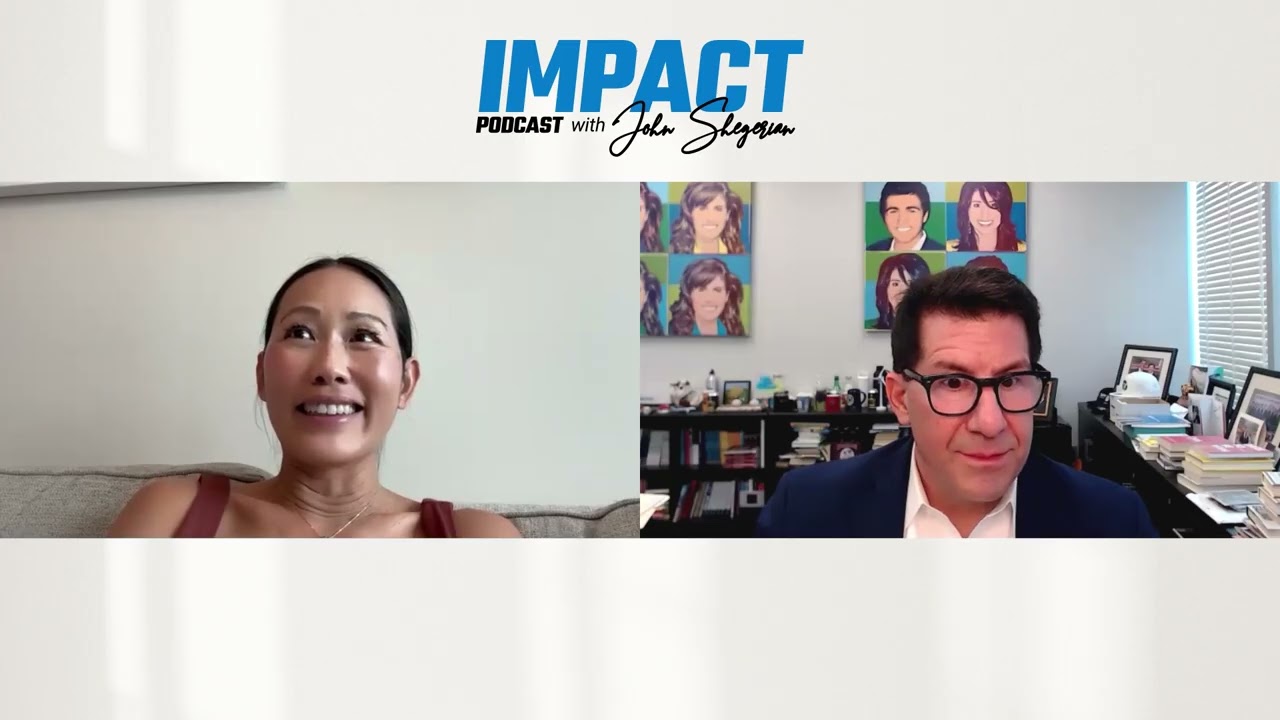

Author of the best-selling memoir, Like a Wave We Break: A Memoir of Falling Apart and Finding Myself Jane Chen is a globally recognized entrepreneur, inventor, and speaker. She is a co-founder of Embrace Global, which developed a groundbreaking infant incubator that has helped to save nearly a million babies. She has been a TED Fellow, an Echoing Green Fellow, and a Young Global Leader of the World Economic Forum. Jane was recognized as a Forbes Impact 30 and Schwab Foundation Social Entrepreneur of the Year by the World Economic Forum and was a recipient of The Economist’s Innovation Award.
https://www.janemariechen.com/
Jane’s memoir: Like A Wave We Break
Jane’s recent TED talk
John Shegarian: Get the latest Impact Podcast right into your inbox each week. Subscribe by entering your email address at impactpodcast.com to make sure you never miss an interview. This edition of the Impact Podcast is brought to you by ERI. ERI has a mission to protect people, the planet, and your privacy, and is the largest fully integrated IT and electronics asset disposition provider and cybersecurity-focused hardware destruction company in the United States and maybe even the world. For more information on how ERI can help your business properly dispose of outdated electronic hardware devices, please visit eridirect.com. This episode of the Impact Podcast is brought to you by Closed Loop Partners. Closed Loop Partners is a leading circular economy investor in the United States with an extensive network of Fortune 500 corporate investors, family offices, institutional investors, industry experts, and impact partners. Closed Loop’s platform spans the arc of capital from venture capital to private equity, bridging gaps and fostering synergies to scale the circular economy. To find Closed Loop Partners, please go to www.closedlooppartners.com
John: Welcome to another edition of the Impact Podcast. I’m John Shegerian, and I’m so honored to have with us today Jane Chen. She’s the author of this wonderful book, Like a Wave, We Break, A Memoir of Falling Apart and Finding Myself. Welcome to the Impact Podcast, Jane.
Jane Marie Chen: Thank you. Thank you for having me.
John: Jane, before we get into the book, I want to get into your backstory a little bit. Could you share a little bit of where you were born, where you were raised, and how you got on this fascinating journey and important journey that you are on?
Jane: Sure. Yeah, I was born in Taiwan. I was born there in, gosh, what year was it? 1978. My family moved to the US when I was four years old, so moved to Southern California. That’s where I spent most of my childhood, was in Southern California. So I ended up- after college, I ended up moving to Hong Kong for about five years, and was doing management consulting there, and then ended up working with an HIV AIDS nonprofit organization that really changed the course of my life. It was my first time doing humanitarian work, and we were helping children orphaned by AIDS. I started to understand that that’s really where I wanted to put my effort. It was what I was passionate about.
John: Jane, I want to go over a couple of things. So you were a first-generation immigrant?
Jane: Yes.
John: And so what did your parents do when you were growing up? What business were they in, or were they entrepreneurs? What did they do for a living? What was your experience with growing up with your parents in Southern California?
Jane: My father was a chemical engineer. My mom was mostly a stay-at-home mom, but my dad dabbled in a couple of other things. Once we moved to the U.S., he tried opening up a restaurant. He got his stockbroker’s license. He jumped around to different professions growing up.
John: Brothers or sisters?
Jane: Two sisters.
John: Younger or older?
Jane: One younger, one older.
John: So you were right in the middle.
Jane: Yes.
John: Got you.So, I’m Armenian. I’m a third-generation immigrant to this country, but I always find a great affinity and connection with everyone that’s in my social or personal or family group that have immigrant DNA. There’s always such wonderful shared ethnic experiences that cut across all lines. We can get into that a little later. So wait a second. You jumped over. You went into school, but you’re so humble. I want to talk about your higher education. Where did you go to undergraduate school?
Jane: I went to Pomona College.
John: And then you went to?
Jane: And then I went to Stanford for my business degree, and I went to Harvard for my public policy degree.
John: Was this part of your upbringing, or was this self-driven, or was this from your parents’ focus on education and saying, “You’ve got to do well, you’ve got to excel in school,” or was this something that was in you, driven from yourself?
Jane: It was both. I would say my parents definitely had a huge focus on academic achievement, and they sacrificed a lot to move us to the U.S. And so, I think for my father, especially, it was really imperative that we succeed and become independent. And I think for so many immigrant families, that’s what makes it worthwhile, right? To see those sacrifices are worthwhile if your children succeed.
John: So funny you say that. That makes total sense to me. A lot of my ABC friends, American-born Chinese friends, and others, and those that were still born on the other side, they tell me about their tiger moms. Was your mom a tiger mom, a classic tiger mom, or not really?
Jane: I would say it was more my dad. He was the one who was very strict. He, yeah, everything was about success and achievement, especially in academics. And it’s interesting, you asked about where I was born. And as I wrote the book, I started to understand what were my parents leaving? What was the Taiwan that my parents were leaving? Well, Taiwan was under martial law for 38 years, during which hundreds of thousands of people were killed, raped, disappeared. It’s something that people didn’t talk about for many years, because just talking about it could get you killed. So there was that level of silencing and oppression. And as I really did the research for this book, I started to understand, oh, wow, that is what my parents were leaving, and why they wanted to come to America to pursue freedom, and economic opportunity, and all of that. And so again, I think when you are leaving that kind of situation, it’s just even more imperative for your children to succeed.
John: So funny, one of my father’s colleagues back, I’m 63. So one of my father’s colleagues, about 40 years ago, it was a Jewish guy named Hilton Kaufman. And he was- and one day, he was a very successful guy. And I said to him, “Why do you work so hard, and long hours, and you’re driven to succeed so much?” And he goes, “I don’t want to shame the sacrifice my ancestors made to get us to America and escape the genocide and everything that we were going through, his grandparents’ generation of survivors of the Holocaust.” And the stories of my friends on both sides of the ocean always ring true in terms of the first and second generation, third generation. I even feel that burden. I don’t want to let down all the sacrifices my grandfather and my grandparents made to get our family to this country. Did you have that burden? Did you feel that burden when you were growing up at any point, or as you became a young adult, that, “Hey, my parents did all this, so I have to perform? I cannot just slide or take it easy or feel entitled in any sense or form.”
Jane: I do not think it was like, I was not thinking about their sacrifices. They never really talked about that. That’s only something I started to understand later. But it was just something that we were punished if we didn’t do well in school. And we can go into that later. But there was a lot of violence in my home growing up, and I did not understand until much later how much that affected me.
John: Got it. Talk a little bit about, you started working after Stanford and Harvard. I mean, great schools. And what were you set out to do? What was your career looking like? What did you envision your career looking like when you got out of both those amazing schools?
Jane: So when I was at Stanford, I took a course at the design school in which my team and I invented a low-cost baby incubator for premature babies in underserved communities. Our technology was portable, and it could work without constant electricity, and was also a fraction of the cost of traditional incubators. So we invented this product, we called it Embrace, and we decided that we were going to turn it into an organization. And this was a product that was intended to help people in developing countries where there isn’t stable electricity, where there isn’t access to traditional medical devices or even hospitals. And so that’s what this was invented for.
John: And you were feeling, I assume, without knowing strictly the numbers, there was a huge void in the marketplace for this, and a great need for this, and a massive total addressable market for this.
Jane: Yes, there’s about 15 million preterm and underweight babies born every year. Many of those are born in developing countries. And it was something, as I heard about- learned about taking this class and then embarked on inventing this project, I just felt so strongly about this work. And then as I was graduating from Stanford, my team and I, we had not thought we would continue the project beyond the class. But we thought, “Gosh, if we do not move this forward, no one else is going to. And we have this great idea here.” And so we, the four of us, decided we were going to turn it into, at first, we turned it into a nonprofit, and we moved to India. So India is home to 40% of all the world’s premature babies. And we thought, if we want to do this right, if we want to both continue developing the product in a way that is most appropriate to the local market, but also figure out manufacturing, distribution, all of that, we have to live and breathe the air of the customers that we’re serving. So I ended up living in India for the next four years to get this off the ground. And it was so challenging. I mean, it seems like a simple concept, but we were doing a medical device, which meant we had to do clinical studies. We had to get regulatory approvals. We had to set up our own manufacturing facility because we couldn’t find a manufacturer who could do this to the quality level that we wanted. It was, you take a typical startup, which is already very hard, multiply that by 100 in terms of difficulty, and that’s what we were doing. And we were also trying to serve the poorest people in the world and working with these very bureaucratic, corrupt government systems. So I think as we set out to do this, we were very naive, which you have to be. And then once we got to India, it was like, “Oh, wow, okay, this is going to be way harder than we expected,” and it was.
John: It is hard enough to do a startup, as you point out, sitting in a nice, cushy desk in Silicon Valley or a nice, cushy garage in Silicon Valley, for that matter, the Hewlett-Packard methodology. But to be in the middle of India, what city were you in over there?
Jane: We were in Bangalore. So this is South India. And it was all the things. It’s a modern city, but we had blackouts constantly, did not have much hot water. A lot of my work was in the villages. So I traveled to the villages constantly to do research, to figure out how are we going to educate doctors about this, how are we going to get government hospitals to get on board. And so it ended up being far more than just a product. It was then, how do we get this out there? What is the right business model to make this sustainable? Most nonprofits do not have products, right? So we were very atypical. And a few years in, we ended up spinning out a for-profit arm of the company as a way to attract both private capital in addition to philanthropic capital.
John: All four of you over there at the same time?
Jane: Yeah.
John: And who is funding that? Like, where was the initial seed capital from?
Jane: So the initial seed capital, as I said, we were nonprofits. So we got funding through different foundations. We got fellowships. It was, all my life- my second… I took this class my first year at Stanford. The second year, we spent the whole year applying to different business plan competitions, fellowships. We lost all of them until a week before I graduated. We won the Stanford business plan competition, and we won the, it is called the Echoing Green Fellowship for social entrepreneurs. So that gave us our first little bit of funding to get going.
John: Just as a bookmark, what year was this that you all four moved to…
Jane: This was 2009.
John: 2009. So about 16 years ago or so. Okay. 16, 17 years ago. Got it. So you’re there, and how did that four years go? What was the journey like, and how did Embrace Global do while you were there?
Jane: Yeah, as I said, it was so challenging in so many ways, but we started to build a local team. We figured each thing out bit by bit, and the most rewarding part of it was definitely getting the product out there and seeing the lives that it was saving. And so just getting to witness that was so remarkable. A few days after we launched the product, we had actually donated some to an orphanage who called us up saying they had found a two-pound baby that was abandoned on a street. They kept him in our incubator for weeks, and he survived. And so I actually had the chance to visit the orphanage and hold this little boy in my arms. And seven months later, he was adopted by a family in Chicago. So I keep in touch with him and his family, and it is wonderful because you don’t- it’s hard to keep track of these babies over time, but this little boy lives in Chicago. So I get to watch him grow up, and it’s so amazing to see his journey.
John: But to be such a young woman with other young postgraduate students, and all of you collectively, it’s fascinating. You weren’t just doing a startup and doing a startup in an emerging economy that has its challenges, as you pointed out earlier, but you were also doing a project that wasn’t just a new technology tool. This was a matter of life and death.
Jane: Yeah, and I think that is what made it so both rewarding and challenging because it just made us want to give everything to the mission. But, truth be told, it also led me to extreme burnout because it was a matter of life and death, right? So the years I was living in India, I never took a weekend off. I typically worked 15-hour days. I did not make a single friend the entire time I lived there because that is not true. I made one friend outside of my office. I made one friend, but because the mission was my life, and I wasn’t going to leave India until we had gotten the organization to a certain place, I felt it almost a personal responsibility. And I remember going into these villages and meeting so many women who had lost their babies and just feeling this obligation to help, and I didn’t know where that drive came from until much later, until everything fell apart.
John: So I have read and done the homework on Embrace Global, that your product saved over a million babies over the course of the years.
Jane: Yeah, as of last year, we reached a million babies, which was the goal we had set out as students at Stanford. We had no idea how long it would take, but it took about 17 years, and it’s exciting to see that it’s reached so many babies.
John: Jane, most people, it could be said that most people don’t get to save one life in their life, nonetheless, a million lives. A million lives is a lot of lives.
Jane: Yeah, it is really special, and it is, over the last couple years especially, we have done a lot of our work in humanitarian crisis zones. So everything from every place from Ukraine to Sudan to Syria, to just places that are stricken by humanitarian crises. And so those areas, it was amazing to donate 3,000 incubators to Ukraine and hear from the nurses and doctors on the ground how much the incubators were helping because they could use them in bomb shelters. So that has been really rewarding.
John: Talk about how did those four years wind down? Was it a winning campaign where everyone left together, or did you leave separately, or what…
Jane: We all left separately. I left four years in. At that point, we had actually found a new CEO, which I had wanted to come back to the U.S. I’d stayed there far longer than I had anticipated. And so I continued on with the organization, but we had new leadership in place. But that’s kind of when the big challenges started. Up until then, we had lots of challenges, but then we had some really serious challenges that were back-to-back between years four and ten of the organization, the first of which was, pretty soon we realized that economics didn’t make sense to manufacture and distribute a single product on our own. We needed the help of a global distributor. And so we were approached by a multinational medical device company. They were going to fund us and become our global distributors. And we worked on this deal for about nine months. And then, right before we signed the paperwork, their CEO stepped down, who was the main advocate for the deal, and they pulled the plug on the whole thing, which meant we no longer had financing, and we no longer had a distributor. And so that was kind of the first of a series of major setbacks that ultimately led to us shutting down the company ten years in.
John: So after you left, after four years in India, the company continued while you were in the United States, and you were running it in the United States with the team. There is [inaudible] a team in India at that point.
Jane: So we had a couple of different pivots. So that happened. So I was working on this deal back in the U.S. That deal fell through. Then we had to figure out, “Okay, what’s the new business strategy, right?” How do we make this financially sustainable such that we are not only reliant on donations? That is why we had spun out the for-profit arm. And so we ended up launching a U.S. version of the product, not the exact same product, but it was a consumer product that used similar technology. And our idea was like, could we do a Tom’s Shoes one-for-one model and have that be the funding engine? So initially that went really well, but then a manufacturing error led to us having to recall the product in the U.S. So that was the second major setback. And then the third setback at the 10-year mark was, we had run out of funding and there was supposed to be an acquisition of the company. And then this time we had signed all the paperwork for the deal to go through. And after signing, just waiting for the bank transfer, the acquiring company shut down. And so that was the third and final straw. So this was, I feel like many people who are entrepreneurs, startups, resonate with us because it’s like one thing after another, but this is 10 years in now. And we just, that was the ultimate moment of, “Okay, we’re going to have to shut this down.” And at that point, I was so burned out. I did not see a path forward.
John: Okay. When you say you were burned out, you had pretty much sacrificed the last 10 years from the time you were in your early 20s to now 10 years out, just focusing on this business. Didn’t have much of a social deal going, no married[?], no kids, no nothing.
Jane: Nothing.
John: You were just on a[crosstalk]…
Jane: I was[?] on a mission. Yeah. I had my blinders on this[?] mission. I was very focused, but yeah, it felt like, wow, I had given a lot of my life, and most of my business school classmates went on to take very cushy, high-paying jobs. I did the opposite. And so, yeah, that was a really hard moment for me on so many levels.
John: How did you deal with it?
Jane: Well, I was just- I hit rock bottom. I was depressed. I started having panic attacks. I just completely spiraled. I had a mental and physical breakdown. And I was really kind of- I would say by four years in, by the time I came back from India, I was feeling burned out, but I kept pushing for another six years. So by the time this all collapsed, I was in a very bad place. So I decided the only way to cope with this was to get away from everything. I needed to leave everything behind and try to find myself again. So I basically packed up my surfboard and a suitcase, and I bought a one-way ticket to Indonesia. And I decided to go on a healing journey very much in the eat, pray, love style. And so I traveled the world, surfing- and experimenting with different healing modalities. And really at that point, I was looking for relief. I just wanted to feel better. I wanted to get to myself again. And so I tried everything from psychedelics to frog poisoning to different somatic therapies, self-help seminars, all of it. And through the process, I was forced to confront the fact that I had grown up with a lot of physical violence in my upbringing. And I hadn’t connected the dots that it was feeling so powerless through my childhood. That’s what drove me to help the most powerless people in the world. That’s what had given me that intense drive and fuel and the fire to do that work. But it’s also what led me to extreme burnout.
John: The breakdown is- you’re in the midst of the breakdown. Was the violence top of mind in your adult life historically? It came bubbling up during the crash and burn period.
Jane: Yeah, it was. I just knew I had experienced that, but I did not think it was a big deal. I thought, “Oh, I come from an Asian household, an immigrant household. That’s just common.” And I’m just going to sweep it under the rug. So I didn’t understand how much it affected me, and I never dealt with it. I never processed it. And so…
John: I don’t want to make any wrong assumptions, nor do I want to ask anything too personal. Was the violence in and around the house or against you personally?Even though[crosstalk]
Jane: Yeah, I got beaten up a lot. And so it was me personally. And there were just some moments that, it’s all in the book, but there are some moments where it didn’t make sense to me why I was getting beaten up. It felt really unfair and unjust. And I knew that growing up. And often it was tied to academics or not doing well enough in school. But sometimes it wasn’t. Sometimes it felt arbitrary. And so there is a lot of repercussion of that that I didn’t understand until I was forced to look at it. And that is what this healing journey led me to do.
John: Were your siblings subject to the same violence?
Jane: Yes.
John: So although you were singled out, you were singled out as a group. It wasn’t you versus- you didn’t get the violence and they did not. It was the three of you.
Jane: Yes.
John: Have they gone through similar journeys that you have shared together? Has it been a healing experience writing this wonderful book? Has that been a healing experience for the three of you together?
Jane: We’ve all had our own ways of processing this, but I try to respect their privacy. And so I always prefer just to talk about my own personal experience.
John: Got it. So you’re on a healing journey. By the way, I’ve heard from my friends. One country- I’ve been all around the world many times. And a lot of time I have spent a lot of time in Asia. I’ve never been to Indonesia, but my friends who are surfers tell me that’s some of the greatest surfing on the planet. So I assume that’s why that was the big stop for you over there.
Jane: That was the first stop. But I ended up traveling around the world and having the opportunity to work with some of the best teachers and healers. And I will not ruin the story because I want people to read the book. But Tony Robbins ended up playing this pivotal role in saving my company later. And also that was the start of my healing journey, was getting to work with Tony Robbins. And so that was the start. But then I ended up working with so many incredible teachers and people who just held space for me to grieve and to feel the feelings that I’d pushed aside for so many years.
John: Shout out to Tony Robbins. He’s helped a lot of people. Talk about a guy who has helped millions of people. He is truly still an inspiration.
Jane: He’s such an inspiration. And he just was so serendipitous. I’d watched, before I left for Indonesia, I watched his documentary called I’m Not Your Guru on Netflix. I didn’t know much about Tony until I watched the documentary. And I thought, “Oh, I have to go to his events.” And I didn’t apply to go. I didn’t reach out or anything. But his team reached out to me about three weeks later out of the blue, saying that Tony had found out about Embrace, my company, and he invited me to go to Date with Destiny, his big event, as his guest. So it’s just this incredible stroke of beautiful serendipity that led to him ultimately saving the company, because once I told him and his team what happened, they orchestrated a deal that allowed the company to be saved.
John: I want to toggle between the healing journey, but I want to go into the book. When did you have the epiphany to, or the aha moment, or whatever we want to call it, to write this beautiful book, Like a Wave, We Break?
Jane: Really coming out of the healing journey, not out of, but I would say at least a year into it, I realized I really wanted to write about my experiences as a way to help other people who had been through anything similar. And I think all of us have experienced trauma, whether that’s big T or little t, but we have all experienced adversity in our lives. And it shapes us. And then oftentimes, and I see this particularly with social entrepreneurs, people who are trying to make impact in the world, that it comes from this place of wounding, right. And so it gives us that fire, as I said, but it also becomes our shadow. And I see so many people fall into the same pattern where they burn out as a result of this work. And I think it’s so imperative that we look inside and heal those wounds so that we can do our work from a more sustainable place. And so I just thought, “Gosh, I really think that the healing journey, rather than my business story, that is what is going to help people the most.”
John: I mean, from the outside, Stanford, Harvard, a massive success coming out of school, saving lives. You were, in many ways, the American dream epitomized, truly, as a first-generation immigrant, even.
Jane: Right. Yeah. Well, what’s funny is my parents never saw it that way, because to them, it was like, “You are going to nonprofit work? Why are you not making a lot of money and doing a corporate job?” They did not understand the concept. And so, in many ways, I felt like a failure in their eyes. I completely went against the grain because I was following my heart. And so, truth be told, even though I was doing all these great things in the world, there was still this part of me that just always felt like I was not enough, no matter how much I did.
John: Well, that makes sense, because they’re from the really- like me, they’re from Gordon Gekko generation of “greed is good, more is better.”
Jane: Yeah.
John: You are part of the first wave of that generation of, really, you want to not only make a paycheck and make a living, but you want to make an impact.
Jane: Yeah, exactly. I really wanted to make an impact. And that was more important to me. I was willing to forego everything to do that work. But the point is, even as I was doing this great work, it[?] was like the goalposts kept moving. And no matter how many babies I saved, or how many accolades I received, there’s this part of me that felt like I was never enough. And as I’ve gone around on my book tour, one question I often ask the audience is, who here has felt like you weren’t enough? Right. And John, 100% of people raise their hands in every event I have been to. And this is, yeah, even in the most high-achieving environments, and I’m talking from classrooms ar Stanford to just these incredible corporate audiences, every single person raises their hand. And so we, as a society, are somehow programmed to believe that we’re not adequate, we are not enough. And so this leads us to constantly be chasing external validation.
John: More is better, right?
Jane: More is better.
John: That’s what they tell us.
Jane: Yes. And what the research shows is the more we are focused on extrinsic success, as opposed to having the intrinsic motivation, that leads to higher rates of depression, anxiety, mental health disorders. It causes us to be unhappy because nothing is enough.
John: True.
Jane: So that, yeah.
John: Talk about though- you’re a year into the healing journey. You’re trying different protocols and modalities. Then you start writing this book, you start writing this book. Then approximately…
Jane: Kind of. I started writing the proposal at that point. I just remember taking pen to paper and just writing as much as I could, just getting something out. And I started working on a proposal. And so, yeah, that’s how the process started. I shopped it around to different agents. I had been approached to do a business book a few years before that, which is the first time I have ever thought about writing a book. But it didn’t feel right to me. So I actually went back to the agents, two agents who had wanted to represent me. And they were not interested at all. They were just like, “No one reads memoirs.” So eventually, I was introduced to an agent who I- the more I read about her, her name is Laura Love, the more I was just wowed in terms of how she thinks, the way she helps her authors. And I sat with her, this is during COVID. And I sat with her at a coffee shop, we were both in Santa Cruz. And I had just come out of this frog poison ceremony, where I had to burn 14 holes in my leg, and you sprinkle desiccated frog poison, and then you retch into a bucket for the next 10, 20 minutes. Anyway, I had come from that. And I showed Laura those scars. It was funny because later, and Laura has six or seven New York Times bestsellers under her belt. She is very selective about who she works with. And so later, she told me she had- a friend who had introduced us. She was going to just give me some advice and wish me well, but she was not going to take me on as a client. But after I showed her my scars, she was really intrigued.
John: You had to write a low[?]then,[inaudible]I’ve heard of a lot of ways to close a deal, Jane. You just topped[?] any methodology I have ever heard before. That’s the ultimate closer.
Jane: It’s the ultimate closer. Yeah. And it was not even intentional. I was not planning to show her. It just came up in conversation. And so-
John: Who’s going to say no to you at that moment? Like you are saying to yourself, “I’ve got to help her, because she’s not going to help herself this way.” She’s throwing up, and she’s got frog poison, and she’s got burns on her leg. I’ve got to intervene here. I mean, that must have been a meeting[?][inaudible] the whole time. I mean, that’s…
Jane: Well, what was funny was Laura called me the next day. And she said, “I want to bring a book into this world with you, but only if you’re willing to write a different book than you think.” And she wanted me to focus even more on my personal story. We found a happy medium between the Embrace story, my personal story in the end. But initially, she was like, “You have got to condense Embrace into one chapter, and it is your healing journey and your personal story, that’s what people are going to connect with.” And she was spot on. And I am so happy I had the chance to work with her.
John: Good for you. Well, you chose the right person, because she had a feel for this. She knew this was her wheelhouse.
Jane: She had a vision for it. And she was instrumental. And this dear friend now, but she was instrumental in helping me craft the story. So from there, we rewrote the proposal. I worked with a collaborative writer, and end to end, the process was about five years.
John: Wow. So what was the healing like while you wrote? Was writing for you, before you wrote the book, when you went to Pomona, Stanford, and Harvard, was writing for you a challenge always or a cathartic experience?
Jane: No, I always loved writing, but I’d never written about such personal things. And I hadn’t done this type of writing. And so it was very cathartic. It was very hard in moments because I was exploring very painful experiences from my past. And so it forced me to really go into the details of those experiences and relive them in certain ways. But at the same time, by doing that, I could process it. And that’s what it takes. So often, we take these painful emotions and we sweep them under the rug. We don’t want to feel them. And guess what, when you do that, you are not allowing yourself to process, which means they come up in all sorts of ways in your life, in your interactions, your relationships, as a leader. And so it’s imperative that we do that inner work. And that is what this forced me to do. So I’m very grateful. And I found so much relief and ultimately healing in the writing itself.
John: Mental health was not a topic. Let’s just go back. Mental health was, 25 years ago, 27 years ago, 30 years ago, a topic that was pretty taboo. It’s still in the middle of having its moment. It’s still not[inaudible]. What are some of the- well, first of all, for our listeners and viewers, we have got Jane Marie Chen with us today. You can find her at janemariechen.com. You can buy her wonderful book on amazon.com or other great booksellers in your area. And of course, on our website, she is a public speaker, obviously an entrepreneur, an inventor, and now a thought leader on topics that we are getting into here. On your healing journey, what was your healing journey like, besides the frog poison and all that stuff and ayahuasca[?], I assume, and psilocybin and other mushroom therapies? What was working the most for you in terms of the healing journey? Did you also, at the same time, have a constant therapist that you were talking to while you were experimenting with these other neuroplastic protocols?
Jane: I did. So I think there are a couple of things that I often talk about that were most helpful in the healing journey. And I recognize not everyone has the fortune to be able to go take some time off and do this. And so that was another reason I wanted to write the book, to share what I learned so people do not have to do that, right? And so I would say a couple of things really helped me ultimately. One was slowing down, right? So we live in this do-do-do culture. And even in my healing journey, I had my like spreadsheet with all the modalities, I was going to try everything. And it wasn’t until I really slowed down and allowed myself to start feeling these feelings, right? Feeling these difficult emotions, I could get somewhere where I finally started to process. The other thing I often talk about is reading The Body Keeps the Score by Bessel van der Kolk. Yes, beautiful book. And[crosstalk] yeah, and that so that really woke me up to what is trauma. Trauma is not a thing that happened in your past, right? Trauma actually affects the wiring of your brain and your nervous system, such that you’re bringing the past into the present. And it affects every part of your life. And so it’s not something you can just say, “Oh, that happened back then.” That’s not how trauma works, right? Trauma is also stored in our limbic system, not in our thinking brain, the neocortex, which means for me, talk therapy was never that helpful, right? Because that talk therapy is at level of our neocortex, our thinking brain. And so that’s why I needed to do therapies that got into my feelings and into deeper levels of consciousness. After I read that book, I became so obsessed with Dr. van der Kolk that I stalked him until he agreed to become my therapist. So I’ve worked with him now for the last three years as my therapist, and that has been tremendous in terms of providing me the support I really need in my healing process.
John: You are still the ultimate overachiever.
Jane: Yeah, maybe. Yeah, I really had like the Avengers of trauma support. So I worked with Bessel. Bessel introduced me to Dick Schwartz, who wrote No Bad Parts, and he is the founder of Internal Family System. So that’s another therapeutic modality that I often recommend to people. Are you familiar with that?
John: Tell me, say more.
Jane: Okay. So Internal Family Systems or parts work as it is referred to is based on the premise that all of us consist of a multitude of parts. So John, you might have the perfectionist in you, the inner critic, the people pleaser, the overachiever, right? I’m making all of this up, but these are all parts of yourself. [inaudible]parts that carry difficult feelings like shame or abandonment or rejection. So the goal of this practice is to be able to recognize and have compassion for all of the parts of ourselves, right? Instead of like shaming parts of ourselves or banishing them, to really intimately become familiar with them, right? And then to almost reparent ourselves to come to love and have compassion for each of these parts. And I have found this just one of the most effective tools I have ever come across. For folks who are interested, I’ve actually taken this and developed just a very short one-page framework that you can try on yourself. It’s on my website. It’s a free download. So check out the resources page of my website if you’ve any interest. But it’s just by far one of the most effective healing modalities I have come across.
John: Jane, what about historical trauma? I have been reading more and more and working with my professionals that I work with on these issues that I, that we all have, but some work on them and some do not, on trauma that’s…
Jane: Inherited.
John: … generational from families like yours that escaped not nice circumstances. Probably your parents were subject to some sort of violence in their situation besides the external violence going on in Taiwan. My family comes from a family of genocide as well. How much is that now being passed through us vis-a-vis through our DNA and how do we work through that?
Jane: It very much is, and there’s an incredible body of science now that shows this. By the way, we do work in Armenia, Embrace does, and one of my original co-founders was Armenian. So I very much have so much empathy for the history of Armenia. But indeed, this is getting passed down into our lineage. And so I think this is why it’s even more important to do the inner work and to understand, right, part of what I said at the beginning was this book helped me to go into my family’s history, to understand the histories that they came from and the ways my parents were raised that led to what happened in our home. And so I have a tremendous amount of both compassion and forgiveness for my parents for what happened, and I understand their stories. And so I think everything to me starts with compassion for ourselves and for others. And where my book ultimately ends is I spent years looking in every crevice of the world for the person who could heal me, for the modality that could heal me. And ultimately, I had to find that within myself. I had to learn how to love those wounded parts of myself. Right. And so that is my message that you are enough. Right. And you have to believe that first and foremost.
John: Was that the intent of the book when you wrote it? Was that what you wanted people to take away? And then when people have now read your book, and they are writing to you and emailing you or DMing[?] you, what are some of the great unexpected results that you are hearing your readers [inaudible]back to you with that they got out of this wonderful book, which is so important in today’s times?
Jane: Yes, no. Well, that has been the most rewarding part of this whole journey is I get letters from people almost every day saying, “Thank you for making me feel less alone. I didn’t know I could talk about these things,” especially in immigrant families, I wanted to break the silence. People have said to me, like one person said he booked a ticket home to see his parents right after finishing my book, so he could have conversations with them that he had been avoiding. Another person told me he had been a heroin addict for many years, and the book was helping him to face the pain that he had ignored. I am actually going to speak at his rehab clinic for people who have problems with addiction and homelessness. So I’m doing that next week. And he set that up because he bought books for everyone at the center, saying that this is going to help them face their pain. And then it’s just beautiful letters on people saying they see themselves differently. They;ve given themselves more compassion, like it goes on and on and on. But it has been the most rewarding part of this journey.
John: That is so wonderful. You know, when you wrote the book, you wanted people to take away that at the end of the day, no one is going to fix them. They’re going to fix themselves. They got to love themselves for who they are. How did this- how when you wrote the book and your siblings and parents read it or got understanding of what was in it? How did that go? Like, how did everyone react? [inaudible]prepared[?] to deal with that?
Jane: Yeah, well, I knew that that was going to be the hardest part of this journey, especially my parents, because I was talking about some difficult things. And again, that’s why my intention from day one was to write about every character with love and respect, and tell my truth. And so I told my parents what I was doing. I didn’t get into the details, but I told them that I would be writing about these difficult subjects. And then when I finished the manuscript last March, they were in Taiwan. So I flew back to see them. And my sister and I sat down with them and just really prepared them for what was coming and also why it was important to me. And so my mom was really scared. And what’s been really amazing is seeing how much she’s come around, and especially as I have shared with her the stories of people who have been impacted. And she’s even said that- my parents are not fluent in English, it’s a second language. So she has had to use a translation tool. And she’s even said that in moments where it is hard to read, she will put it down and just ask herself, “What can I learn from this?” which is so beautiful and such an incredible evolution. And so that’s all led- and again, everyone in my family has had different paths to healing, I don’t judge that we all heal in different ways at different times. But what I do believe is that the more we can stand in our truth, right, the more we have the courage to do that, no matter how uncomfortable, no matter how much disruption there is to the family system, then the more others can start to stand in their truths. And that’s where collective healing can happen.
John: But you feel post book that your siblings and you and your parents are closer than ever?
Jane: Yes, I know. I think again, I think the book has brought up a lot. And so everyone is still kind of coming to process in different ways, and at different paces[?]. But I do believe that ultimately, yes, this will bring us closer together. And I think hopefully, it will help stop what you were talking about in terms of intergenerational trauma that we can put an end to it here.
John: You’re a young woman still you have massive education under your belt. Obviously, Embrace Global is a huge success over a million lives a million babies saved over the 17 years or so 16 years or so 17 years. What are you going to do now with the success of this beautiful book like A Wave We Break and you’re speaking, you’re doing more public speaking now than ever before? What do you envision the next two or three years look like for you?
Jane: Yeah, well, I stepped down from Embrace last year. So that was after almost 17 years of the organization. And I’ve now moved into leadership training and development. And that is something I feel really passionate about, because I get to bring everything that I have learned in my journey and help equip leaders with those lessons. And I think that that is what creates a ripple effect. And what I see is that we live in a world where I think there’s a lot of trauma at very high leadership levels. And what happens is, when we act from that place of wounding, and we’re not even able to recognize that, then we act from a place of fear and ego and control, right, as opposed to a place of shared purpose and love and compassion. And so the only way I think for us to have a harmonious society is for each of us to do our inner work, especially at those leadership levels, because we have people in leadership positions that are making decisions that are affecting hundreds, if not thousands, if not millions of people. So that is the greatest impact that I think I can have and what I truly believe my purpose is. And so I work with teams in organizations, I do corporate training, I also work with individuals one-on-one, and I love it. It’s just work that I find so much joy in doing.
John: So people could go to your website, JaneMarieChen, and not only buy your book, or of course on Amazon and other places, but can they actually reach out to you and hire you to work with them?
Jane: Yes.
John: Wonderful.
Jane: Absolutely, yeah. My website is janemariechen.com, and you could find all the things I offer there. And so please contact me if you are interested in learning more, but it’s work that I feel passionate about, and I know I want to dedicate my life to this.
John: Lessons learned as an entrepreneur. What I find to be one of the saddest things that you said today is when you went to India, you were so mission-focused and soul-focused to make one friend in four years. I mean, being an entrepreneur, as you know already, a startup entrepreneur is a lonely enough journey.
Jane: It is.
John: You made it even[inaudible] is it possible, or is it part of your learnings now, of course, and retrospectively speaking, which of course is always 2020 versus prospective vision, that work can also be a form of medicating ourselves?
Jane: Oh, absolutely. Yeah, I say that often. I just did a TED Talk. I will share the link with you. In it, I say, “Some people numb their pain with substances. I numbed mine with productivity,” and many people do, right?
John: It sounds acceptable.
Jane: Yeah, it’s acceptable and that’s what I think is leading to these epidemic burnout rates in this country and epidemic levels of burnout, exhaustion, anxiety, all of that. That’s what is leading to it because we do not want to feel our pain. So what do we do? We grab a glass of wine. We turn on our TV or look at social media. We work. And so that’s what is leading to all of this. But I think just knowing that I have much more balance in my life now, it’s why I moved to Hawaii. I surf every day. I try to make it a point to bring that balance and to do things more from a place of joy as opposed to obligation.
John: That’s[?] so fascinating. So you mean the four of you, when you went to India, you were the social network for each other. There was really nothing else.
Jane: Yeah.
John: And I think even during that whole time, my belief is we started getting more isolated people from the advent of the Internet. So let us just call it ’98. Google was founded. And then COVID hits and we become even more accelerated, isolated. So I think the isolation crisis and the loneliness crisis is only growing more than ever. So I think the timing of your book and the timing of your mission and your wisdom couldn’t be better because I think there are so many people out there that are seeking but are unbelievably lost at this point.
Jane: I think so, too. So, yeah, I hope this book can bring healing to many.
John: Jane, I thank you so much for your time. I thank you for this beautiful book. To buy this book, you can go to- or to hire Jane for leadership or other counseling, you can go to JaneMarieChen.com. You can buy this book on Amazon.com or other great booksellers wherever you are, wherever you live. This is a great book. I thank you for your time. I thank you for your wisdom and your journey and your bravery and courage to share what is not an easy story to share, Jane. But because you shared it, I think you are going to not only wrap up the million babies that you have saved over your life, but you’re going to really effectuate positively millions of lives around the world with the wisdom that you have shared in your book. And I just wish you continued great health and success. Thank you so much for all you do and the impact that you have made on this wonderful planet that we are in.
Jane: Thank you, John. It was wonderful to be on today.
John: This edition of the Impact Podcast is brought to you by Engage. Engage is a digital booking platform revolutionizing the talent booking industry. With thousands of athletes, celebrities, entrepreneurs, and business leaders, Engage is the go-to spot for booking talent for speeches, custom experiences, live streams, and much more. For more information on Engage or to book talent today, visit letsengage.com. This edition of the Impact Podcast is brought to you by ERI. ERI has a mission to protect people, the planet, and your privacy and is the largest fully integrated IT and electronics asset disposition provider and cybersecurity focused hardware destruction company in the United States and maybe even the world. For more information on how ERI can help your business properly dispose of outdated electronic hardware devices, please visit eridirect.com.
 Spotify
 Apple Podcasts
 Amazon Music
 iHeartRadio
 YouTube
 YouTube Music
 Audible
 Pandora