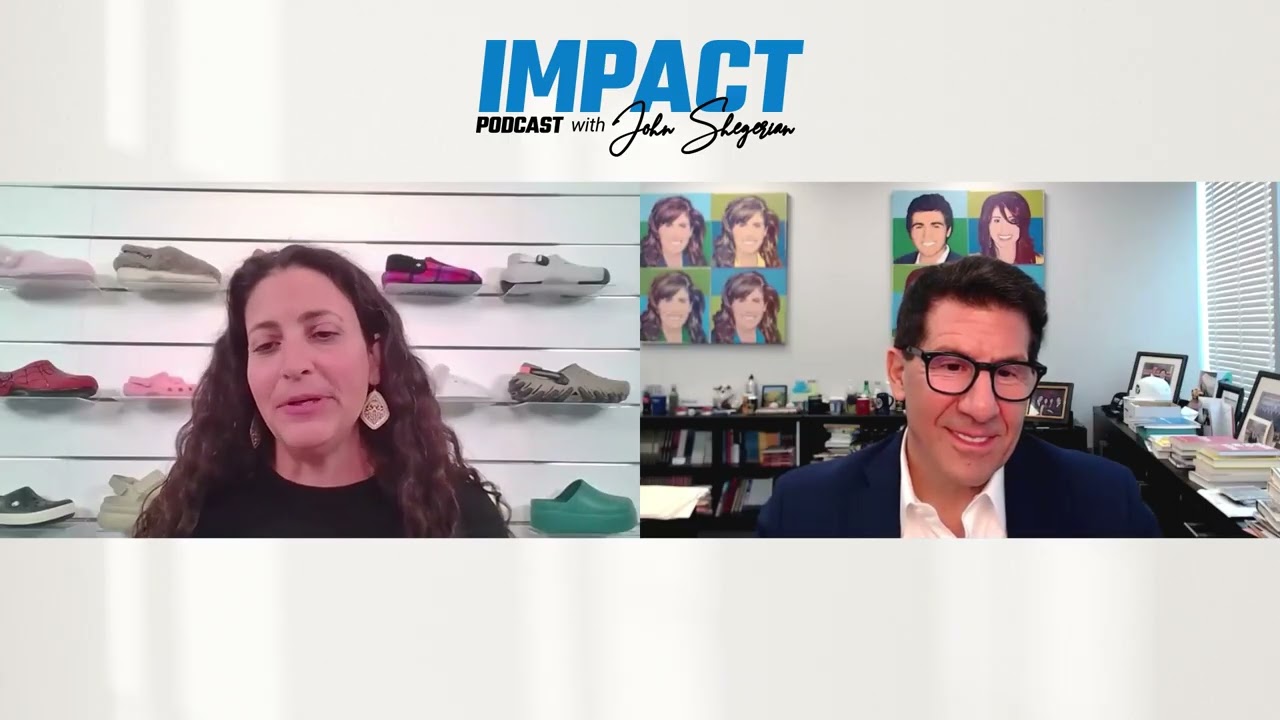

Deanna Bratter is Chief Sustainability and Compliance Officer at Crocs, Inc., where she leads the company’s journey toward achieving net zero emissions by 2040. Since joining in 2022, she has championed a holistic approach to sustainability, advancing circularity, environmental and social responsibility, and corporate governance and compliance initiatives that reflect Crocs, Inc.’s commitment to “Create a More Comfortable World for All.” Deanna is driven by the belief that the actions we take today shape the world we leave for future generations, infusing her work with a sense of pragmatic activism and responsibility.
John Shegerian: Get the latest Impact Podcast right into your inbox each week. Subscribe by entering your email address at impactpodcast.com to make sure you never miss an interview. This edition of the Impact Podcast is brought to you by ERI. ERI has a mission to protect people, the planet, and your privacy, and is the largest fully integrated IT and electronics asset disposition provider and cybersecurity-focused hardware destruction company in the United States and maybe even the world. For more information on how ERI can help your business properly dispose of outdated electronic hardware devices, please visit eridirect.com. This episode of the Impact Podcast is brought to you by Closed Loop Partners. Closed Loop Partners is a leading circular economy investor in the United States with an extensive network of Fortune 500 corporate investors, family offices, institutional investors, industry experts, and impact partners. Closed Loop’s platform spans the arc of capital from venture capital to private equity, bridging gaps and fostering synergies to scale the circular economy. To find Closed Loop Partners, please go to www.closedlooppartners.com.
John: Welcome to another edition of the Impact Podcast. I’m John Shegerian, and I’m so honored to have with us today Deanna Bratter. She’s the Chief Sustainability and Compliance Officer for Crocs. Welcome, Deanna, to the Impact Podcast.
Deanna Bratter: Thanks, lovely to be here. Thanks for having me.
John: Well, since it’s your first time here, before we get talking about all the important and great work you and your colleagues are doing at Crocs in sustainability, I want to hear a little bit about you. Where did you grow up, and how did you get on this fascinating and actually very important journey that you’re on in sustainability?
Deanna: Well, I’d love to share. I am from South Florida originally, but I have been out in beautiful, sunny Colorado for nearly 25 years. How I got on this journey is really one of following interest and following my heart, honestly. I went to college not with a plan. I took classes in what interested me, followed my passions around, ended up with a few, I won’t say irrelevant degrees, but very creative degrees, religious studies, environmental archaeology, museum studies, because I was really interested around that connection of culture, people, and planet and places. I graduated school still not knowing what I wanted to do. Moved out to Colorado, specifically to Boulder, which was really the hub of the natural products industry, and really saw a lot of connections, mentors, and speakers talking about the intersection of food, organic food systems, sustainable food systems, and the planet. That was really my entry point into corporate sustainability of hearing brands and how they think about people, planet, environment. It caught my eye, so I started engaging with the local community. I should say I worked at a health food store in college. I was pretty connected to the food space, and so coming out to Boulder, home of so many of these brands, I was looking to get a foot in the door. My first job was with Silk Soy Milk, when it was called Silk Soy Milk as a standalone brand back in early 2005, under a very mission and purpose-led founder, Steve Demos, who had this concept of responsible livelihood, built off this Buddhist sense of right livelihood, that we should be fulfilled by the work we do, and we should contribute to the world through the work that we do. I joined that company in customer service at a $15, $12 an hour customer service job, and started in customer service, did some work in transportation and logistics, and as I learned more about the business, more about production, I started to say, “All right, what are we doing about recycling? What is our package recyclable? How are we engaging with our local community?” Every time there was an opportunity to sort of raise my hand and say, “I’ll volunteer for this, I’ll work with the local organic growing group and help young kids learn about farming,” I would teach myself, and then I would be that person. So when the time came to formalize more of those programs at the company, there I was. So I joke that I think my first six jobs I had following that entry-level customer service job were ones that I pitched, put forward, created a title for, and helped make the business case for, and really incredible that they gave me that opportunity, a lot of mentors, and incredible leaders. And soon after I joined Silk, and the idea of the opportunity of plant-based will be part of the future of sustainability, we became part of Horizon Organic Dairy. We were bought by Dean Foods, the largest conventional dairy processor, and so it was very much a journey of thinking of sustainability very narrowly through maybe these organic plant-based products, and then broadening it to understand the role that business plays, the decisions that any business can make, and the impact it has on sustainability. So my career really evolved from there. I think I was responsible livelihood manager, moved up through, and then Whitewave Foods, which was all of these brands, I think there were 16 brands at the time, was purchased by Danone, 26 billion dollar French yogurt and bottled water company. I continued to lead in sustainability, influence strategy, and really think through this idea of sustainable development, that intersection between corporate, product, people, environment, and how to bring it all together. From there, about four years ago, joined Crocs, so took a big leap from food systems into fashion and apparel. Amazingly, the issues that we face in corporate sustainability really hold true across businesses and across industries. It’s really the maturity of the industries, the systems at play that you have to work through with or create to make sustainability impact. It’s been a pretty wild journey, and I really feel so fortunate to be part of not many people working in this corporate sustainability nexus, because I do believe that business has an incredible role to play and a lot of power in helping shift economies, shift consumers, decision-making to make positive impact. At the end of the day, I am driven by making positive impact. If I’m not making impact, I’m antsy, and I’m joining non-profit boards to try to figure out different ways to make impact and really be fulfilled.
John: Wonderful. When you were growing up in South Florida, were you a beach-and-ocean woman? Was that your jam back then?
Deanna: Yeah, I definitely will say anytime we could get out of class early and go to the beach and enjoy, for sure, being in the natural environment, everything that South Florida has to offer. But I will say that it’s hard to mark life and time without seasons. And so, 25 years in Colorado, starting a family here and putting roots down in a different way, I think seasons are definitely part of what helps me thrive and move through the year. When I look back on Florida, I’m like, “It was all summer. It was always summer.” [inaudible].
John: [inaudible] summer. The endless summer of your childhood.
Deanna: Exactly.
John: That’s interesting. I’ve spent a lot of time in both states over my life, and they’re both environmentally pro-positive. You get to love the sunshine, the beach, and the ocean in Florida. Of course, it’s hard to beat the mountains and the fresh air and all the gorgeous beauty of Colorado. So, you’ve really been blessed with having to live in two areas, you chose the second one, the environment is first and [inaudible]. It’s right, it’s really, really table stakes every day in Colorado and in Florida. So, it’s funny to hear that journey, but it makes total sense from where you sit today. For our listeners and viewers to understand a little bit more about Crocs, first of all, it will be in the show notes, but you can go to www.crocs.com. Annual revenue north of $4 billion, over 8,000 employees in over 80 countries around the world. I know we were talking before we started recording this podcast, how I love to see the Crocs stores in all the countries that I get to travel in on business. I sometimes have a little dead time, and I’ll walk the mall just to get a sense of the community or for the culture in that area. And some of the most gorgeous Crocs stores, for instance, in South Korea and Seoul, I just said, I just marvel at them. I walk into them over there. I don’t walk through malls a lot in the United States, so I really can’t compare and contrast, but it’s fun to see great iconic American brands over in foreign lands doing so well and being so beloved, especially in South Korea.
Deanna: Yeah, love to hear it.
John: Let’s talk a little bit about your role. As you and I know, first of all, when I started this show, sustainability was a mixed bag of a word. Back then, there weren’t a lot of chief sustainability officers at all. Number two, when C-suite heard the word sustainability, they basically had a VA moment, hit their head, and said, “How much is this going to cost me if we do this?” And now, of course, we know these huge, huge ROIs in many ways that we’re going to get into. How wide or narrow, because sustainability, as we know now, is so robust of a topic, it can be read narrowly and executed narrowly or widely. How do you approach chief sustainability officer at Crocs?
Deanna: So, sustainability should always be seen through a broad, holistic lens, or we’re not doing it right, I guess, from a philosophical high-level perspective. I think it’s a great question because we can set it up in terms of corporate sustainability or the acronym we don’t use anymore, ESG, environmental social governance. My role really spans the breadth of that. I joined Crocs in 2022. Crocs had some really great ambition and intention before I joined. A lot of it was led by incredible folks around the company who were like, “These are the things we should be thinking about and doing,” but there wasn’t actually a lead of sustainability until I joined the organization. So with that, I had the opportunity to really set the strategy and formalize, who are we? How does this connect with our mission as a company? And what is our purpose when it comes to sustainability? And Crocs, it is an icon. It is known for comfort. It’s known for innovation. I love to say it’s the brand you love or you love to hate, but we’ll take it all. And it can be a bit polarizing, but we’re really proud of who we are as a company and how we’ve grown. And so, through that, with our purpose, we establish this purpose to create a more comfortable world for all. We love the word comfort because that is synonymous with Cropps. And so, to create a more comfortable world for all, how do you do that? Well, we had a strategy defined as comfort for the planet, comfort for our communities, and comfort for all people. I came, and I’m like, “We say comfort a lot. What do we mean by comfort? How do we bring comfort into what I like to call pragmatic action for the business?” And so we started to really build out what that looks like. So we have four focus areas: climate, circularity, community, and inclusivity. Within each of those, we have sets of goals, KPIs, and programs for how we bring those to life. When we do that right, we create a more comfortable world for all, and that’s the building blocks of our program. Within that, for example, we have a climate target. We have science-based targets. We have a net-zero by 2040 goal. We have a circularity goal around establishing circular systems of production and consumption. And then we really focus on community engagement and narrowing in on how we support people, shoes are a vital need. Also, there’s a lot of great organizations doing a lot of great work. So we want to support them in doing that work. So we have a program called “Step Up to Greatness,” which is helping young people unlock skills that they need for this rapidly, radically changing world, and how we can be part of that. And it all feeds back into who we are as a brand. We invite people to be their unique selves, to express themselves through fashion and footwear. We want our purpose to be connected with who we are as a brand.
John: It’s wonderful. I love your idea of taking a broad approach because when done, as you said, when done correctly, it really has to be done on a broad approach, looking at the entire ecosystem. You mentioned, and I’m glad you did, by the way, because I was going to bring it up anyway later. Those acronyms, I call them the alphabet soup of acronyms, DEI, ESG, and a whole host of them, have pretty much been way politicized. So when I get the opportunity to interview wonderful people like you, or as I call it, the greatest fraternity on the planet, chief sustainability officers, chief impact officers, et cetera, we talk about where we are today and where we’re going. Let’s talk about some of the words that really matter. You brought up one of them, circularity. I also want to bring up with regards to sustainability, materiality, and then also resilience. We’re going to get into circularity in a second. Talk a little bit about the importance of materiality, and talk a little bit about the outcome besides an ROI outcome for companies that do sustainability right. A real numbers ROI, one of the great ROIs that doesn’t get talked about enough, is resilience. Talk a little bit about materiality, though, and how you approach sustainability at Crocs with regards to materiality of missions, which you said is create a more comfortable world for all.
Deanna: Yeah, sure. I think alphabet soup is very true and persistent in this field. Also, we get caught up in the words when we’re all speaking the same language, which is positive impact.
John: That’s right. Balancing, striving for positive impact, innovating, creating toward positive impact. So I tend to use some of the words interchangeably. I also think we have this really big, important focus on materiality, and materiality is just another way of saying what matters most to your business. And it shouldn’t be, we’re a shoe company, so we really care about disaster relief. It needs to be integrated into your business. We are not a nonprofit. We’re also not trying to be a sustainable shoe brand. There are some of those out there. We’re just trying to be uniquely Crocs, but run our business in a way where it is resilient, where we manage our risks, where we plan for the future, and where we take responsibility for our negative and positive impacts on people and planet, and try to drive them in a positive way. So it’s interesting because when you’re not what I often call a purpose-born brand, when it’s not an inherent piece of what you do and how you operate, you have to think more uniquely about who is your brand, who are your consumers, who are your investors, who are your leaders and what are they driving, and really meet the moment there. If we go too far too fast, we become something we’re not, like a sustainable footwear company instead of uniquely Crocs doing the right thing. So that’s really our goal. That resilience piece is very much tied to risk, and business understands risk. Business understands risk and safety, and these fundamentals where sustainability still feels like either a bolt-on or an add-on or an option, and it’s not. And so the more that we can think about sustainability and connect, ROI isn’t just financial numbers. It is risk avoidance. It is opportunity building. It is building resilience into your business for the long term. I think specifically when it comes to consumers, I know we spoke a little bit before the call around the importance to young people and young people care, care more than any generation before them. It is true that right now, the data shows us that they care more. They want to align with values. They say that they are willing to spend more on sustainable products. I saw one stat from a leading investor briefing from a bank this week that said 91% of consumers in that 15 to 35 or 18 to 35 range, 91% of them say they would pay 10% more for a product that aligned with their values and was sustainable. Now what we see is the drop off, what we call the say-do gap. They say they will pay more, but we have to really face the economic strain that especially millennials and this up-and-coming Gen Z are faced with, and understand that even if they can’t spend or choose not to spend today, we want to align with their values of where that Gen Z, that future shopper will be in the future. So it also becomes a growth opportunity for the business. It’s not a quick 12 to 18-month ROI, but there is inherent value in building brand equity, trust, and consumer longevity through sustainability.
John: And forget the pricing being even higher. All things being equal, they just want a great corporate citizen that they could get behind, as you said, with aligned values, and then they’re happy to vote with their pocketbook just on that. The fact that you’re a great and responsible corporate citizen doesn’t have to be a sustainability brand like you said. Great, responsible corporate citizen equals them voting with their pocketbooks for your brand.
Deanna: Indeed, and I should say that my dream as a consumer and a sustainability professional is that the sustainable option is the more affordable option instead of the more expensive option, because that’s the only way that we’re going to tip the scales where we could actually start making the impacts of the environment. So the goal isn’t to charge more, but it does; people vote with their dollars. And when they’re telling you they’re willing to vote, whether they are or they aren’t, it’s a signal that that values alignment, and care is really there.
John: That’s right. I love it. With regards to the word circularity, let’s use that as a springboard to talk about your expanding take-back program and what you’re learning from that take-back program with regards to circularity and the materiality to the Crocs core mission.
Deanna: Great. Okay, so helpful to start with a little context, but it’s pretty intense. So when we look at consumer goods and footwear specifically, it’s estimated that globally there are about 20 billion pairs of shoes produced each year. 20 billion pairs of shoes for, what are we at, like seven and a half, eight billion people on planet. And with that, there’s an estimate that about half a billion people do not have the shoes they need to make it to school and work, and for safety around the globe. At the same time, nearly a billion pairs of shoes are ending up in the landfill. So when we think about circularity, we’re not just thinking about a hundred million plus pairs of shoes a year that Crocs creates and sells. We’re thinking about the system, the footwear system that we operate within, and our responsibility to consider what happens to our shoes at the end of use. When we started doing that, we wanted to make sure that we approach circularity in a holistic way. You’ve heard me mention a few times, people and planet. I think sometimes sustainability folks can get carbon tunnel vision, I like to call it. We can get really fixated on one thing, and that holistic nature and that broad view of sustainability, I think, helps us create a really strong, solid program. So when it comes to circularity, we’re thinking about addressing both social and environmental challenges of the fashion and footwear industry. We’re also taking an integrated approach to this circular systems of production and consumption. That’s what our framing is and how we want to address the systems at hand, not just what happens to our shoe, but be part of a broader solution. So we can do really good work at Crocs, but then we’re only solving a small percentage of the program. So how can Crocs continue to be the innovator and an ambassador for circularity in a way that’s really meaningful to the industry? We focus on three principles. It’s about designing your products around end of life, but also using better materials at the design phase of your product. And then it’s about keeping your shoes in use as shoes, as long as possible. The best thing you can do from a sustainability perspective, if you buy the thing, is to use the thing for a really long time. And then the third thing is, when it’s reached its end of use, how do we give it a next life? And so we take those three ideas, materials in being the first one, and thinking about thoughtful design. So about two-thirds of our scope three emissions are related to our goods and services of our product, which means our materials, production, and transportation. So when we think about the materials we use normally, how do we make that better? We introduced in 2021 what we call bio-based material. Bio-based means made from plants. It’s actually biocircular, which means it’s not just made from plants, it’s made from plants or plant-based byproducts. So, plants that have already been used. The best easiest example of that is cooking oil. It comes from a plant, canola, corn, whatever it’s from. It’s used as cooking oil, and then it becomes a waste stream. So we can capture that cooking oil and use it as an alternative to a non-renewable, fossil-based oil. So it becomes a renewable resource. As of 2025, 25% of our classic clogs, our icon that you mentioned, you know it when you see it, is made of plant-based material. That’s a way where we’re innovating. It has a direct correlation to carbon reduction, and it helps us have better materials in the long run and continue from an innovation perspective. It’s a really great innovation, and importantly, same comfort. You don’t notice any difference because it’s an oil or an oil. It’s just the source of the oil that’s different. So that’s really cool. Then the last two principles. How do we keep shoes on feet as long as possible? And then what do we do if they’re unwearable and used? We address both of those through our takeback program, which we call “Old Crocs. New Life.” In 2024, we launched a pilot in 45 stores in the U.S. and then quickly took a bunch of learnings from that and expanded to about 180 stores across the continental U.S. and Canada. We also have a mail-in option. Basically, the program hinges on, we will take your Crocs back in any condition, from gently worn to well-loved, and then we take them back, and we sort them. And if they are gently used, say your too fast-growing kid outgrew their shoes, but they still have life left, we give those to a non-profit organization called Soles4Souls. They’re really incredible. They’re an international non-profit organization, and they work with partners around the world to create local economic benefit in communities through entrepreneurship and employment. So they’re providing the shoes, they’re creating social entrepreneurship programs, and those shoes are getting another life as shoes, and we’re keeping them in play. Often going to communities where we don’t sell shoes already, which is a bonus for the company. If those shoes are well-loved, they have reached their end of their wearable life cycle, we send them to be processed. So that means sorting and deconstructing them and essentially shredding them into a post-consumer recycled material. We like to call this Crocs shreds. And we go from there. So this program has been a lot of learnings in process and a really great way where we continue to engage consumers, and we’re going to continue the expansion of that program as we go. Another piece of this is that we want to incentivize consumers to participate. So I know we love to say, “What did we learn from this?” So we launched this program and said, “All right, let’s take Crocs back and say thanks by giving them a jibbit.” A jibbit is a little charm that we are very well known for at Crocs. It’s our personalization and customization of your shoes to make them one of a kind in your own. And those charms are loved by our fans. And so we said, “Okay, give us your old Crocs back, and we’ll give you a limited edition jibbit that calls you a Crocs saver, and you can wear it on your shoes and feel really proud.” People liked them, and they said, “Thanks for the charm. Thanks for the jibbits. Can I have a discount?” That was a really great learning for us in terms of meeting the consumer where they are. The most important thing we can do is meet the needs of the consumer in this program because it doesn’t work if they don’t participate. And that is the basis of any takeback program: can you get your consumers engaged, and do you have a good strategy for what you’re doing with these shoes that you’re collecting, and how do you keep the momentum of the program?
John: So wonderful how great companies and great leaders like you have such openness. The jibbits you thought would be wonderful, but again, under the heading of no deed goes unpunished, they wanted more; they wanted a discount. And by the way, I get it, it makes total sense. And then you talked about Crocs shreds. Does that material go back into new Crocs in some way, shape, or form? Or what’s the next life after the Crocs shreds? Does it go to some new type of circular product?
Deanna: Great question. So the program’s doing really well. We’re in U.S. and Canada, we actually expanded last year into 23 stores across Europe, UK, Germany, France, Austria, Netherlands. So we’ve got some stores there. Next time you’re traveling in that region, you can check out our stores. We’re planning to expand across the globe in key regions and key markets where we operate in terms of takeback. The idea is a global program with regional activation. What I mean with regional activation is we don’t want to be moving waste and shreds around the world. We want to create an opportunity to have regional, can we sort it locally? Can we process it locally? Can we get it to souls for souls in region? And then what do we do with those shreds? Can we reuse it locally? So we’ve got some exciting innovation. There’s a lot of circularity purists out there, which say it’s only true circularity if you take it and you put it back into a shoe. I really believe that we have to be innovative and creative with circularity. And I think about open-loop solutions in service of what I call the closed loop. So the closed loop would be back in the Crocs, but there’s a lot of need opportunity for this material from a business case perspective, and a waste material. We make the majority of our shoes in Asia, which means we’d be collecting in the US and shipping it back. So, how do we get more creative, and what do we do with the shreds is a very good question. Let’s see, I’m mixing up my dates, but I think at the end of 2024, we launched the first keep it going classic clog, which is made from 25% of that plant-based material that I mentioned before, the bio circular material, and 25% recycled shreds from shoes we’ve taken back. So, inherently, about half of the material in the product is circular in nature, post-consumer shredded material. So, the “Keep It Going Clog, the tagline there is “Made better, thanks to you.” It’s really a nod to consumers that they are participating in making this possible. The classic clog did really well. We’re going to be launching a second colorway. I was going to say, keeping it going, it’s called the “Keep It Going Classic Clog.” We are indeed keeping it going in terms of market by market, collecting locally, and then producing in local key areas where we have local manufacturing, which is a really great story in terms of how we’re addressing waste and how we are creating some closed loop. Then we’re also pursuing lots of other really interesting innovations with the shreds. It’s a really flexible material, and it can do everything from under mats of carpet to yoga mats, fatigue mats in our distribution centers, something we’re working on. So a lot of different, really unique use cases, and continuing to innovate and look for opportunities for it.
John: I’m so glad you parsed out the difference between circularity purists and practical circularity, because as you said, first of all, it makes zero sense to forsake good enough for just perfect. And so the fact that all the shred doesn’t go back into shoes per se is no difference. If it goes into new products and the material becomes croc shreds in any other country, including the United States, doesn’t go back into crocs, but goes into the circular economy, that’s wonderful. That’s a practical, huge win. Plus, I also love what you said in terms of you’re doing business in over 80 countries around the world. It makes zero sense to take that croc shreds and then ship it across oceans and create all sorts of new carbon footprints when it should be recycled and put back into the circular economy in that region of use. That makes so much sense. That’s just great leadership as far as I’m concerned, and great corporate citizenship on every level. So that’s off to you, and I applaud what you’re doing. That’s just real common sense. But I’ve seen the other. Things go the other way. For me, I produce about a million pounds of shred every day from your old electronics. The fact that it doesn’t go back into all new electronics, some of it does, but not all of it. But how about if it goes into new office buildings and new airplanes, and it goes back into the circular economy, and that’s all that matters. That’s really what matters. So, to me, I love what you’re doing, and I really believe in it.
Deanna: And you know, it takes a village. It takes our distributional logistics teams. It takes DC teams. It takes so many different people, materials, innovation to really put everyone together to figure out what these solutions can look like. But that’s also what makes it exciting and interesting; this is uncharted territory for everyone, and we’re really good at making shoes. So how can we be really good at making more sustainable shoe systems as we go?
John: Well, also, as you said, you create the master paradigm as you laid out already in terms of your old Crocs, new life program, which I love. But just because it’s a wonderful paradigm doesn’t mean it’s going to have the same partners in South Korea, in Japan, in France, and other parts of the 80-plus countries you’re doing business in. If the paradigm will work, but the partners will be different, probably.
Deanna: Absolutely. That is correct. Makes it more complex, but it also keeps it local, and it’s a big reward.
John: And you’re never bored. [inaudible].
Deanna: Yeah, definitely never bored. There is a group that’s called the Footwear Collective that we’re a member of, that are a bunch of other footwear brands who’ve joined together with us and some really incredible leadership through EarthDNA nonprofit. And we’re all coming together, mapping our materials, mapping our waste streams, mapping our production locations, and looking for shared insights so that one person’s waste is another person’s treasure type of thinking that we can take advantage of the footwear system. And the idea that, again, if we’re successful, that’s great for Crocs, but it’s not great for the planet. It’s good for the planet as a whole, but we’re not changing the system that’s creating the waste in footwear. So the Footwear Collective is this really incredible collaborative of folks who are looking holistically at the footwear industry and trying to change the system so that everyone can benefit. We’re really proud of our collaboration with that team and that the learnings from our program are feeding into that work as well.
John: So wonderful. Why do I call it the world’s greatest fraternity that I get to talk with all the time? Because the truth of the matter is, although we are in a competition in many ways, it’s not a zero-sum game. We only have one planet. The leaders that I get to interview like you, share the information willingly and openly, and really with care and love, because we all realize if all companies do better in their sustainability efforts, the boat goes up, the tide rises, and all the boats on the ocean go up. Because as we know, if some, God forbid, environmental crisis happens in any other country around the world, it’s borderless. It affects us here in the United States and vice versa. So everybody wins when you get to share the information in your fraternity. I also love what you’re doing with Soles4Soul. First of all, it sounds like an amazing organization. How many Crocs shoes don’t go to Crocs shreds that go into getting people who need shoes to go to work or to live? How many people are getting shoes every year through that program?
Deanna: It’s a great question. I don’t have the numbers off the top of my head, but it’s actually another really interesting learning. When we started taking the shoes back, we assumed that the majority of them would be wearable and go to Soles4Souls, and that the minority of them would be shredded for waste. Turns out it was opposite of that. People are loving their Crocs, I was going to say to death, but they are loving their Crocs till they are worn.
John: [inaudible].
Deanna: They are very loved. They are worn. A lot of them are coming back that just couldn’t be put into the reuse program and needed to be shredded. So we actually had to shift the entire way that the supply chain was running for sortation, because we didn’t want to be moving the majority, we wanted to be moving fewer Crocs. Now they’re being sorted at the recycler, and the wearable ones are going. It changes, but it’s roughly 60% recycled, 40% reuse, or 70% recycled, 30% reuse. Just depends on what’s coming in, seasons, all of that, but we’re still learning a lot of our way through.
John: By the way, the same goes for the electronics. That’s pretty much our breakdown as well, when all the electronics come in. So it tracks, industries track. It’s interesting. Talk a little bit about what else you do, Deanna. And by the way, for our listeners and viewers who just tuned in, we’ve got Deanna Bratter with us today. She’s a Chief Sustainability Compliance Officer for Crocs. To find Deanna and all of her colleagues and the important work they’re doing in sustainability, please go to www.crocs.com. Carbon emission reduction. The net zero chase is, again, a trend and a common theme. It gets us out of the alphabet soup of all the acronyms and just makes things real. What other programs besides your wonderful “Old Crocs. New Life,” are you using to help reduce your emissions around the world?
Deanna: I think like most companies, we’ve gone through the process of mapping. I think the best thing about our carbon data is it tells us where to focus and what to focus on. So when we look holistically at our emissions, we, like many, think it’s a very significant percentage. I want to say 97% of our emissions are in scope three, which means in our value chain, in our supply chain, in our materials. When we look at that 97%, about 75% of that is in purchase goods and services, which is materials itself, production itself, and then the other areas are packaging and distribution and logistics. So we’re definitely looking holistically across the business for where we can influence. A lot of it is influence and partnership with the manufacturers who are making our products, with the carriers, major carriers who are moving our products, being willing to be part of their pilots. I think we’ve reached a bit of a tipping point in carbon accounting and carbon goal setting, where most of the big players and most of the suppliers and partners we work with have their own carbon goals. So instead of us figuring out how do we reduce carbon, many more conversations with these suppliers, distribution companies, of what are you doing to reduce your emissions and can we help be part of a pilot, help create some learnings from the program, early fast boat shipping versus slow boat shipping versus natural gas fuels, those types of things, and really thinking more thoughtfully about how we can partner, influence, and leverage, as opposed to trying to create reduction programs within our own supply chain, because again, that magnitude and order of scale. We are a large $4 billion company, but we’re a $4 billion company, and when we put ourselves in the context, we need partnerships to create that change. So, looking broadly across all of our emissions areas and where we can partner to drive reductions.
John: Big in so many ways, big scale and bigness gives you buying power, selling power, and also just overall a great megaphone. Talk a little bit about the challenges of your kind of bigness when it comes to the fact that you’re working in over 80 countries around the world, you’re dealing with the, how do we say it respectfully, the patchwork quilt of rules and regulations when it comes to sustainability and carbon emissions and other things in Europe versus in North America versus Asia versus South America versus now the Gulf. It just doesn’t seem like we can get any of them on the same page. What do you feel like is going to happen? What’s the 2026 in the future look like in terms of getting some harmonization so you can get out, you can stop all the absolute, I’m sure, mind numbing responsiveness that you have to have with regards to the regulators across the world and they create some sort of rationalization or harmonization of rules and regs so companies like yours can focus on the real work of being more sustainable and not the real work of reporting to seven or eight different regulation bodies around the world.
Deanna: You’re not passionate about this one at all.
John: Not at all, I don’t care, this is a throwaway question.
Deanna: I might shake some things up with this answer, so I have two answers. I have my put on my corporate hat, Crocs, sustainable compliance officer. More standardization will be critically helpful in meeting the need for this regulation. If I take off that hat and say general sustainability person, consumer who cares, impact person, bring on the regulation. The reality is that regulation drives businesses to change and there’s a lot that we are doing because it’s the right thing to do but when I think about, I think it was CDP from a handful of years ago published a report that said something like 80 plus percent of global emissions are created by 100 companies and most of those companies are oil and gas, steel, like these huge emissions creating companies that are out there. So it’s true, food makes up a decent percent of global emissions, footwear and fashion makes up a decent amount of global emissions. We need the scale and the only way we’re going to get the scale to actually create a dent in global emissions, which is what science-based targets are about, is corporates in partnership with regulation and I think regulation has a very, very important role to play in tipping the needle, not for those of us who are going to do it because it’s the right thing to do and are able to create the business case between our consumers and our employees and everyone else, but the ones who aren’t who are really responsible for a significant amount of the emissions globally. So it is massively challenging to navigate regulations, to keep up on them, to ensure that we’re setting up our business properly so that our data supports the output and the auditability of the regulations in markets where it’s where it is regulatory and needs to be filed along with financials. There’s a lot of systems adjusting that needs to be done, visibility, traceability, and transparency within systems that has to evolve. Hopefully, we’re going to bezable to unlock AI to support some of that, we’re going to unlock our creativity to support some of that, but if I’m going to kind of pull back, regulation is a challenge, but it is one that is necessary if we’re actually going to deliver the impact we need and reduce global warming parts per million we need to over this next decade.
John: I totally agree with you. There is a huge place in all of this for good government everywhere, but also good government means not overreach, and I agree with your analysis; your analysis is spot on. There has to be a happy medium and things of that such, but I just always feel bad for great leaders like you that are running multinational companies and sustainability, and they’re just the fits and the starts, “We’re going to do it, we’re not going to do it,” it’s just [inaudible].
Deanna: Yeah, that is really challenging and it is having this fallout effect where how many sustainability leaders are spending the majority of their time responding to regulations instead of actually driving impact. That worries me, and that’s something we work really hard on is we should always be driving more programs, more change, more engagement, supported by reporting, not making reporting the lead and everything else if we have time, so there’s a balance.
John: And that’s the heart of the matter, that’s the heart of why I asked the question, and you answered it perfectly, and that’s right. We just have to make sure it’s a balancing act, and it doesn’t tip one way too far than the other, and I totally agree with you. Let’s talk a little bit, because sustainability, as you read it is broad, and I love that, social impact work. What kind of social impact work are you doing at Crocs? I heard about your “Step Up To Greatness.” You mentioned it earlier. Share more about “Step Up To Greatness.”
Deanna: Yeah, social impact is such an important part, and I didn’t actually touch in the intro about my job. My title has recently changed from Chief Sustainability Officer to Chief Sustainability and Compliance Officer, which you introduced me as. I think that speaks to the changing environment for sustainability practitioners of providing even more value and tying in the business resiliency and risk avoidance or risk mitigation opportunities. The compliance part of my role covers social compliance, so factory audits, human rights, as well as chemicals management and restricted substances, and so really getting closer to the materials, which we’re already close to from a sustainability side. But now from a chemicals management side and then getting closer to people, which we already work closely with from a value chain and social impact side, but into our factories through partners, and human rights social compliance lens. So it’s really interesting when I think more holistically about social now. It’s gotten much broader in the last several months, which I think is a great evolution, and specifically to social impact. “Step Up to Greatness: is grounded in this idea of what is Croc’s uniquely positioned to do in line with our purpose to create a more comfortable world for all. And as we started to get into that, we started to really understand the idea that young people, we focus on ages 15 to 29, are not necessarily equipped for the world that’s coming with a digital-oriented life, the world, diverse backgrounds. What are the 21st century skills that they really need, and is the digital connection actually creating disconnection? Do they have the powers of influence, the powers of communication, the confidence in face-to-face, and how do we help support those needs? What does success look like for young people? And it looks different for all young people. So we didn’t want to say, “All right, it’s a college education,” because that’s not what the world looks like today. So “Step Up to Greatness” is this idea that greatness looks different from everyone, and we want to equip young people with the skills they need to build confidence, access resources, access opportunities, and be a positive force in their own communities, and that is something that Crocs is really well positioned to do. So we just really formalized this program over the last year. We set a goal to reach 3 million young people through non-profit partners by the end of 2027, and essentially, we’re doing that through key partnerships. We have a U.S. and Canada partner of Big Brothers Big Sisters. Of course, they are a leading mentoring organization across the U.S. and Canada, and we’re working with them not only supporting their programs to help young people build skills but also bringing them into our stores and connecting our employees with them. So we’ve had over 80 store visits and office visits with mentors and young people coming into our stores, learning about retail business, engaging with our products, getting free Crocs, and really being part of what Big Brothers Big Sisters is trying to bring to life from a mentorship perspective. And then globally, we’ve recently partnered with UNICEF and their UPSHIFT program, and that’s a global social innovation accelerator equipping young people through skill-building workshops, mentorship, and training. So we have a global partner, we have a North American partner, and we’re really using their expertise to help unlock what Crocs is good at, reaching people, bringing joy, bringing creativity, uniqueness, and connecting them with resources in their local communities. So we’re excited to see how that program continues to evolve and the results of it.
John: When did you roll that one out?
Deanna: Just formalized it about a year ago, and our Big Brothers Big Sisters partnership’s off to an amazing start. The UNICEF UPSHIFT is just in the last few months, we formalized it.
John: Obviously, where do you set out your goals and then show the results? You have an annual sustainability report that lives on Crocs.com?
Deanna: We do. So Crocs.com on our investor page, we call it our comfort report because that’s what we do, which we love, and something that’s actually unique about our report, and I hope if anyone listening goes and checks it out, it’s something that you’ll find, is a lot of these reports are written for external folks like investors or raters and rankers. We actually write our report with our employees as the first audience intended. We think of it more as a handbook. It’s got tabs for circularity, climate, community, inclusivity, and governance. We want it to be more of a resource where they’re like, “What are we doing on this?” Or, “A customer or a retailer asked me about our materials program. I don’t know what materials we use.” They can go in there. So writing it in a way that really speaks to our employees, because our employees are the ones making decisions every day that impact sustainability. So, an engaging report, we try to set a lot of context and help people understand the why, and then that is where you will find our progress against a lot of these programs and our updates. So we’ll have our next one out in first half of this year.
John: I talked about size and scale being a net benefit in many ways. One of the things I find it to be more tough is communication, great and easy communication, seamless communication. What do you use as your communication tool? You have over 8,000 employees? How do you communicate to them to make them ambassadors for sustainability in the Crocs ecosystem?
Deanna: A lot of different methods because we have a lot of different individuals, points of view around the globe, languages. It’s so fascinating when you reach into the business and really try to connect with people. So one of the most important things I think about communicating sustainability is meeting people where they are. We have a lot of folks who are not motivated by climate change and doing their part to reduce climate, but they sure are motivated by cost savings or the kids in their local community. And so we might capture them in through our Step Up to Greatness, Big Brothers Big Sisters partnership. We might not capture them on our climate reduction or biomaterials program, but there’s space for everyone. I think we employ a lot of mechanisms, the comfort report and making that available to everyone is definitely one, and trying to make it engaging. We do lunch and learns, we call them sustainability 101s. We have a lot of mechanisms. We try to do roadshows at local groups. So we talked about our old Crocs’ new life program. We’re going to be expanding to Asia soon in a couple of months. We’re really excited. And we’ll be going into those communities, into the stores, training at a couple stores, inspiring them so they can share that with the rest of their peers. We do videos for our retail store employees. That’s a significant part of those 8,000 employees, and really making sure that they can be ambassadors because they’re the ones at the store, talking to consumers, bringing the program to life.
John: That’s your front line.
Deanna: [inaudible].
John: Just to be clear with our listeners and viewers, you’re expanding to Asia. You’re already are in Asia. You’re expanding just the Crocs.
Deanna: Just [inaudible].
John: “Old crocs. New Life.” I just want people to understand. You’re there already.
Deanna: Yes, [inaudible].
John: You’re there in a big way. That’s wonderful. You use all types of medium platforms to get your points across and your information across.
Deanna: Yes, and try to meet people where they are at their interest points and make sure that it’s two-way communication. We’re listening to their input, and we’re meeting their needs, not just saying, “Here’s our sustainability goals over and over,” which we have to do a little bit of, but we really try to meet them where they are.
John: That’s just wonderful. Since we’re talking about people and meeting them where they are, talk a little bit about the importance of sustainability to great brands like Crocs and the ability that it gives you when you do sustainability right, like you are doing it there, how it is a recruiting tool and a retention tool for the next generation of employees.
Deanna: I think that what we see that is consistent with consumers around care and values alignment is what we are seeing of the workforce for the future. They want to work for companies who support and align with their values in general. They want to work at workplaces where they enjoy showing up every day, and sustainability plays such a huge part of that. We’re so proud to be part of our recruiting efforts, our retention efforts, how sustainability can come to life with those initiatives in partnership with our HR teams and the work they’re doing to be a desirable brand people want to work for. I think those themes are really consistent around what we expect and how we try to engage. Honestly, I think it comes down to being an authentic brand and being credible. What we say is what we do, how we show up, and I think we’re doing a pretty good job at that at Crocs.
John: Deanna, every day that we either read the New York Times or Wall Street Journal or turn on Bloomberg or CNBC, we always hear the lead story has something to do with AI, typically. How is AI helping you and your colleagues in the sustainability world do more of your great work that you’re doing at Crocs?
Deanna: I think AI and sustainability is an important topic. It’s not just a hot topic. AI has been employed and used by a lot of companies for a very long time to unlock profit, to unlock efficiency, and programs. We’re slow on the uptake from a sustainability lens. We have a lot of work to do to catch up. Right now, for us, it’s coming through in the tools that we’re using, accounting, data, really trying to streamline, and then using it to look for opportunities that we’re able to unlock in terms of reductions. I think it’s going to be another very important tool in the toolkit. It won’t stand alone. I know a lot of people have environmental concerns, water, and energy around AI. I think there is a fascinating amount of knowledge and learning we need to do about, I don’t know if you’ve heard of this term, enabled emissions. AI is enabling the generation of more emissions. We need to tip that so that it is enabling more reductions. We need to get good at it from a sustainability perspective. I’m really hopeful there’s a lot of great innovation and a lot of really smart folks working on this.
John: All new inventions, they have great things that they get to do, but there’s also a dark side. I never learned that terminology before, but thanks to you, now I know it, and I’ll use it. Obviously, you’ve done so much, you and your team, in sustainability at Crocs, and it’s really impressive. What’s next? What are you looking forward to? What gets you out of bed in 2026?
Deanna: I think having an outlook of the importance of corporate sustainability, incremental progress in service of transformation. Sometimes we get ahead of ourselves, and it’s all about sustainability transformation. I think holding on to incremental progress, especially today, I think we have some phenomenal programs in play. We’re not looking at a lot of net new at the moment. We’re looking to deepen our existing programs, expand them, grow them, continue to look for this innovation, and then amplify them. Because our industry is quiet, not our industry of footwear, our industry of sustainability, we’re quiet. We’ve all heard greenwashing, and we’ve all heard greenhushing. I don’t know the right word for it, but I am all about green courage. We need to start getting courageous again, to be having the conversation, engaging, meeting the consumers where they are, and really figuring out how to credibly and authentically use our voice. That’s what I’m looking forward to in 2026, more of that.
John: Deanna, thank you so much. For our listeners and viewers to find Deanna and all our colleagues in the sustainability field at Crocs, who are really doing great work, please go to www.crocs.com. Thank you, Deanna, not only for the hour you spent with us today, but thank you and your colleagues at Crocs for making the world a more sustainable and better place.
Deanna: Thanks very much, John.
John: This edition of the Impact Podcast is brought to you by Engage. Engage is a digital booking platform revolutionizing the talent booking industry. With thousands of athletes, celebrities, entrepreneurs, and business leaders, Engage is the go-to spot for booking talent for speeches, custom experiences, live streams, and much more. For more information on Engage or to book talent today, visit LetsEngage.com. This edition of the Impact Podcast is brought to you by ERI. ERI has a mission to protect people, the planet, and your privacy, and is the largest fully integrated IT and electronics asset disposition provider and cybersecurity-focused hardware destruction company in the United States, and maybe even the world. For more information on ERI and how ERI can help your business properly dispose of outdated electronic hardware devices, please visit eridirect.com.
 Spotify
 Apple Podcasts
 Amazon Music
 iHeartRadio
 YouTube
 YouTube Music
 Audible
 Pandora